Venzi Marcello, Tóth Miklós, Häggkvist Jenny, Bogstedt Anna, Rachalski Adeline, Mattsson Anna, Frumento Paolo, Farde Lars
Department of Clinical Neuroscience, Centre for Psychiatry Research, Karolinska University Hospital, Karolinska Institutet, Stockholm, Sweden.
Personalised Healthcare and Biomarkers, AstraZeneca, PET Science Centre, Karolinska Institutet, Sweden.
J Alzheimers Dis Rep. 2017 Nov 16;1(1):169-180. doi: 10.3233/ADR-170006.
The Apolipoprotein E (ApoE) alleles 2, 3, and 4 are known to differentially modulate cerebral glucose metabolism and the risk for Alzheimer's disease (AD) via both amyloid-β (Aβ)-dependent and independent mechanisms.
We investigated the influence of ApoE on cerebral glucose metabolism in humanized APOE Targeted Replacement (TR) mice at ages that precede the comparison of Aβ parenchymal deposits in APOE4-TR mice.
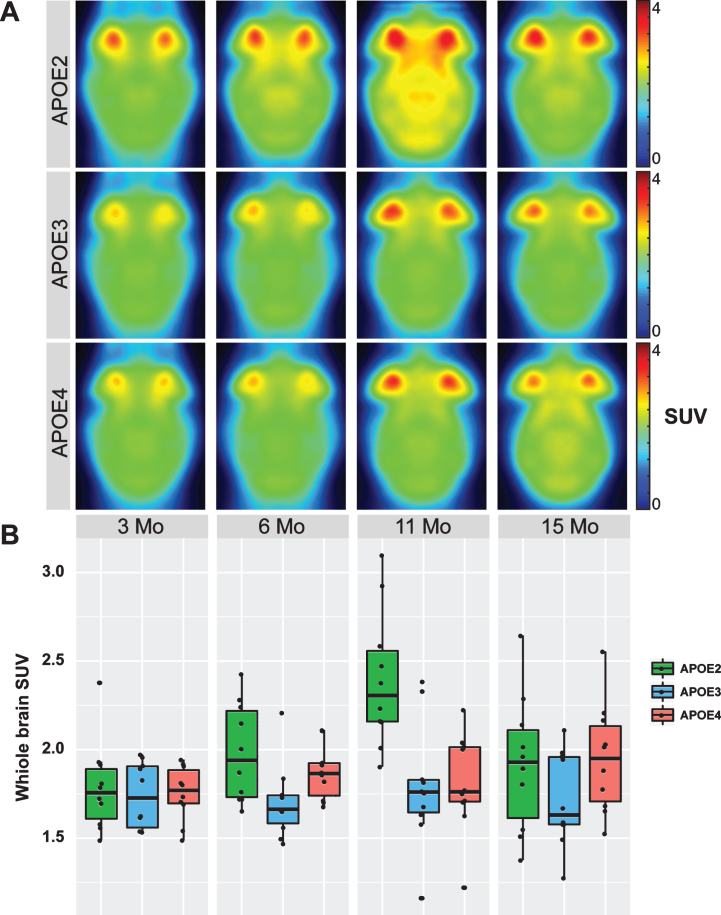
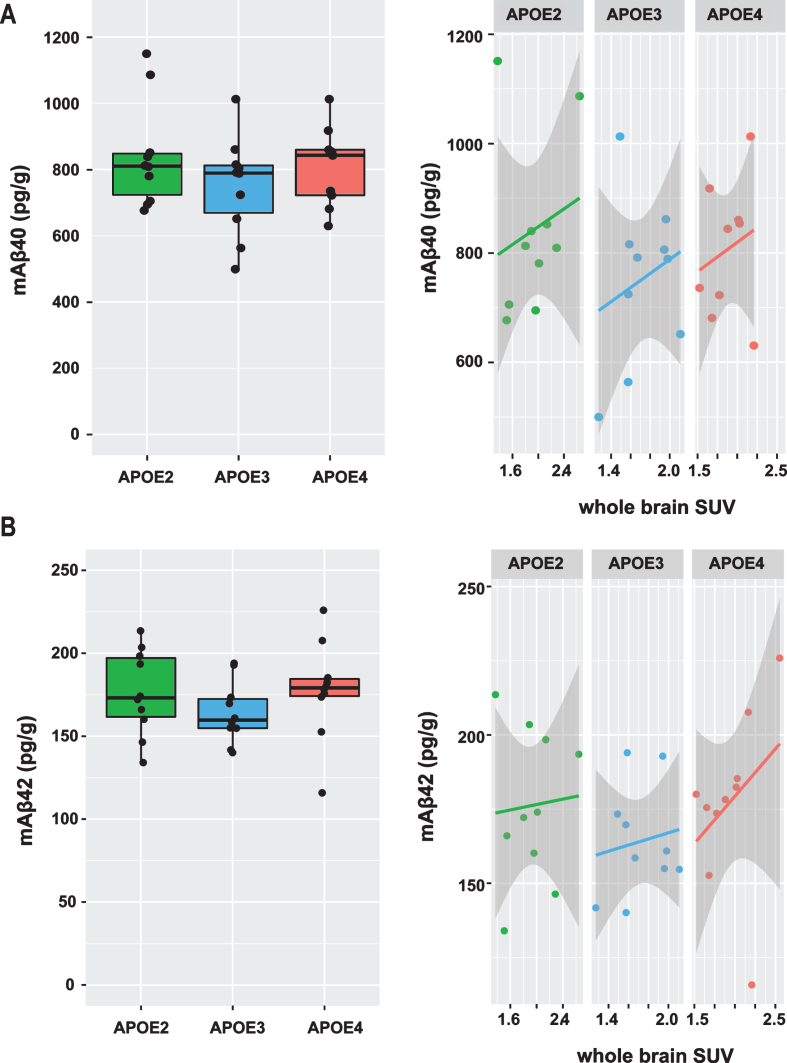
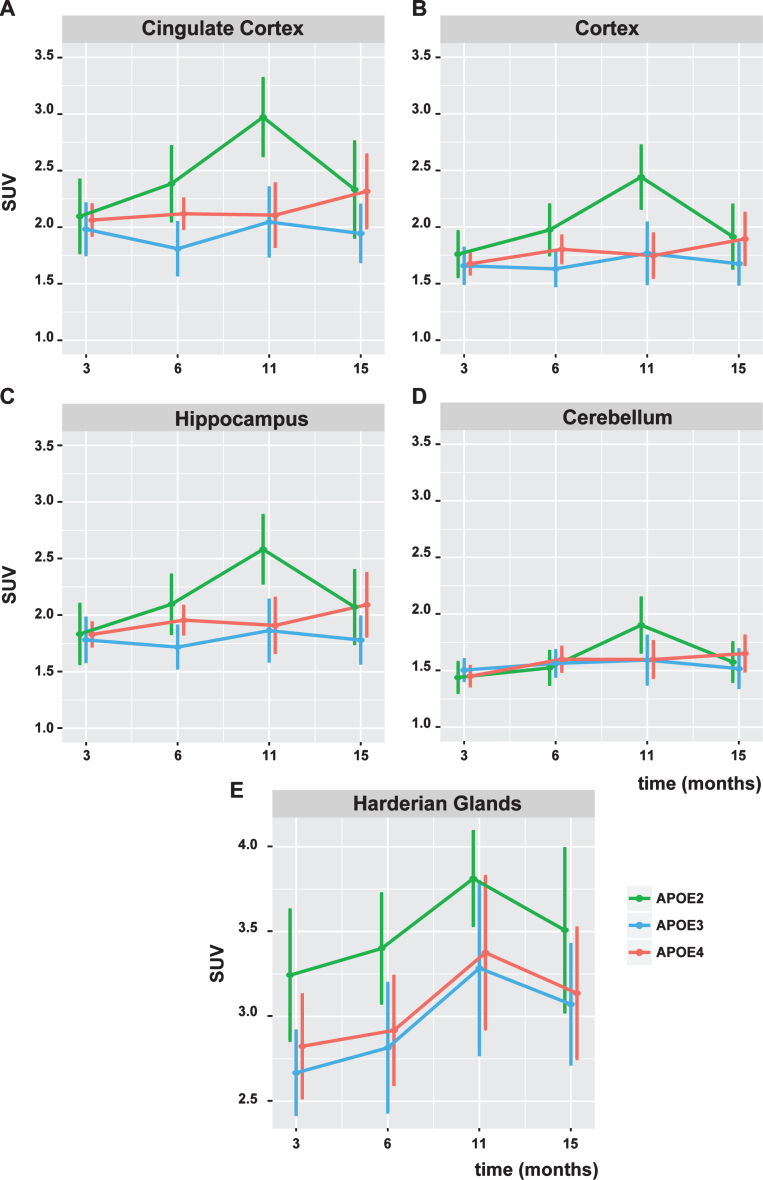
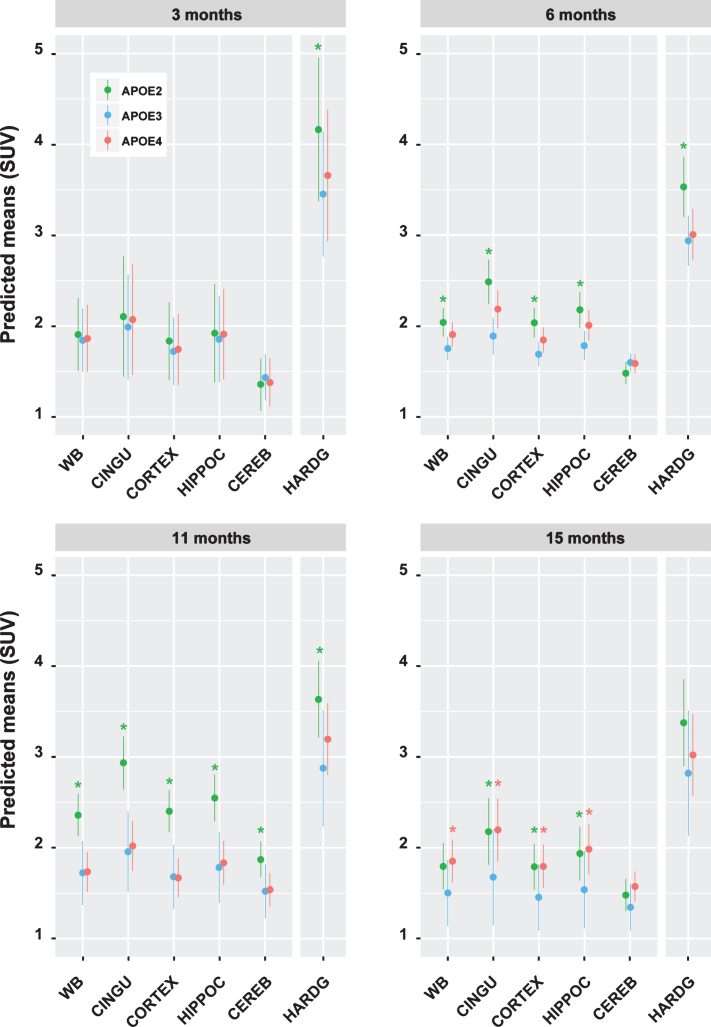
Fludeoxyglucose ([F]FDG) positron emission tomography (PET) measures were performed longitudinally in homozygous APOE-TR mice (APOE2, APOE3, APOE4; = 10 for each group) at 3, 5, 11, and 15 months. Results were quantified using standard uptake values and analyzed statistically using a linear mixed effects model. Levels of the Aβ and Aβ peptides were quantified using enzyme-linked immunosorbent assay (ELISA) at 15 months in the same animals.
APOE2 mice (versus APOE3) showed a significant increase in glucose metabolism starting at 6 months, peaking at 9 months. No evidence of hypometabolism was apparent in any region or time point for APOE4 mice, which instead displayed a hypermetabolism at 15 months. Whole brain soluble Aβ and Aβ levels were not significantly different between genotypes at 15 months.
Introduction of human APOE alleles 2 and 4 is sufficient to produce alterations in brain glucose metabolism in comparison to the control allele 3, without a concomitant alteration in Aβ and Aβ levels. These results suggest novel Aβ-independent metabolic phenotypes conferred by 2 and 4 alleles and have important implications for preclinical studies using TR-mice.
已知载脂蛋白E(ApoE)的2、3和4等位基因通过淀粉样β蛋白(Aβ)依赖性和非依赖性机制差异调节脑葡萄糖代谢以及阿尔茨海默病(AD)风险。
我们在APOE4靶向替换(TR)小鼠脑实质Aβ沉积物比较之前的年龄阶段,研究了ApoE对人源化APOE靶向替换(TR)小鼠脑葡萄糖代谢的影响。
对纯合APOE-TR小鼠(APOE2、APOE3、APOE4;每组n = 10)在3、5、11和15个月时进行纵向氟脱氧葡萄糖([F]FDG)正电子发射断层扫描(PET)测量。使用标准摄取值对结果进行定量,并使用线性混合效应模型进行统计分析。在15个月时对同一批动物使用酶联免疫吸附测定(ELISA)定量Aβ和Aβ肽水平。
APOE2小鼠(与APOE3相比)从6个月开始葡萄糖代谢显著增加,在9个月时达到峰值。APOE4小鼠在任何区域或时间点均未出现代谢减退的证据,相反在15个月时表现为代谢亢进。15个月时各基因型之间全脑可溶性Aβ和Aβ水平无显著差异。
与对照等位基因3相比,引入人ApoE等位基因2和4足以引起脑葡萄糖代谢改变,而Aβ和Aβ水平无相应改变。这些结果提示由2和4等位基因赋予的新的Aβ非依赖性代谢表型,对使用TR小鼠的临床前研究具有重要意义。