Pharmaceutical Product Development, San Diego, California.
Center for Vaccine Development and Global Health, University of Maryland School of Medicine, Baltimore.
Clin Infect Dis. 2019 Aug 16;69(5):777-785. doi: 10.1093/cid/ciy1003.
We evaluated a Russian-backbone, live, attenuated influenza vaccine (LAIV) for immunogenicity and viral shedding in a randomized, placebo-controlled trial among Bangladeshi children.
Healthy children received a single, intranasal dose of LAIV containing the 2011-2012 recommended formulation or placebo. Nasopharyngeal wash (NPW) specimens were collected on days 0, 2, 4, and 7. Reverse transcription polymerase chain reactions and sequencing identified the influenza virus (vaccine or wild-type). On days 0 and 21, blood specimens were collected to assess immunogenicity using hemagglutination inhibition, microneutralization, and immunoglobulin A (IgA) and G enzyme-linked immunosorbent assays (ELISAs); NPW specimens were also collected to assess mucosal immunogenicity using kinetic IgA ELISA.
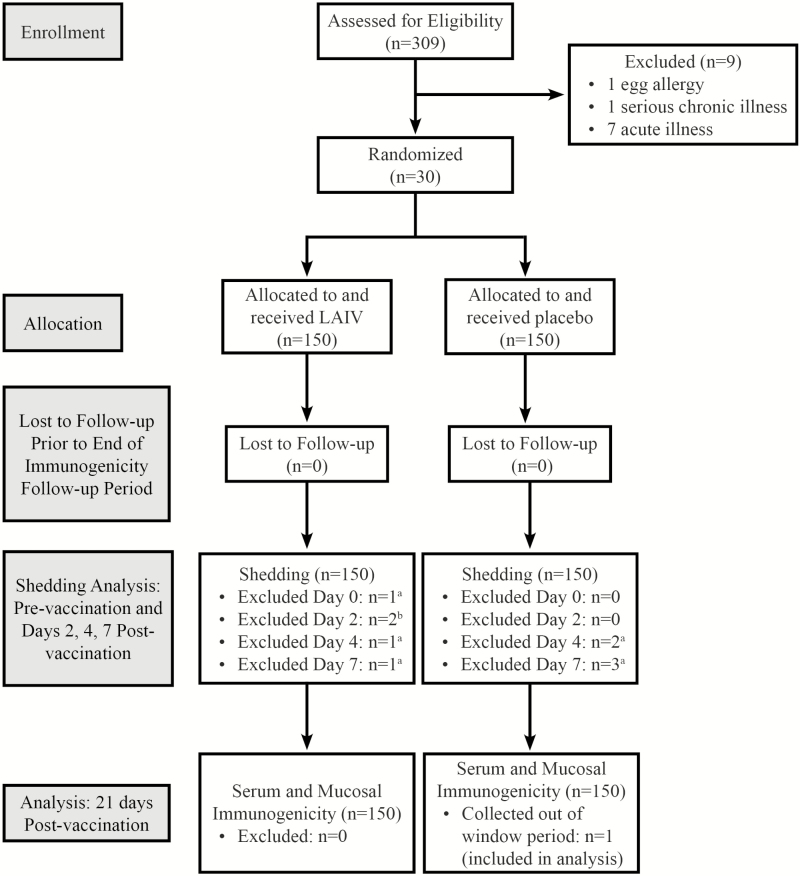
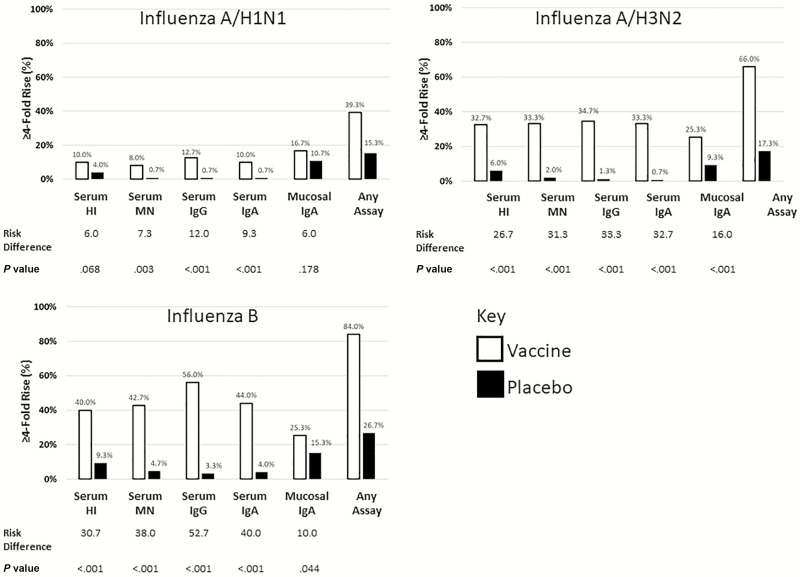
We enrolled 300 children aged 24 through 59 months in the immunogenicity and viral shedding analyses. Among children receiving LAIV, 45% and 67% shed A/H3N2 and B vaccine strains, respectively. No child shed A/H1N1 vaccine strain. There were significantly higher day 21 geometric mean titers (GMTs) for the LAIV, as compared to the placebo groups, in all immunoassays for A/H3N2 and B (log10 titer P < .0001; GMT Ratio >2.0). Among immunoassays for A/H1N1, only the mucosal IgA GMT was significantly higher than placebo at day 21 (log10 titer P = .0465).
Children vaccinated with LAIV had serum and mucosal antibody responses to A/H3N2 and B, but only a mucosal IgA response to A/H1N1. Many children shed A/H3N2 and B vaccine strains, but none shed A/H1N1. More research is needed to determine the reason for decreased LAIV A/H1N1 immunogenicity and virus shedding.
NCT01625689.
我们在孟加拉国儿童中进行了一项随机、安慰剂对照试验,评估了一种基于俄罗斯的、活的、减毒流感疫苗(LAIV)的免疫原性和病毒脱落情况。
健康儿童接受单剂量鼻内 LAIV 或安慰剂接种。在第 0、2、4 和 7 天采集鼻咽抽吸物(NPW)标本。使用逆转录聚合酶链反应和测序鉴定流感病毒(疫苗或野生型)。在第 0 和 21 天采集血标本,使用血凝抑制、微量中和和免疫球蛋白 A(IgA)和 G 酶联免疫吸附测定(ELISA)评估免疫原性;还采集 NPW 标本,使用动力学 IgA ELISA 评估黏膜免疫原性。
我们将 300 名年龄在 24 至 59 个月的儿童纳入免疫原性和病毒脱落分析。在接受 LAIV 的儿童中,分别有 45%和 67%脱落 A/H3N2 和 B 疫苗株。没有儿童脱落 A/H1N1 疫苗株。与安慰剂组相比,在所有 A/H3N2 和 B 的免疫测定中,LAIV 在第 21 天的几何平均滴度(GMT)都显著升高(对数滴度 P<0.0001;GMT 比值>2.0)。在 A/H1N1 的免疫测定中,只有黏膜 IgA GMT 在第 21 天显著高于安慰剂(对数滴度 P=0.0465)。
接种 LAIV 的儿童对 A/H3N2 和 B 产生了血清和黏膜抗体反应,但仅对 A/H1N1 产生了黏膜 IgA 反应。许多儿童脱落 A/H3N2 和 B 疫苗株,但无一脱落 A/H1N1。需要进一步研究以确定 LAIV A/H1N1 免疫原性和病毒脱落减少的原因。
NCT01625689。