Department of Environmental Health, Harvard T.H. Chan School of Public Health, 401 Park Drive, Landmark Center, L3-046, PO Box 15677, Boston, MA, 02215, USA.
Department of Biostatistics, Harvard T.H. Chan School of Public Health, Boston, MA, USA.
J Expo Sci Environ Epidemiol. 2019 Sep;29(5):663-673. doi: 10.1038/s41370-018-0095-0. Epub 2018 Nov 27.
Scientists use biomarkers to evaluate metal exposures. One biomarker, toenails, is easily obtained and minimally invasive, but less commonly used as a biomarker of exposure. Their utility will depend on understanding characteristics of their variation in a population over time. The objective of our study is to describe the correlation of toenail metal levels many years apart among participants in the VA Normative Aging Study (NAS).
Toenail clippings from 825 participants of the NAS from year 1992 to 2014 were analyzed for lead (Pb), Arsenic (As), Cadmium (Cd), Manganese (Mn), and Mercury (Hg). We utilized linear mixed models to assess correlation between toenail metal concentrations in multiple toenail samples from the same subject collected years apart and identified the optimal covariance pattern by likelihood ratio tests and Akaike's information criterion (AIC). Correlations among different metals were described using Spearman correlations.
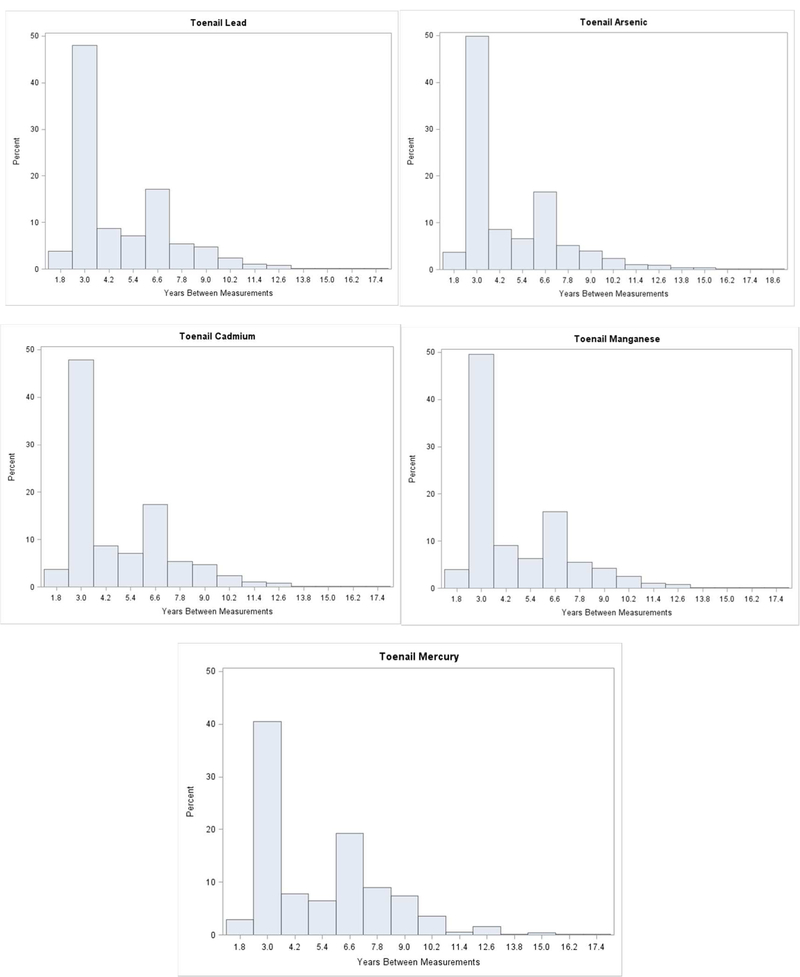
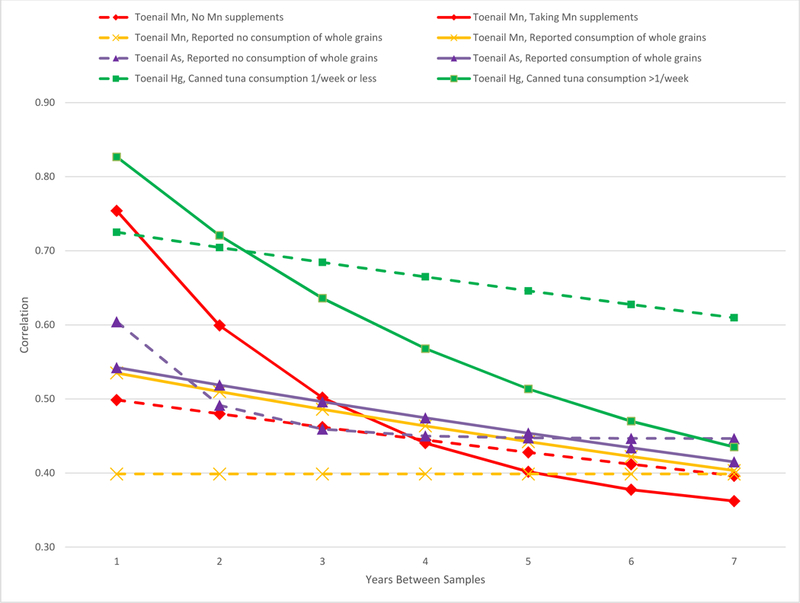
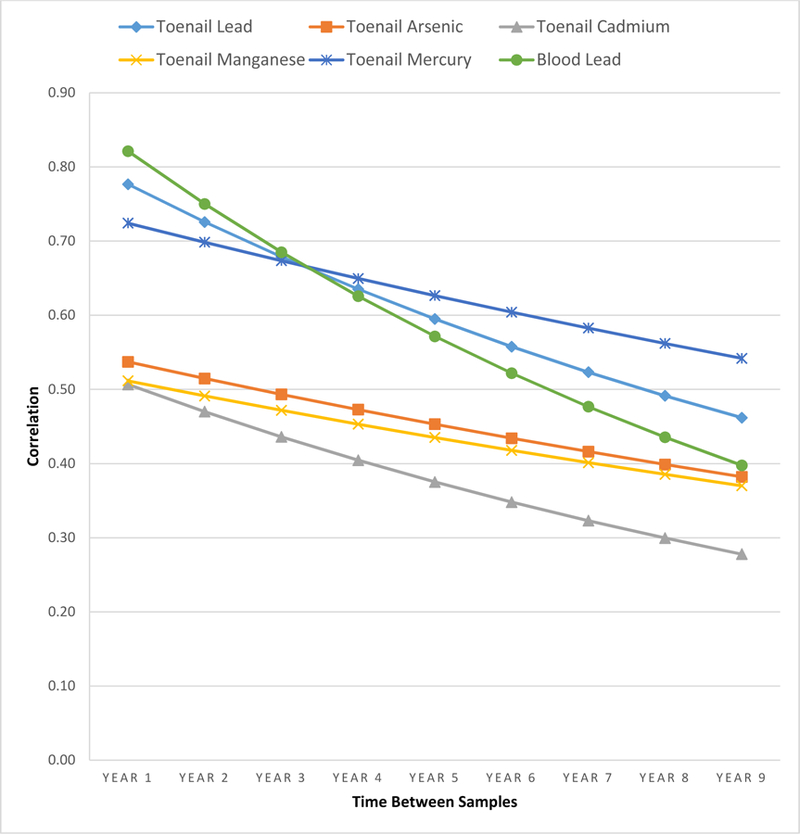
The average number of times toenail samples were collected from each subject ranged from 1.63 (Hg) to 2.04 (As). The average number of years between toenails collected per subject ranged from 4.73 (SD = 2.44) (Mn) to 5.35 (SD = 2.69) (Hg). Metal concentrations had slightly different correlation patterns over time, although for all metals correlations decreased with increasing time between samples. Estimated correlations over a 3-year span were highest for toenail Pb (0.68) and Hg (0.67), while As, Cd, and Mn had lower correlations of 0.49, 0.44, and 0.47, respectively. Even across a 6-year span, the lowest correlation was 0.35 (Cd).
Our results suggest that Pb, As, Cd, Mn, and Hg levels from toenail clippings can reasonably reflect exposures over several years in elderly men in the NAS. Even across 6 years, toenail metal levels were generally well correlated among NAS participants. As such, they may be useful as biomarkers of exposure in epidemiological studies of similar populations.
科学家使用生物标志物来评估金属暴露情况。一种生物标志物,即趾甲,易于获取且微创,但作为暴露生物标志物的使用较少。它们的实用性将取决于了解人群中多年来趾甲中金属含量变化的特征。我们研究的目的是描述退伍军人事务部正常老化研究(NAS)参与者多年来的趾甲金属水平的相关性。
对来自 1992 年至 2014 年 NAS 的 825 名参与者的趾甲进行了分析,检测铅(Pb)、砷(As)、镉(Cd)、锰(Mn)和汞(Hg)。我们利用线性混合模型来评估多年来从同一受试者收集的多个趾甲样本中趾甲金属浓度之间的相关性,并通过似然比检验和赤池信息量准则(AIC)来确定最佳协方差模式。描述了不同金属之间的相关性。
每个受试者趾甲样本的平均采集次数范围从 1.63(Hg)到 2.04(As)。每个受试者趾甲样本采集的平均时间间隔范围从 4.73(SD=2.44)(Mn)到 5.35(SD=2.69)(Hg)。虽然对于所有金属,随着样本之间时间的增加,相关性都有所下降,但金属浓度随时间的变化模式略有不同。在 3 年跨度内,趾甲 Pb(0.68)和 Hg(0.67)的估计相关性最高,而 As、Cd 和 Mn 的相关性较低,分别为 0.49、0.44 和 0.47。即使在 6 年跨度内,最低的相关性为 0.35(Cd)。
我们的结果表明,从趾甲屑中提取的 Pb、As、Cd、Mn 和 Hg 水平可以合理反映 NAS 中老年人多年来的暴露情况。即使在 6 年内,NAS 参与者的趾甲金属水平之间也通常具有良好的相关性。因此,它们可能是此类人群的流行病学研究中有用的暴露生物标志物。