
觉醒脑电图的复杂性与睡眠开始后的慢波活动相关。
Complexity of Wake Electroencephalography Correlates With Slow Wave Activity After Sleep Onset.
作者信息
Hou Fengzhen, Yu Zhinan, Peng Chung-Kang, Yang Albert, Wu Chunyong, Ma Yan
机构信息
Key Laboratory of Biomedical Functional Materials, School of Science, China Pharmaceutical University, Nanjing, China.
Division of Interdisciplinary Medicine and Biotechnology, Department of Medicine, Beth Israel Deaconess Medical Center/Harvard Medical School, Boston, MA, United States.
出版信息
Front Neurosci. 2018 Nov 13;12:809. doi: 10.3389/fnins.2018.00809. eCollection 2018.
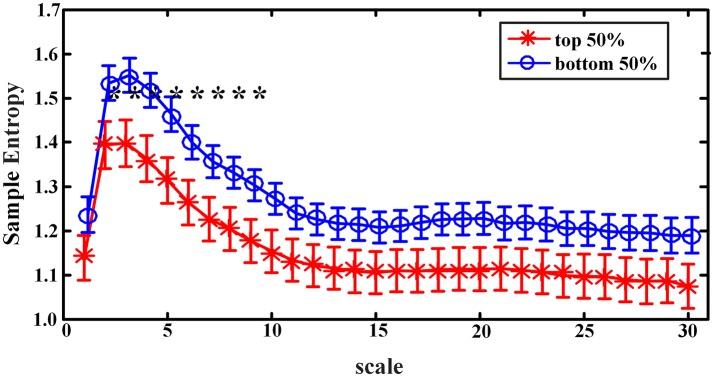
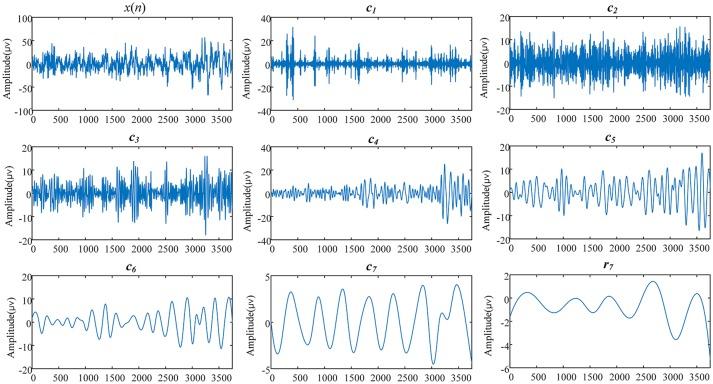
Sleep electroencephalography (EEG) provides an opportunity to study sleep scientifically, whose chaotic, dynamic, complex, and dissipative nature implies that non-linear approaches could uncover some mechanism of sleep. Based on well-established complexity theories, one hypothesis in sleep medicine is that lower complexity of brain waves at pre-sleep state can facilitate sleep initiation and further improve sleep quality. However, this has never been studied with solid data. In this study, EEG collected from healthy subjects was used to investigate the association between pre-sleep EEG complexity and sleep quality. Multiscale entropy analysis (MSE) was applied to pre-sleep EEG signals recorded immediately after light-off (while subjects were awake) for measuring the complexities of brain dynamics by a proposed index, CI. Slow wave activity (SWA) in sleep, which is commonly used as an indicator of sleep depth or sleep intensity, was quantified based on two methods, traditional Fast Fourier transform (FFT) and ensemble empirical mode decomposition (EEMD). The associations between wake EEG complexity, sleep latency, and SWA in sleep were evaluated. Our results demonstrated that lower complexity before sleep onset is associated with decreased sleep latency, indicating a potential facilitating role of reduced pre-sleep complexity in the wake-sleep transition. In addition, the proposed EEMD-based method revealed an association between wake complexity and quantified SWA in the beginning of sleep (90 min after sleep onset). Complexity metric could thus be considered as a potential indicator for sleep interventions, and further studies are encouraged to examine the application of EEG complexity before sleep onset in populations with difficulty in sleep initiation. Further studies may also examine the mechanisms of the causal relationships between pre-sleep brain complexity and SWA, or conduct comparisons between normal and pathological conditions.
睡眠脑电图(EEG)为科学研究睡眠提供了一个机会,其具有混沌、动态、复杂和耗散的性质,这意味着非线性方法可能会揭示一些睡眠机制。基于成熟的复杂性理论,睡眠医学中的一个假说是,睡眠前状态下脑电波较低的复杂性可以促进睡眠开始并进一步提高睡眠质量。然而,这从未有确凿的数据进行过研究。在本研究中,使用从健康受试者收集的脑电图来研究睡眠前脑电图复杂性与睡眠质量之间的关联。多尺度熵分析(MSE)应用于熄灯后立即记录的睡眠前脑电图信号(受试者清醒时),通过一个提出的指标CI来测量脑动力学的复杂性。睡眠中的慢波活动(SWA),通常用作睡眠深度或睡眠强度的指标,基于两种方法进行量化,即传统的快速傅里叶变换(FFT)和总体经验模态分解(EEMD)。评估了清醒脑电图复杂性、睡眠潜伏期和睡眠中SWA之间的关联。我们的结果表明,睡眠开始前较低的复杂性与睡眠潜伏期缩短有关,表明睡眠前复杂性降低在清醒 - 睡眠转换中具有潜在的促进作用。此外,所提出的基于EEMD的方法揭示了清醒复杂性与睡眠开始时(睡眠开始后90分钟)量化的SWA之间的关联。因此,复杂性指标可被视为睡眠干预的潜在指标,鼓励进一步研究检查睡眠开始前脑电图复杂性在睡眠起始困难人群中的应用。进一步的研究还可以检查睡眠前脑复杂性与SWA之间因果关系的机制,或在正常和病理条件之间进行比较。


 Zotero 插件