Terrestrial Ecology Research Group, Department of Ecology and Ecosystem Management, School of Life Sciences Weihenstephan, Technische Universität München, Freising, Germany.
Department of Remote Sensing and Cartography, Institute of Geosciences and Geography, Universität Halle, Halle, Germany.
PLoS One. 2018 Nov 28;13(11):e0207052. doi: 10.1371/journal.pone.0207052. eCollection 2018.
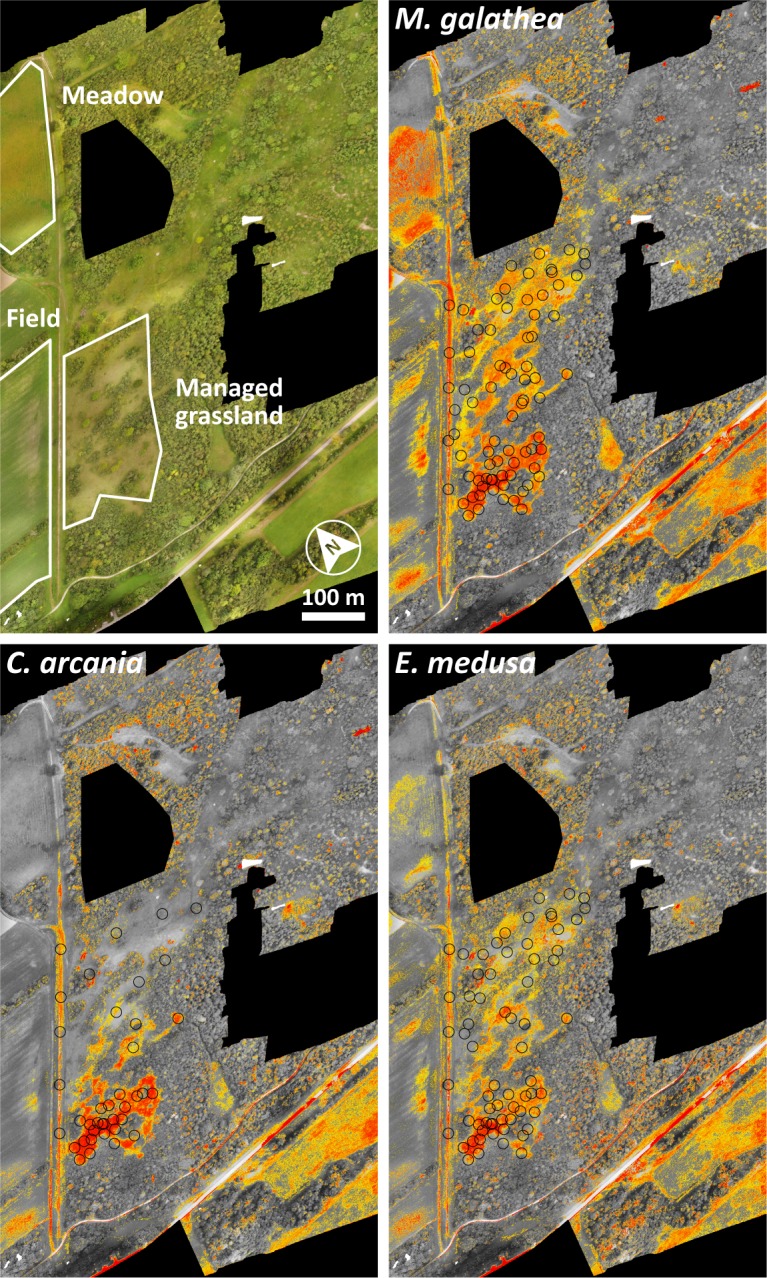
Habitat demands and species mobility strongly determine the occurrence of species. Sedentary species with specific habitat requirements are assumed to occur more patchy than mobile habitat generalist species, and thus suffer stronger under habitat fragmentation and habitat deterioration. In this study we measured dispersal and habitat preference of three selected butterfly species using mark-release-recapture technique. We used data on species abundance to calculate Species Distribution Models based on high-resolution aerial photographs taken using RGB / NIR cameras mounted on a UAV. We found that microhabitats for species with specific habitat requirements occur spatially restricted. In contrast, suitable habitats are more interconnected and widespread for mobile habitat generalists. Our models indicate that even managed grassland sites have comparatively little habitat quality, while road verges provide high quality micro-habitats. In addition, dispersal was more restricted for specialist butterfly species, and higher for the two other butterfly species with less ecological specialisation. This study shows synergies arising when combining ecological data with high precision aerial pictures and Species Distribution Models, to identify micro-habitats for butterflies. This approach might be suitable to identify and conserve high quality habitats, and to improve nature conservation at the ground.
生境需求和物种流动性强烈决定了物种的存在。具有特定生境需求的定居物种被认为比流动性强的生境广适种发生得更为分散,因此在生境破碎化和生境恶化的情况下受到的影响更大。在这项研究中,我们使用标记释放再捕获技术测量了三种选定蝴蝶物种的扩散和栖息地偏好。我们利用物种丰度数据,基于使用安装在无人机上的 RGB/NIR 相机拍摄的高分辨率航空照片,计算了物种分布模型。我们发现,具有特定生境需求的物种的微生境在空间上受到限制。相比之下,流动性强的生境广适种的适宜栖息地更加相互连接和广泛。我们的模型表明,即使是管理良好的草地也只有相对较少的生境质量,而道路边缘则提供了高质量的微生境。此外,对于专门化的蝴蝶物种,扩散受到更多限制,而对于其他两种生态适应程度较低的蝴蝶物种,扩散受到的限制则较小。这项研究表明,当将生态数据与高精度航空照片和物种分布模型相结合时,会产生协同作用,从而确定蝴蝶的微生境。这种方法可能适合于识别和保护高质量的栖息地,并改善地面上的自然保护。