Department of Biomedical Engineering, University of Minnesota, Minneapolis, MN 55455, USA; Physical Sciences-Oncology Center, University of Minnesota, Minneapolis, MN 55455, USA.
Department of Biological Engineering, Koch Institute for Integrative Cancer Research and Physical Sciences-Oncology Center, Massachusetts Institute of Technology, Cambridge, MA 02139, USA.
Cell Rep. 2018 Nov 27;25(9):2591-2604.e8. doi: 10.1016/j.celrep.2018.10.101.
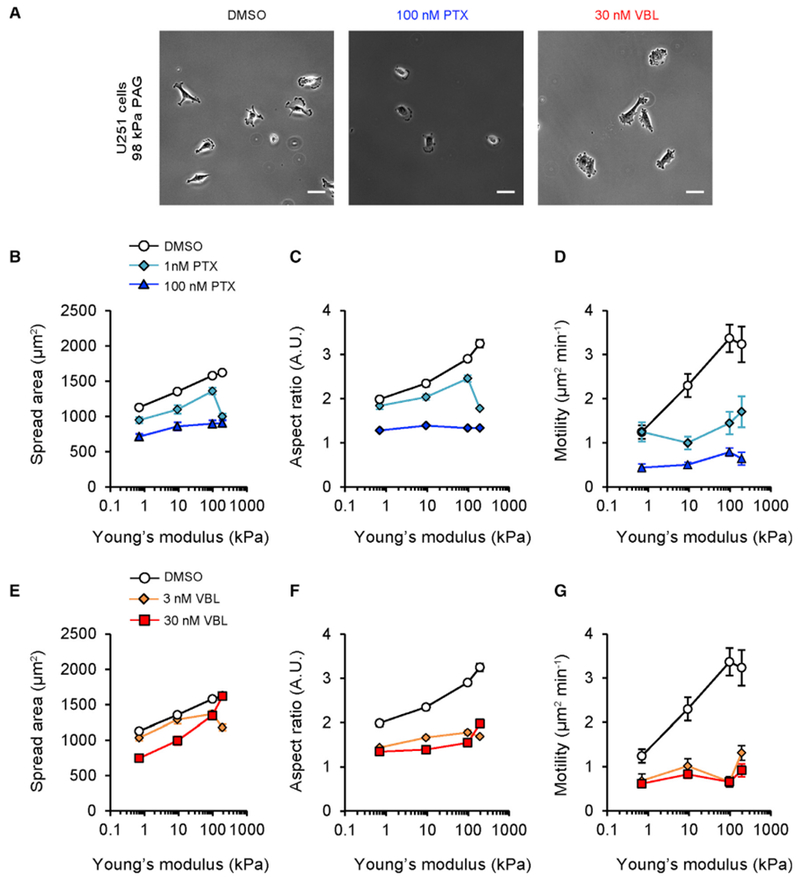
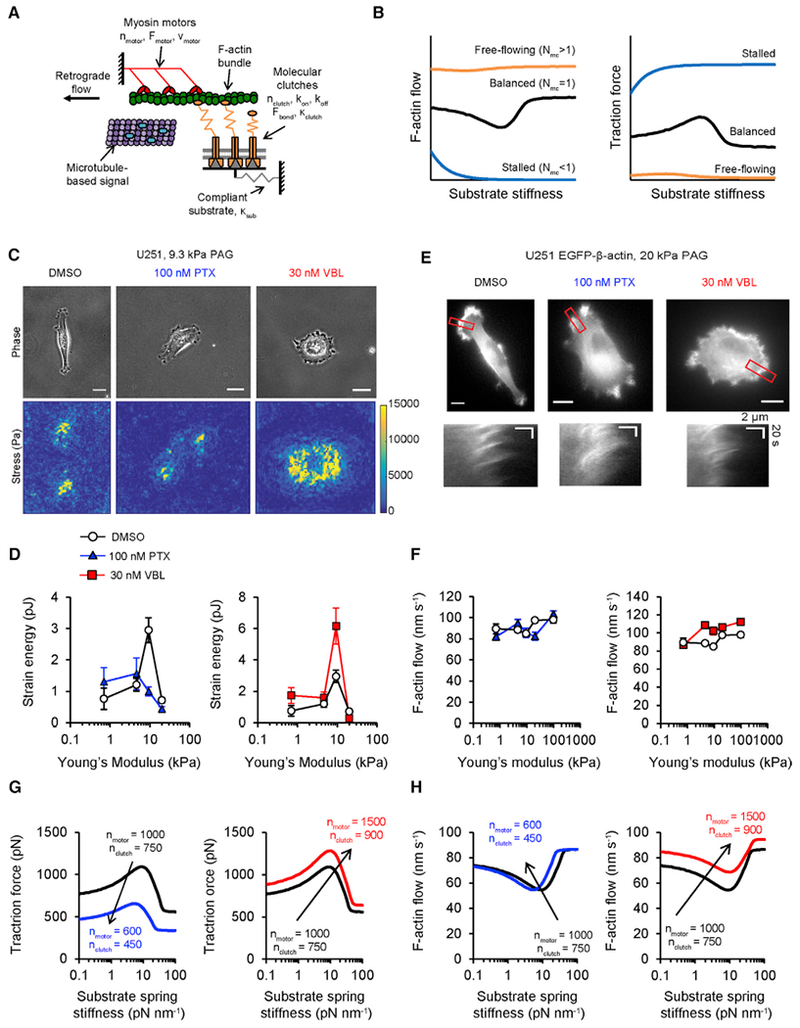
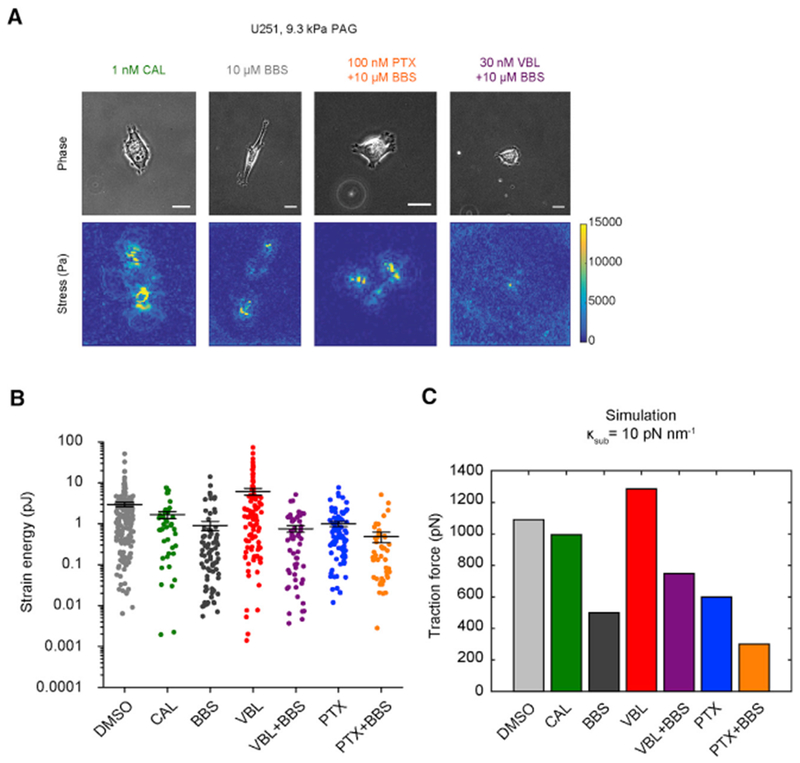
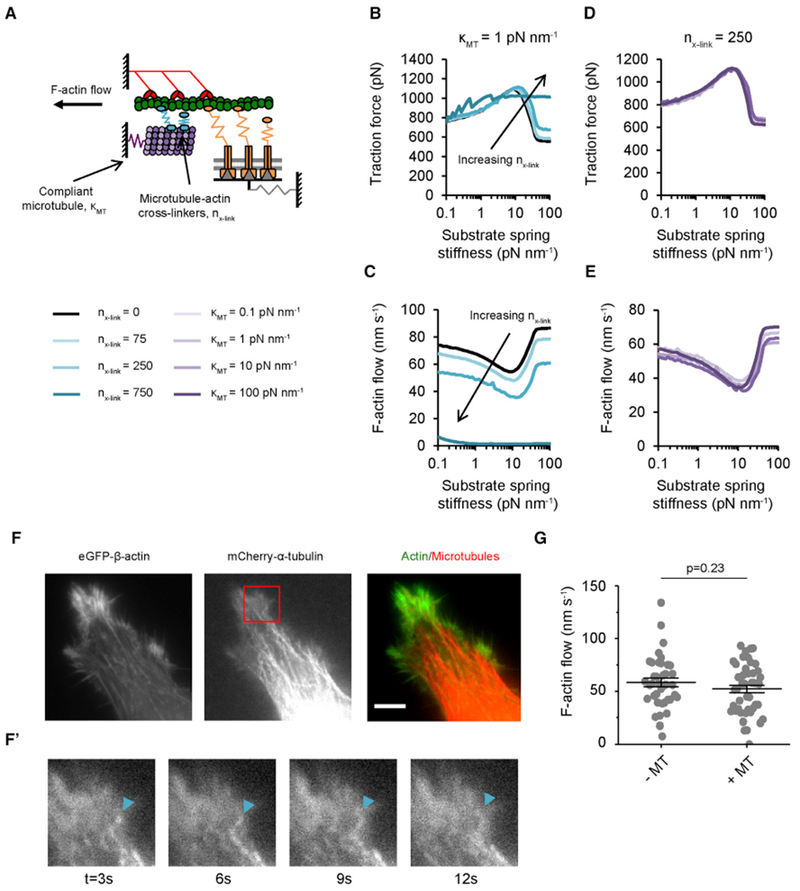
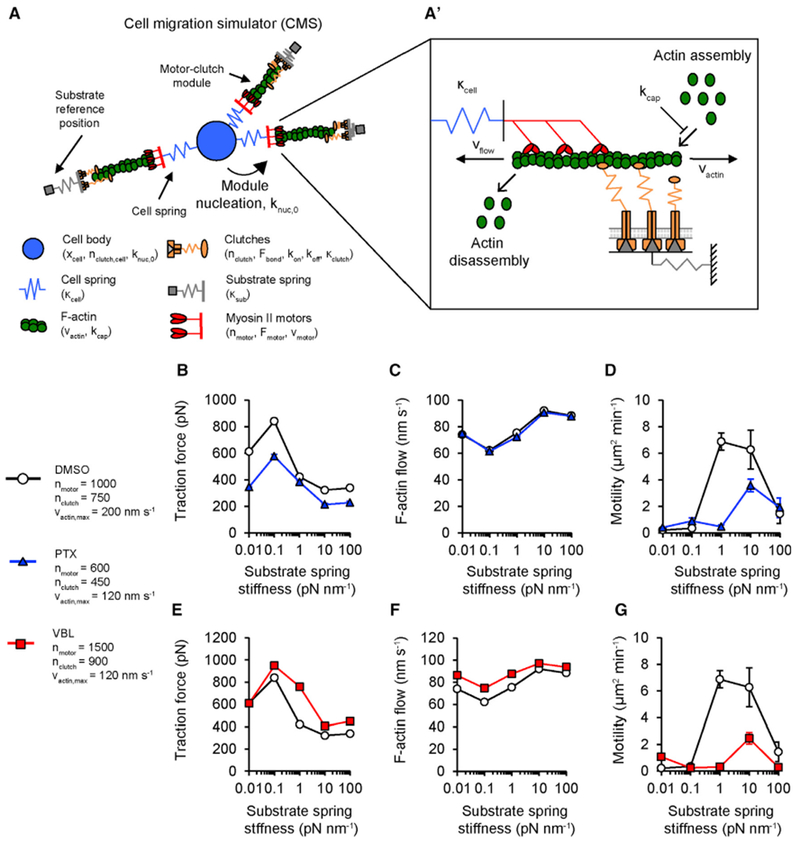
Microtubule-targeting agents (MTAs) are widely used chemotherapy drugs capable of disrupting microtubule-dependent cellular functions, such as division and migration. We show that two clinically approved MTAs, paclitaxel and vinblastine, each suppress stiffness-sensitive migration and polarization characteristic of human glioma cells on compliant hydrogels. MTAs influence microtubule dynamics and cell traction forces by nearly opposite mechanisms, the latter of which can be explained by a combination of changes in myosin motor and adhesion clutch number. Our results support a microtubule-dependent signaling-based model for controlling traction forces through a motor-clutch mechanism, rather than microtubules directly relieving tension within F-actin and adhesions. Computational simulations of cell migration suggest that increasing protrusion number also impairs stiffness-sensitive migration, consistent with experimental MTA effects. These results provide a theoretical basis for the role of microtubules and mechanisms of MTAs in controlling cell migration.
微管靶向剂(MTAs)是广泛应用于化疗的药物,能够破坏依赖微管的细胞功能,如分裂和迁移。我们发现两种临床批准的 MTAs,紫杉醇和长春碱,均能抑制人神经胶质瘤细胞在顺应性水凝胶上的僵硬敏感性迁移和极化。MTAs 通过几乎相反的机制影响微管动力学和细胞牵引力,后者可以通过肌球蛋白马达和黏附离合器数量的变化来解释。我们的结果支持一种基于微管的信号传导模型,通过马达-离合器机制控制牵引力,而不是微管直接在 F-肌动蛋白和黏附中缓解张力。细胞迁移的计算模拟表明,增加突起数量也会损害僵硬敏感性迁移,与实验 MTA 效应一致。这些结果为微管在控制细胞迁移中的作用和 MTAs 的机制提供了理论基础。