Faisal Syed M, Comba Andrea, Varela Maria L, Argento Anna E, Brumley Emily, Abel Clifford, Castro Maria G, Lowenstein Pedro R
Dept. of Neurosurgery, University of Michigan Medical School, Ann Arbor, MI, United States.
Dept. of Cell and Developmental Biology, University of Michigan Medical School, Ann Arbor, MI, United States.
Front Oncol. 2022 Oct 6;12:1005069. doi: 10.3389/fonc.2022.1005069. eCollection 2022.
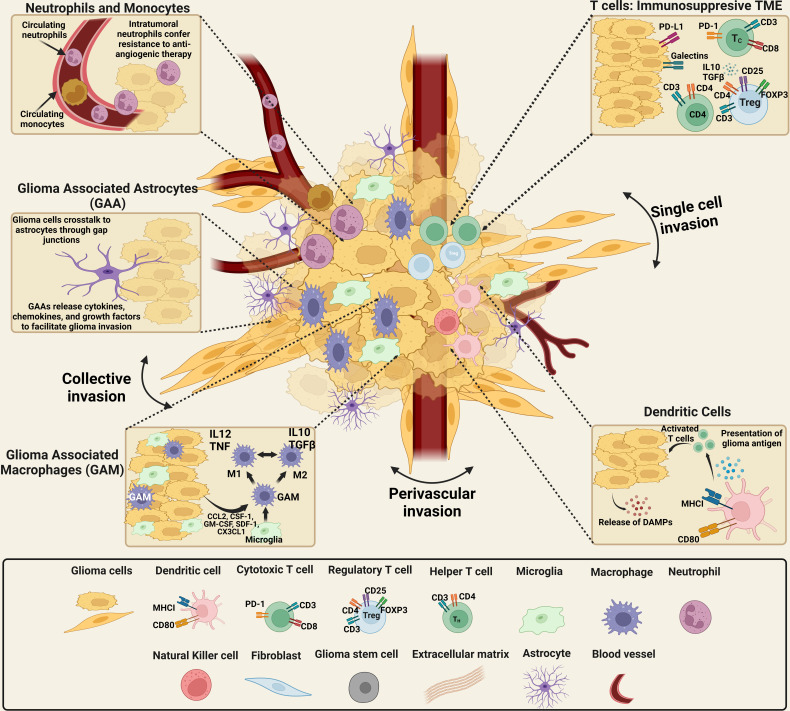
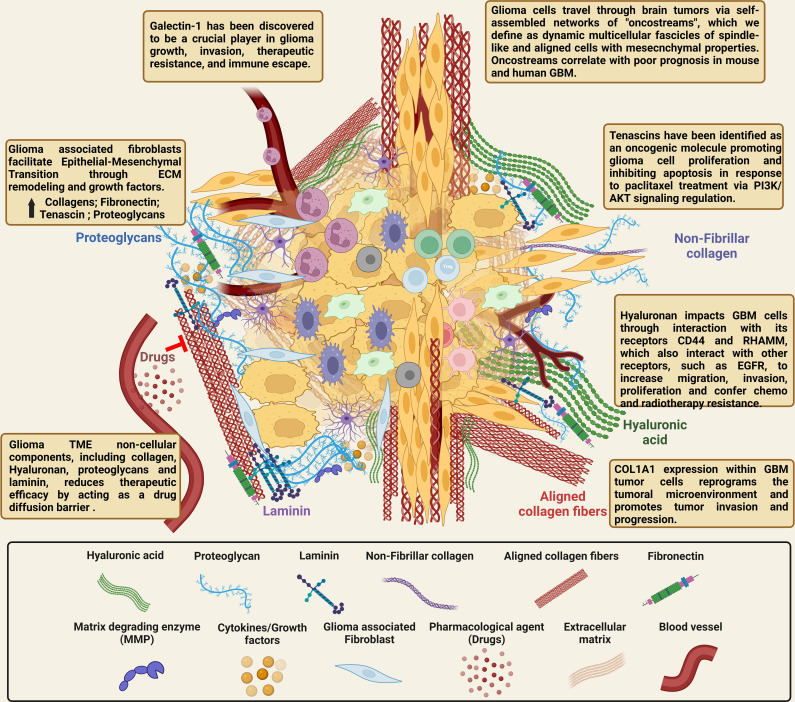
Glioblastoma (GBM), an aggressive high-grade glial tumor, is resistant to therapy and has a poor prognosis due to its universal recurrence rate. GBM cells interact with the non-cellular components in the tumor microenvironment (TME), facilitating their rapid growth, evolution, and invasion into the normal brain. Herein we discuss the complexity of the interactions between the cellular and non-cellular components of the TME and advances in the field as a whole. While the stroma of non-central nervous system (CNS) tissues is abundant in fibrillary collagens, laminins, and fibronectin, the normal brain extracellular matrix (ECM) predominantly includes proteoglycans, glycoproteins, and glycosaminoglycans, with fibrillary components typically found only in association with the vasculature. However, recent studies have found that in GBMs, the microenvironment evolves into a more complex array of components, with upregulated collagen gene expression and aligned fibrillary ECM networks. The interactions of glioma cells with the ECM and the degradation of matrix barriers are crucial for both single-cell and collective invasion into neighboring brain tissue. ECM-regulated mechanisms also contribute to immune exclusion, resulting in a major challenge to immunotherapy delivery and efficacy. Glioma cells chemically and physically control the function of their environment, co-opting complex signaling networks for their own benefit, resulting in radio- and chemo-resistance, tumor recurrence, and cancer progression. Targeting these interactions is an attractive strategy for overcoming therapy resistance, and we will discuss recent advances in preclinical studies, current clinical trials, and potential future clinical applications. In this review, we also provide a comprehensive discussion of the complexities of the interconnected cellular and non-cellular components of the microenvironmental landscape of brain tumors to guide the development of safe and effective therapeutic strategies against brain cancer.
胶质母细胞瘤(GBM)是一种侵袭性的高级别胶质瘤,由于其普遍的复发率,对治疗具有抗性且预后较差。GBM细胞与肿瘤微环境(TME)中的非细胞成分相互作用,促进其快速生长、演变并侵入正常脑组织。在此,我们讨论TME中细胞和非细胞成分之间相互作用的复杂性以及整个领域的进展。虽然非中枢神经系统(CNS)组织的基质富含纤维状胶原蛋白、层粘连蛋白和纤连蛋白,但正常脑细胞外基质(ECM)主要包括蛋白聚糖、糖蛋白和糖胺聚糖,纤维状成分通常仅在与脉管系统相关时才会发现。然而,最近的研究发现,在GBM中,微环境演变成更复杂的成分阵列,胶原蛋白基因表达上调且纤维状ECM网络排列整齐。胶质瘤细胞与ECM的相互作用以及基质屏障的降解对于单细胞和集体侵入邻近脑组织都至关重要。ECM调节的机制也导致免疫排斥,这对免疫治疗的递送和疗效构成了重大挑战。胶质瘤细胞通过化学和物理方式控制其周围环境的功能,为自身利益利用复杂的信号网络,导致放疗和化疗抗性、肿瘤复发以及癌症进展。针对这些相互作用是克服治疗抗性的一种有吸引力的策略,我们将讨论临床前研究的最新进展、当前的临床试验以及潜在的未来临床应用。在这篇综述中,我们还全面讨论了脑肿瘤微环境景观中相互关联的细胞和非细胞成分的复杂性,以指导针对脑癌的安全有效治疗策略的开发。