Bavarian Health and Food Safety Authority, Veterinärstraße 2, 85764 Oberschleißheim, Germany.
Bavarian Health and Food Safety Authority, 91058 Erlangen, Germany.
Int J Environ Res Public Health. 2018 Nov 27;15(12):2666. doi: 10.3390/ijerph15122666.
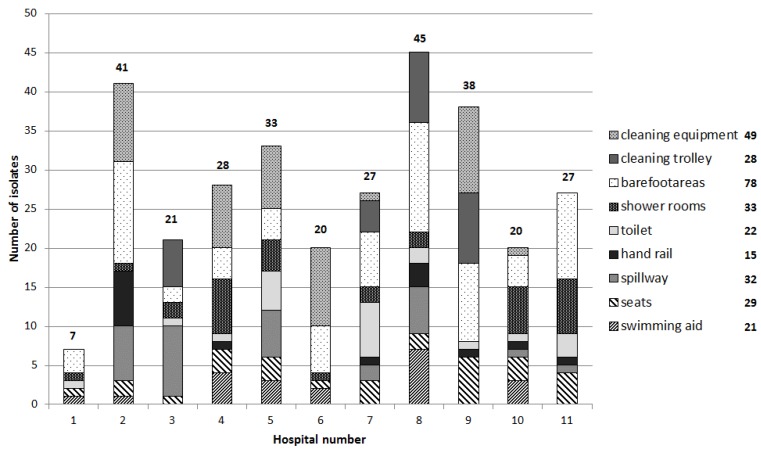
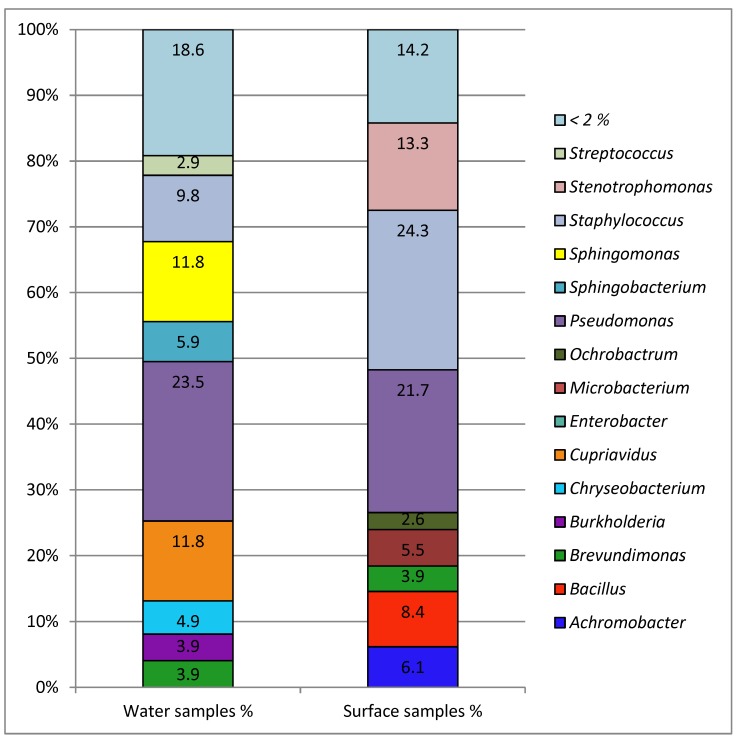
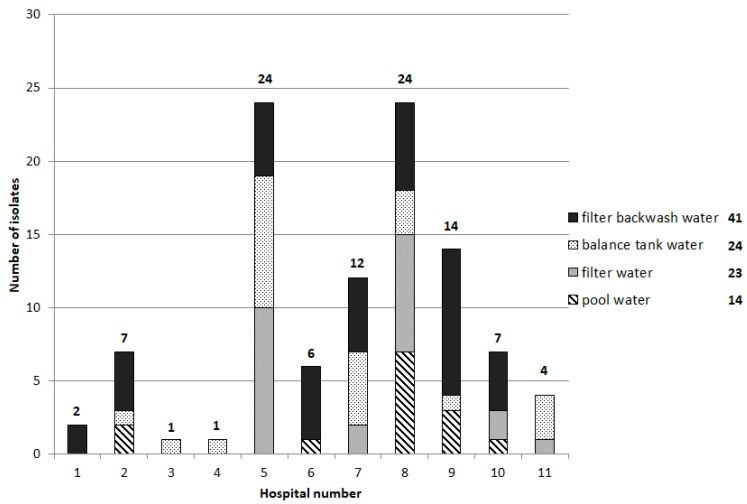
The number of patients colonized with antibiotic-resistant bacteria is increasing in health care facilities. Because transmission of antibiotic-resistant bacteria is feared, there exist reports that the affected patients are frequently excluded from hydrotherapy, which is a non-invasive and beneficial treatment used for patients with different diseases. Data from the literature suggest that deficient water disinfection measures exist, which are not always sufficient to kill all released bacteria. If the pool water is not disinfected properly, it may also infect the bathers. Immunocompromised patients are particularly susceptible to be infected with (antibiotic-resistant) bacteria. In order to determine the distribution of antibiotic-resistant bacteria in the pool water treatment system and the pool environment and to estimate the associated transmission risk we analyzed samples from eleven health care facilities. Antibiotic-resistant bacteria were found in the water and surface samples collected. One hundred and two antibiotic-resistant isolates from water samples and 307 isolates from surrounding surfaces were obtained, respectively. The majority of the isolates belonged to non-fermenting Gram-negative rods, like spp. Some isolates were resistant to a wide range of the tested antibiotics. The results indicate a relation between the number of isolates in water samples and the number of patients using the pools in combination with deficiencies in water treatment. In the pool environment the highest number of isolates was obtained from barefoot areas and floor cleaning equipment.
医疗机构中定植抗生素耐药菌的患者数量正在增加。由于担心抗生素耐药菌的传播,有报道称受影响的患者经常被排除在水疗之外,水疗是一种用于治疗不同疾病患者的非侵入性且有益的治疗方法。文献中的数据表明,水消毒措施存在缺陷,这些措施并不总是足以杀死所有释放的细菌。如果游泳池水没有得到适当的消毒,它也可能会感染游泳者。免疫功能低下的患者特别容易感染(抗生素耐药)细菌。为了确定游泳池水处理系统和游泳池环境中抗生素耐药菌的分布,并评估相关的传播风险,我们分析了来自 11 家医疗机构的样本。在收集的水样和表面样本中均发现了抗生素耐药菌。分别从水样中获得了 102 株抗生素耐药株和 307 株周围表面的耐药株。大多数分离株属于非发酵革兰氏阴性杆菌,如 spp。一些分离株对测试的多种抗生素具有耐药性。结果表明,水样中分离株的数量与使用游泳池的患者数量之间存在关系,同时还存在水处理缺陷。在游泳池环境中,从赤脚区域和地板清洁设备中获得了最多的分离株。