Lee Wen-Chin, Lee Yueh-Ting, Li Lung-Chih, Ng Hwee-Yeong, Kuo Wei-Hung, Lin Pei-Ting, Liao Ying-Chun, Chiou Terry Ting-Yu, Lee Chien-Te
Division of Nephrology, Department of Internal Medicine, Kaohsiung Chang Gung Memorial Hospital and Chang Gung University College of Medicine, Kaohsiung 83301, Taiwan.
J Clin Med. 2018 Nov 28;7(12):493. doi: 10.3390/jcm7120493.
Chronic kidney disease (CKD) is a global health threat affecting approximately 10% of the adult population worldwide. Multimorbidity is common in CKD, but its impacts on disease outcomes are seldom investigated.
This prospective cohort analysis followed patients, who were part of a multidisciplinary CKD care program, for 10 years. We aimed to determine the impact of multimorbidity on renal outcomes.
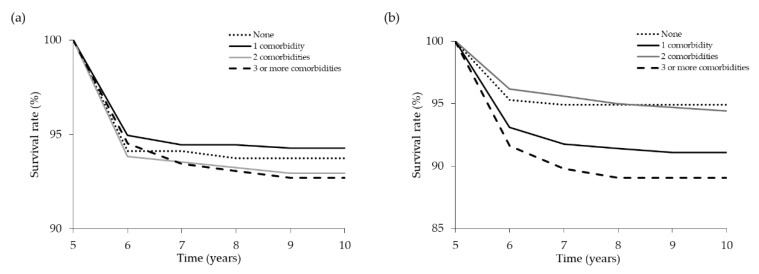
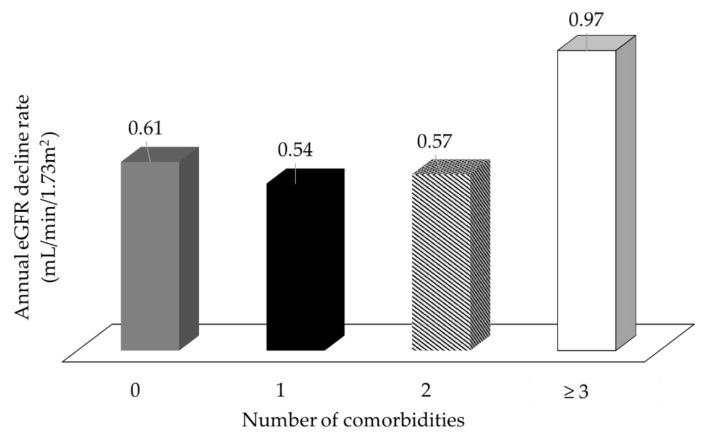
Overall, 1463 patients with stage 3⁻5 CKD were enrolled and stratified by the number of comorbidities. Mean follow-up time was 6.39 ± 1.19 years. We found that stage 3⁻5 CKD patients with at least three comorbidities at enrollment initiated dialysis earlier (hazard ratio (HR): 2.971) than patients without comorbidities. Risk factors for multimorbidity included old age, smoking, and proteinuria.
By analyzing the number of comorbidities, a simple and readily applicable method, we demonstrated an association between multimorbidity and poor renal outcomes in stage 3⁻5 CKD patients. In addition to current guideline-based approaches, our results suggest an urgent need for tailored CKD care strategies for high-risk groups.
慢性肾脏病(CKD)是一种全球性的健康威胁,影响着全球约10%的成年人口。多重疾病在CKD中很常见,但其对疾病结局的影响很少被研究。
这项前瞻性队列分析对参与多学科CKD护理项目的患者进行了10年的随访。我们旨在确定多重疾病对肾脏结局的影响。
总体而言,1463例3-5期CKD患者入组,并根据合并症数量进行分层。平均随访时间为6.39±1.19年。我们发现,入组时至少有三种合并症的3-5期CKD患者比无合并症患者更早开始透析(风险比(HR):2.971)。多重疾病的危险因素包括老年、吸烟和蛋白尿。
通过分析合并症数量这一简单且易于应用的方法,我们证明了3-5期CKD患者中多重疾病与不良肾脏结局之间的关联。除了当前基于指南的方法外,我们的结果表明迫切需要为高危人群制定针对性的CKD护理策略。