Puth Marie-Therese, Weckbecker Klaus, Schmid Matthias, Münster Eva
Institute of General Practice and Family Medicine, University of Bonn, Sigmund-Freud-Straße 25, 53127, Bonn, Germany.
Department of Medical Biometry, Informatics and Epidemiology, University Hospital Bonn, Sigmund-Freud-Straße 25, 53127, Bonn, Germany.
BMC Public Health. 2017 Oct 18;17(1):826. doi: 10.1186/s12889-017-4833-3.
Multimorbidity is one of the most important and challenging aspects in public health. Multimorbid people are associated with more hospital admissions, a large number of drug prescriptions and higher risks of mortality. As there is evidence that multimorbidity varies with age and socioeconomic disparity, the main objective aimed at determining age-specific prevalence rates as well as exploring educational differences relating to multimorbidity in Germany.
This cross-sectional analysis is based on the national telephone health interview survey "German Health Update" (GEDA2012) conducted between March 2012 and March 2013 with nearly 20,000 adults. GEDA2012 provides information on 17 self-reported health conditions along with sociodemographic characteristics. Multimorbidity was defined as the occurrence of two or more chronic conditions in one individual at the same time. Descriptive statistical analysis was used to examine multimorbidity according to age and education, which was defined by the International Standard Classification of Education (ISCED 1997).
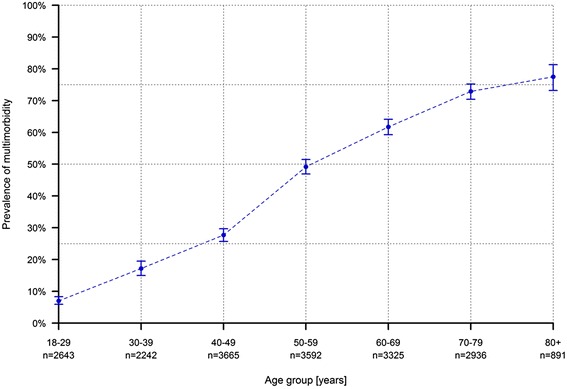
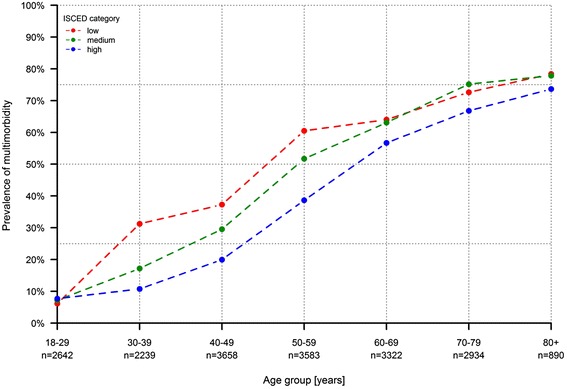
Overall, 39.6% (95% confidence interval (CI) 38.7%-40.6%) of the 19,294 participants were multimorbid and the proportion of adults with multimorbidity increased substantially with age: nearly half (49.2%, 95% CI 46.9%-51.5%) of the adults aged 50-59 years had already two or more chronic health conditions. Prevalence rates of multimorbidity differed considerably between the levels of education. Low-level educated adults aged 40-49 years were more likely to be multimorbid with a prevalence rate of 47.4% (95% CI 44.2%-50.5%) matching those of highly educated men and women aged about ten years older.
Our findings demonstrate that both, age and education are associated with a higher risk of being multimorbid in Germany. Hence, special emphasis in the development of new approaches in national public health and prevention programs on multimorbidity should be given to low-level educated people aged <65 years.
多病共存是公共卫生领域最重要且最具挑战性的方面之一。患有多种疾病的人住院次数更多,药物处方数量众多,死亡风险更高。鉴于有证据表明多病共存情况会因年龄和社会经济差异而有所不同,本研究的主要目的是确定特定年龄的患病率,并探究德国与多病共存相关的教育差异。
本横断面分析基于2012年3月至2013年3月期间对近20,000名成年人进行的全国性电话健康访谈调查“德国健康更新”(GEDA2012)。GEDA2012提供了17种自我报告的健康状况以及社会人口学特征方面的信息。多病共存被定义为一个人同时患有两种或更多种慢性疾病。描述性统计分析用于根据年龄和教育程度来研究多病共存情况,教育程度按照国际教育标准分类(ISCED 1997)进行定义。
总体而言,在19,294名参与者中,39.6%(95%置信区间(CI)38.7%-40.6%)患有多种疾病,成年人中多病共存的比例随年龄大幅增加:50 - 59岁的成年人中近一半(49.2%,95% CI 46.9%-51.5%)已经患有两种或更多种慢性健康问题。多病共存的患病率在不同教育水平之间存在显著差异。40 - 49岁受教育程度低的成年人患多种疾病的可能性更大,患病率为47.4%(95% CI 44.2%-50.5%),与年龄大十岁左右的高学历男性和女性相当。
我们的研究结果表明,在德国,年龄和教育程度都与患多种疾病的较高风险相关。因此,在国家公共卫生和多病共存预防项目新方法的开发中,应特别关注65岁以下受教育程度低的人群。