Chapagain Durga, Virányi Zsófia, Huber Ludwig, Serra Jessica, Schoesswender Julia, Range Friederike
Clever Dog Lab, Comparative Cognition, Messerli Research Institute, University of Veterinary Medicine Vienna, Medical University of Vienna, University of Vienna, Vienna, Austria.
Royal Canin Research Centre, Aimargues, France.
Front Psychol. 2018 Nov 14;9:2217. doi: 10.3389/fpsyg.2018.02217. eCollection 2018.
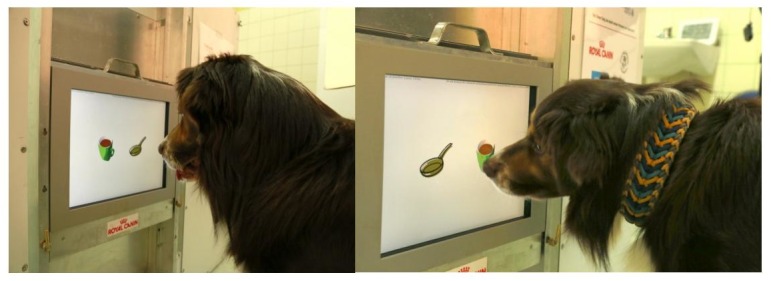
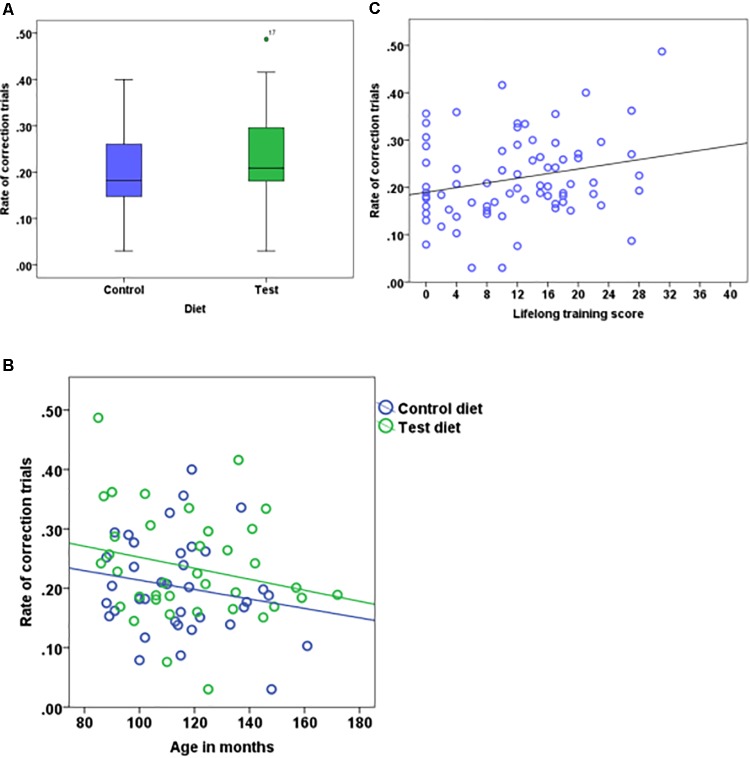
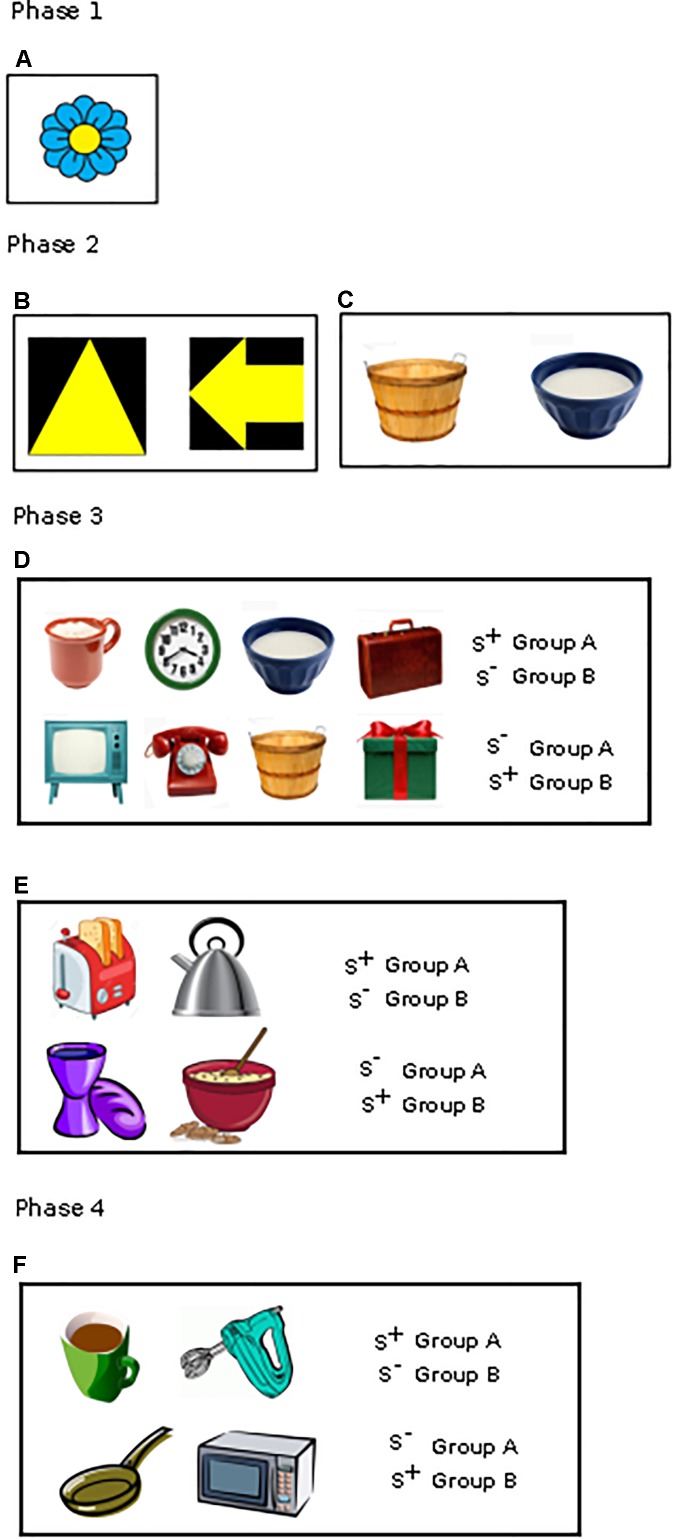
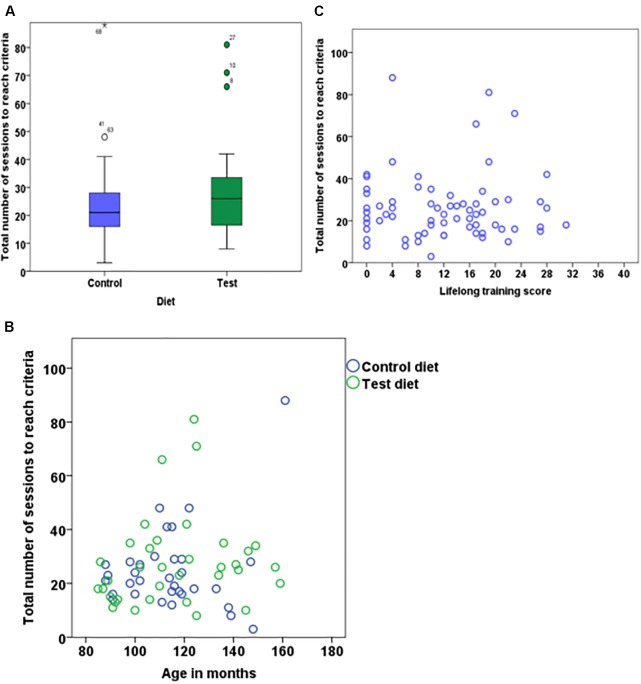
Aging is associated with a decline in cognitive functions such as learning, memory, attention, cognitive flexibility, and executive functions. Recent evidence indicates that interventions such as exercise, diet and cognitive training can be used to reduce the rate of age-dependent cognitive decline. In this study, we examined the changes in discrimination learning in older pet dogs, tested whether a dietary intervention counteracts a potential decline in learning and evaluated the influence of lifelong training on learning speed and cognitive flexibility. We included 115 pet dogs (>6 years) of 30 different breeds into one of two treatment groups: either a diet enriched with antioxidants, docosahexaenoic acid (DHA), Phosphatidylserine and tryptophan or a control diet for 1 year. Lifelong training was calculated for each dog using a questionnaire where owners filled their dog's training experiences over years. Dogs were trained to discriminate different pictures at the start of the dietary intervention using a touch screen methodology. After 1 year of dietary intervention, they were tested on a main picture discrimination task where they were confronted with a discrimination of four new pictures. We used the total number of sessions needed to reach learning criterion as a measure of learning speed and the rate of correction trials as a measure of deficit in learning from feedback/cognitive flexibility. In the main discrimination task, we found an influence of neither age nor diet on the speed of learning and deficit in learning from feedback. We did not find any influence of lifelong training either. The null findings were further corroborated by Bayesian statistics. The null findings might be due to the fact that pet dogs live in a stimulating environment which may reduce the rate of cognitive decline and hinder finding an age or diet effect. Also, the similarity between the training and the main discrimination task might have made the main task too easy for the animals to solve. Further studies are warranted to assess the effect of enriched diets on pet dogs using tasks that measure cognitive functions with a higher sensitivity.
衰老与学习、记忆、注意力、认知灵活性和执行功能等认知功能的衰退有关。最近的证据表明,运动、饮食和认知训练等干预措施可用于降低与年龄相关的认知衰退速度。在本研究中,我们研究了老年宠物狗辨别学习的变化,测试了饮食干预是否能抵消潜在的学习能力下降,并评估了终身训练对学习速度和认知灵活性的影响。我们将30个不同品种的115只宠物狗(年龄>6岁)纳入两个治疗组之一:要么是富含抗氧化剂、二十二碳六烯酸(DHA)、磷脂酰丝氨酸和色氨酸的饮食,要么是对照饮食,为期1年。使用问卷调查计算每只狗的终身训练情况,主人在问卷中填写他们的狗多年来的训练经历。在饮食干预开始时,使用触摸屏方法训练狗辨别不同的图片。经过1年的饮食干预后,对它们进行主要图片辨别任务测试,让它们辨别四张新图片。我们将达到学习标准所需的总训练次数作为学习速度的指标,将纠正试验的次数作为从反馈中学习/认知灵活性不足的指标。在主要辨别任务中,我们发现年龄和饮食对学习速度以及从反馈中学习的不足均无影响。我们也未发现终身训练有任何影响。贝叶斯统计进一步证实了这些零结果。这些零结果可能是由于宠物狗生活在刺激的环境中,这可能会降低认知衰退速度并阻碍发现年龄或饮食效应。此外,训练与主要辨别任务之间的相似性可能使主要任务对动物来说太容易解决了。有必要进行进一步研究,使用具有更高灵敏度的认知功能测量任务来评估强化饮食对宠物狗的影响。