Forbes Scott C, Holroyd-Leduc Jayna M, Poulin Marc J, Hogan David B
Department of Physiology and Pharmacology, Faculty of Medicine, University of Calgary, Calgary, AB;
Departments of Medicine, Clinical Neurosciences and Community Health Sciences, Faculty of Medicine, University of Calgary, Calgary, AB;; Alberta Seniors Health Strategic Clinical Network, Alberta Health Services, Calgary, AB.
Can Geriatr J. 2015 Dec 23;18(4):231-45. doi: 10.5770/cgj.18.189. eCollection 2015 Dec.
Observational studies have suggested that various nutrients, dietary supplements, and vitamins may delay the onset of age-associated cognitive decline and dementia. We systematically reviewed recent randomized controlled trials investigating the effect of nutritional interventions on cognitive performance in older non-demented adults.
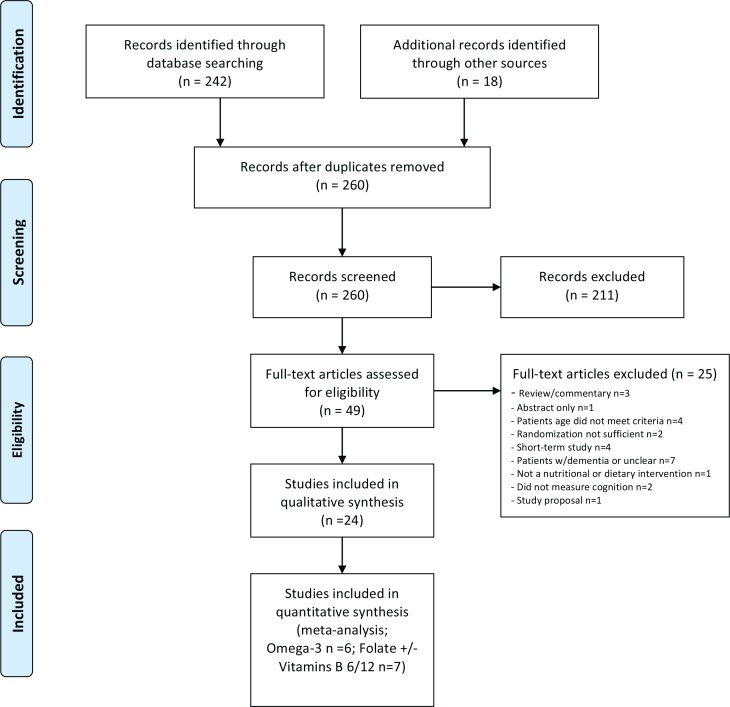
We searched MEDLINE, CINAHL, Embase, and the Cochrane Library for articles published between 2003 and 2013. We included randomized trials of ≥ 3 months' duration that examined the cognitive effects of a nutritional intervention in non-demented adults > 40 years of age. Meta-analyses were done when sufficient trials were available.
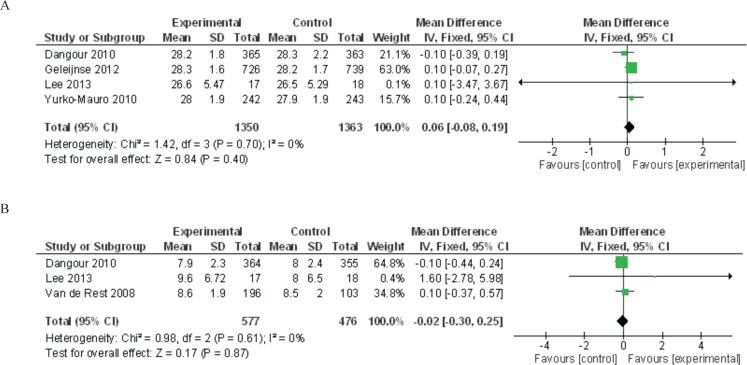
Twenty-four trials met inclusion criteria (six omega-3 fatty acids, seven B vitamins, three vitamin E, eight other interventions). In the meta-analyses, omega-3 fatty acids showed no significant effect on Mini-Mental State Examination (MMSE) scores (four trials, mean difference 0.06, 95% CI -0.08 - 0.19) or digit span forward (three trials, mean difference -0.02, 95% CI -0.30 - 0.25), while B vitamins showed no significant effect on MMSE scores (three trials, mean difference 0.02, 95% CI -0.22 - 0.25). None of the vitamin E studies reported significant effects on cognitive outcomes. Among the other nutritional interventions, statistically significant differences between the intervention and control groups on at least one cognitive domain were found in single studies of green tea extract, Concord grape juice, chromium picolinate, beta-carotene, two different combinations of multiple vitamins, and a dietary approach developed for the control of hypertension.
Omega-3 fatty acids, B vitamins, and vitamin E supplementation did not affect cognition in non-demented middle-aged and older adults. Other nutritional interventions require further evaluation before their use can be advocated for the prevention of age-associated cognitive decline and dementia.
观察性研究表明,各种营养素、膳食补充剂和维生素可能会延缓与年龄相关的认知衰退和痴呆症的发病。我们系统回顾了近期调查营养干预对老年非痴呆成年人认知表现影响的随机对照试验。
我们在MEDLINE、CINAHL、Embase和Cochrane图书馆中检索了2003年至2013年发表的文章。我们纳入了持续时间≥3个月的随机试验,这些试验研究了营养干预对40岁以上非痴呆成年人的认知影响。当有足够数量的试验时进行荟萃分析。
24项试验符合纳入标准(6项关于ω-3脂肪酸,7项关于B族维生素,3项关于维生素E,8项关于其他干预措施)。在荟萃分析中,ω-3脂肪酸对简易精神状态检查表(MMSE)评分(4项试验,平均差异0.06,95%置信区间-0.08至0.19)或顺背数字广度(3项试验,平均差异-0.02,95%置信区间-0.30至0.25)无显著影响,而B族维生素对MMSE评分(3项试验,平均差异0.02,95%置信区间-0.22至0.25)无显著影响。没有维生素E研究报告对认知结果有显著影响。在其他营养干预措施中,在绿茶提取物、康科德葡萄汁、吡啶甲酸铬、β-胡萝卜素、多种维生素的两种不同组合以及一种为控制高血压而制定的饮食方法的单项研究中,干预组和对照组在至少一个认知领域存在统计学显著差异。
补充ω-3脂肪酸、B族维生素和维生素E对非痴呆的中年和老年人的认知没有影响。其他营养干预措施在被提倡用于预防与年龄相关的认知衰退和痴呆症之前,需要进一步评估。