Instituto Nacional de Saúde (INS), Maputo, Mozambique.
Division of Infectious Diseases and Tropical Medicine, University Hospital, LMU Munich, Germany.
PLoS One. 2018 Nov 29;13(11):e0206838. doi: 10.1371/journal.pone.0206838. eCollection 2018.
We evaluated the safety and immunogenicity of (i) an intradermal HIV-DNA regimen given with/without intradermal electroporation (EP) as prime and (ii) the impact of boosting with modified vaccinia virus Ankara (HIV-MVA) administered with or without subtype C CN54rgp140 envelope protein adjuvanted with Glucopyranosyl Lipid A (GLA-AF) in volunteers from Tanzania and Mozambique.
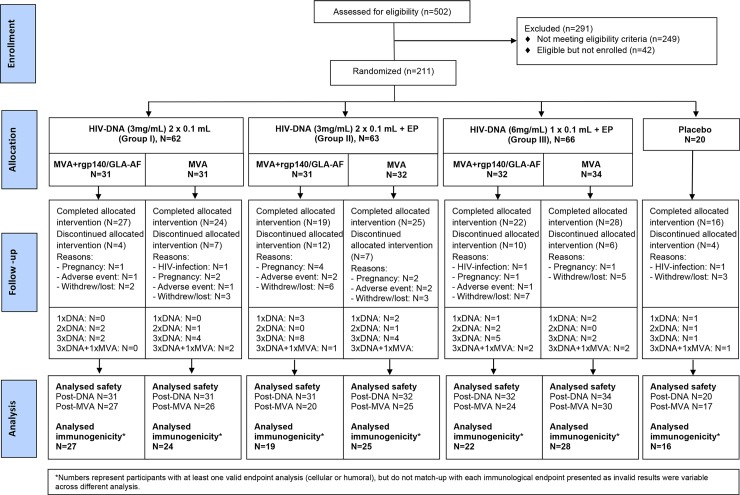
Healthy HIV-uninfected adults (N = 191) were randomized twice; first to one of three HIV-DNA intradermal priming regimens by needle-free ZetaJet device at weeks 0, 4 and 12 (Group I: 2x0.1mL [3mg/mL], Group II: 2x0.1mL [3mg/mL] plus EP, Group III: 1x0.1mL [6mg/mL] plus EP). Second the same volunteers received 108 pfu HIV-MVA twice, alone or combined with CN54rgp140/GLA-AF, intramuscularly by syringe, 16 weeks apart. Additionally, 20 volunteers received saline placebo.
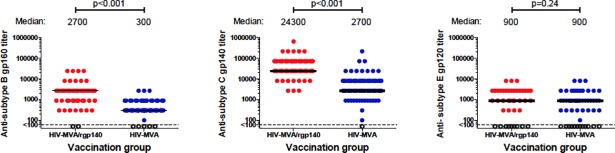
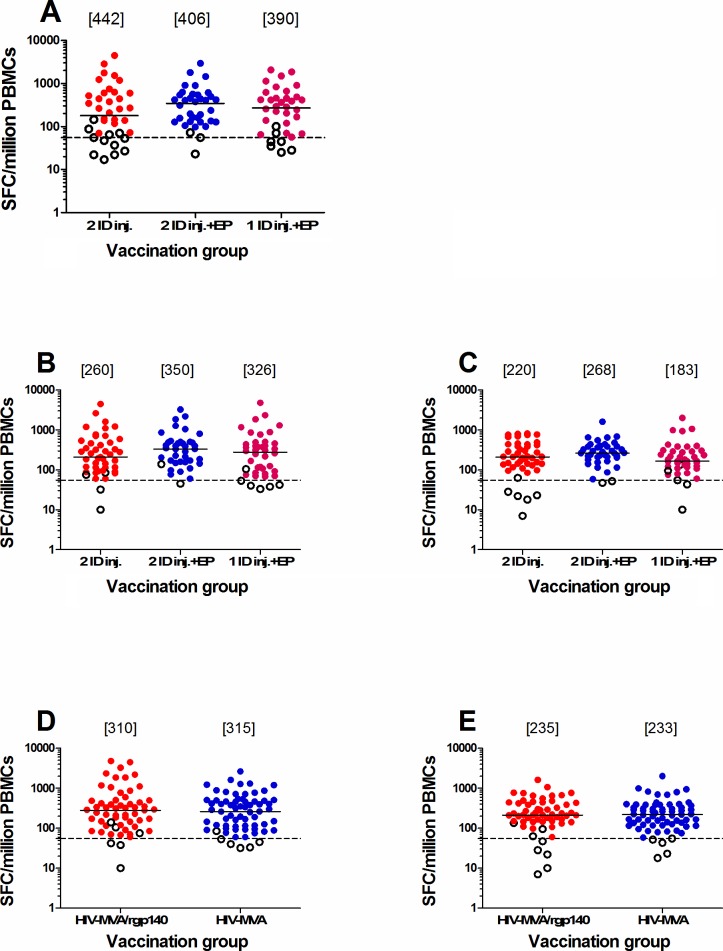
Vaccinations and electroporation did not raise safety concerns. After the last vaccination, the overall IFN-γ ELISpot response rate to either Gag or Env was 97%. Intradermal electroporation significantly increased ELISpot response rates to HIV-DNA-specific Gag (66% group I vs. 86% group II, p = 0.026), but not to the HIV-MVA vaccine-specific Gag or Env peptide pools nor the magnitude of responses. Co-administration of rgp140/GLA-AF with HIV-MVA did not impact the frequency of binding antibody responses against subtype B gp160, C gp140 or E gp120 antigens (95%, 99%, 79%, respectively), but significantly enhanced the magnitude against subtype B gp160 (2700 versus 300, p<0.001) and subtype C gp140 (24300 versus 2700, p<0.001) Env protein. At relatively low titers, neutralizing antibody responses using the TZM-bl assay were more frequent in vaccinees given adjuvanted protein boost.
Intradermal electroporation increased DNA-induced Gag response rates but did not show an impact on Env-specific responses nor on the magnitude of responses. Co-administration of HIV-MVA with rgp140/GLA-AF significantly enhanced antibody responses.
我们评估了(i)经皮注射给予的 HIV-DNA 方案,联合/不联合经皮电穿孔 (EP) 作为初免,以及(ii)使用改良痘苗病毒安卡拉 (HIV-MVA) 进行加强免疫,联合/不联合含有 GLA-AF 的亚型 C CN54rgp140 包膜蛋白佐剂的安全性和免疫原性,在来自坦桑尼亚和莫桑比克的健康 HIV 未感染者(N=191)中进行。
健康的 HIV 未感染者(N=191)进行了两次随机分组;首先,使用无针 ZetaJet 设备经皮注射三种 HIV-DNA 初免方案,每周一次,共 3 次(第 0、4、12 周)(第 I 组:2x0.1mL[3mg/mL],第 II 组:2x0.1mL[3mg/mL]加 EP,第 III 组:1x0.1mL[6mg/mL]加 EP)。其次,同一志愿者接受 108 pfu HIV-MVA 肌肉注射,2 次,间隔 16 周,单独或联合使用 CN54rgp140/GLA-AF。此外,20 名志愿者接受生理盐水安慰剂。
疫苗接种和电穿孔未引起安全性问题。最后一次接种后,Gag 或 Env 特异性 IFN-γ ELISpot 反应率总体为 97%。经皮电穿孔显著增加了 HIV-DNA 特异性 Gag 的 ELISpot 反应率(第 I 组 66% vs. 第 II 组 86%,p=0.026),但对 HIV-MVA 疫苗特异性 Gag 或 Env 肽库的反应率或反应幅度没有影响。在 HIV-MVA 中联合使用 rgp140/GLA-AF 并没有影响针对亚型 B gp160、C gp140 或 E gp120 抗原的结合抗体反应的频率(分别为 95%、99%、79%),但显著增强了针对亚型 B gp160(2700 比 300,p<0.001)和亚型 C gp140(24300 比 2700,p<0.001)Env 蛋白的反应幅度。在相对较低的滴度下,使用 TZM-bl 测定法检测到的中和抗体反应在接受佐剂蛋白加强免疫的疫苗接种者中更为频繁。
经皮电穿孔增加了 DNA 诱导的 Gag 反应率,但对 Env 特异性反应率或反应幅度没有影响。在 HIV-MVA 中联合使用 rgp140/GLA-AF 显著增强了抗体反应。