U.S. Military HIV Program, Rockville, MD, USA.
Vaccine. 2012 Feb 27;30(10):1830-40. doi: 10.1016/j.vaccine.2011.12.131. Epub 2012 Jan 9.
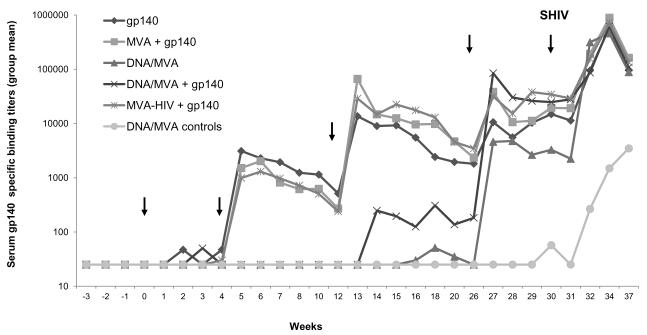
The current study assessed the immunogenicity and protective efficacy of various prime-boost vaccine regimens in rhesus macaques using combinations of recombinant DNA (rDNA), recombinant MVA (rMVA), and subunit gp140 protein. The rDNA and rMVA vectors were constructed to express Env from HIV-1 subtype CRF01_AE and Gag-Pol from CRF01_AE or SIVmac 239. One of the rMVAs, MVA/CMDR, has been recently tested in humans. Immunizations were administered at months 0 and 1 (prime) and months 3 and 6 (boost). After priming, HIV env-specific serum IgG was detected in monkeys receiving gp140 alone or rMVA but not in those receiving rDNA. Titers were enhanced in these groups after boosting either with gp140 alone or with rMVA plus gp140. The groups that received the rDNA prime developed env-specific IgG after boosting with rMVA with or without gp140. HIV Env-specific serum IgG binding antibodies were elicited more frequently and of higher titer, and breadth of neutralizing antibodies was increased with the inclusion of the subunit Env boost. T cell responses were measured by tetramer binding to Gag p11c in Mamu-A*01 macaques, and by IFN-γ ELISPOT assay to SIV-Gag. T cell responses were induced after vaccination with the highest responses seen in macaques immunized with rDNA and rMVA. Macaques were challenged intravenously with a novel SHIV-E virus (SIVmac239 Gag-Pol with an HIV-1 subtype E-Env CAR402). Post challenge with SHIV-E, antibody titers were boosted in all groups and peaked at 4 weeks. Robust T cell responses were seen in all groups post challenge and in macaques immunized with rDNA and rMVA a clear boosting of responses was seen. A greater than two-log drop in RNA copies/ml at peak viremia and earlier set point was achieved in macaques primed with rDNA, and boosted with rMVA/SHIV-AE plus gp140. Post challenge viremia in macaques immunized with other regimens was not significantly different to that of controls. These results demonstrate that a gp140 subunit and inclusion of SIV Gag-Pol may be critical for control of SHIV post challenge.
本研究评估了使用重组 DNA(rDNA)、重组 MVA(rMVA)和亚单位 gp140 蛋白组合对恒河猴进行各种初免-加强疫苗方案的免疫原性和保护效力。rDNA 和 rMVA 载体被构建为表达来自 HIV-1 亚型 CRF01_AE 的 Env 和来自 CRF01_AE 或 SIVmac 239 的 Gag-Pol。其中一种 rMVA,MVA/CMDR,最近已在人类中进行了测试。免疫接种在 0 个月和 1 个月(初免)和 3 个月和 6 个月(加强)进行。初免后,仅接受 gp140 或 rMVA 免疫的猴子中检测到 HIV env 特异性血清 IgG,而接受 rDNA 免疫的猴子中未检测到。这些组在单独用 gp140 加强或用 rMVA 加 gp140 加强后,滴度均增强。接受 rDNA 初免的组在用 rMVA 加强时产生了 env 特异性 IgG,无论是否加用亚单位Env 加强。与包含亚单位Env 加强相比,HIV Env 特异性血清 IgG 结合抗体的产生更为频繁,滴度更高,中和抗体的广度增加。T 细胞反应通过 Gag p11c 与 Mamu-A*01 猕猴的四聚体结合,以及通过 IFN-γ ELISPOT 测定到 SIV-Gag 来测量。接种疫苗后诱导 T 细胞反应,在接受 rDNA 和 rMVA 免疫的猕猴中观察到最高的反应。猕猴通过静脉内途径用新型 SHIV-E 病毒(SIVmac239 Gag-Pol 带有 HIV-1 亚型 E-Env CAR402)进行挑战。用 SHIV-E 进行挑战后,所有组的抗体滴度均增强,在 4 周时达到峰值。所有组在挑战后均观察到强大的 T 细胞反应,在接受 rDNA 和 rMVA 免疫的猕猴中观察到反应明显增强。在接受 rDNA 初免和 rMVA/SHIV-AE 加 gp140 加强的猕猴中,在病毒血症峰值和较早的设定点时,RNA 拷贝/ml 下降超过两个对数。用其他方案免疫的猕猴在挑战后的病毒血症与对照组没有显著差异。这些结果表明,gp140 亚单位和包含 SIV Gag-Pol 可能对控制 SHIV 挑战后至关重要。