Department of Biomedical Engineering, Duke University, Durham, NC 27708, USA.
Department of Biology, Trinity College of Arts and Sciences, Duke University, Durham, NC 27708, USA.
Biomaterials. 2019 Feb;192:475-485. doi: 10.1016/j.biomaterials.2018.11.012. Epub 2018 Nov 28.
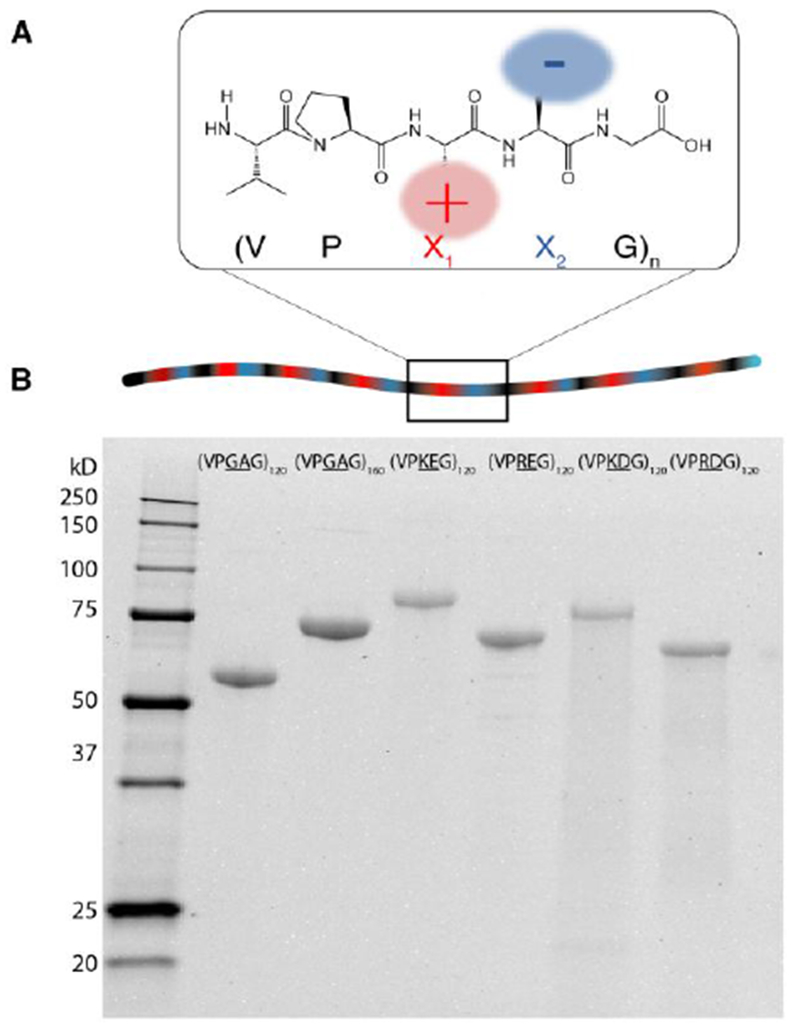
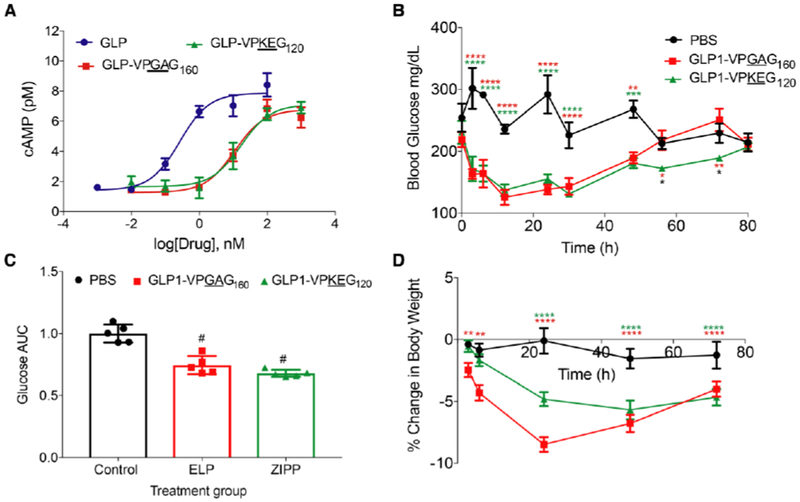
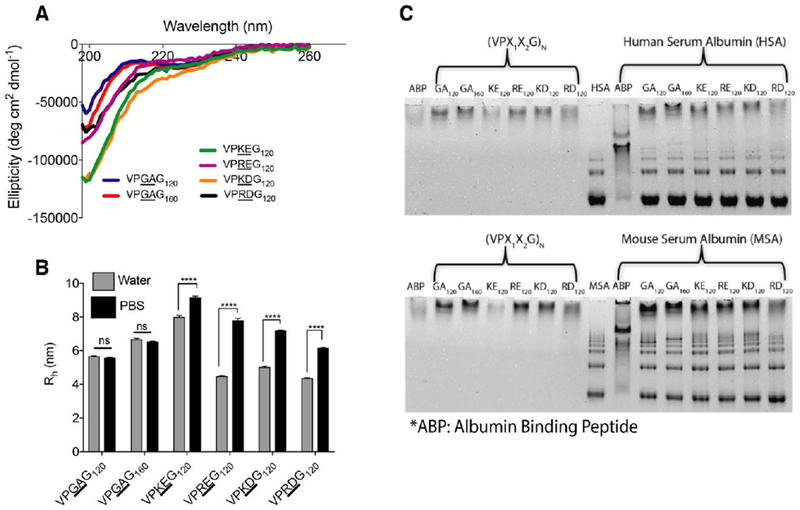
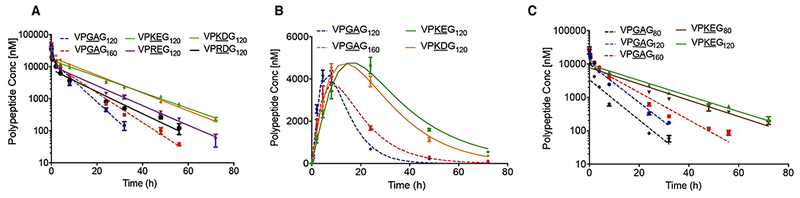
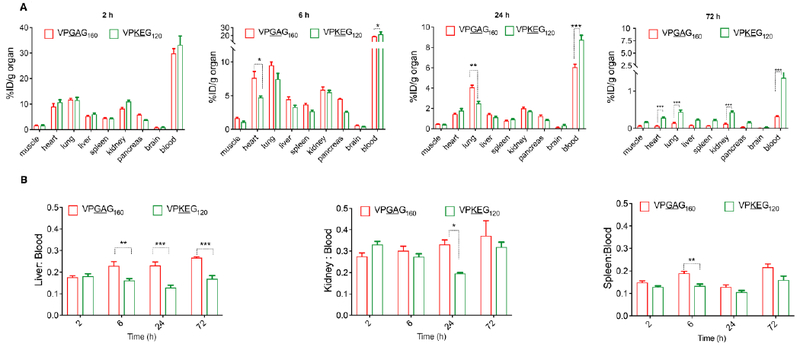
The clinical utility of many peptide and protein drugs is limited by their short in-vivo half-life. To address this limitation, we report a new class of polypeptide-based materials that have a long plasma circulation time. The design of these polypeptides is motivated by the hypothesis that incorporating a zwitterionic sequence, within an intrinsically disordered polypeptide motif, would impart "stealth" behavior to the polypeptide and increase its plasma residence time, a behavior akin to that of synthetic stealth polymers. We designed these zwitterionic polypeptides (ZIPPs) with a repetitive (VPXXG) motif, where X and X are cationic and anionic amino acids, respectively, and n is the number of repeats. To test this hypothesis, we synthesized a set of ZIPPs with different pairs of cationic and anionic residues with varied chain length. We show that a combination of lysine and glutamic acid in the ZIPP confer superior pharmacokinetics, for both intravenous and subcutaneous administration, compared to uncharged control polypeptides. Finally, to demonstrate their clinical utility, we fused the best performing ZIPP sequence to glucagon-like peptide-1 (GLP1), a peptide drug used for treatment of type-2 diabetes and show that the ZIPP-GLP1 fusion outperforms an uncharged polypeptide of the same molecular weight in a mouse model of type-2 diabetes.
许多肽类和蛋白质药物的临床应用受到其体内半衰期短的限制。为了解决这一限制,我们报告了一类新的基于多肽的材料,它们具有较长的血浆循环时间。这些多肽的设计基于这样一种假设,即在一个固有无序的多肽基序中加入一个两性离子序列,会赋予多肽“隐身”特性,并增加其血浆停留时间,这种行为类似于合成的隐身聚合物。我们设计了这些带有重复(VPXXG)基序的两性离子多肽(ZIPPs),其中 X 和 X 分别是阳离子和阴离子氨基酸,n 是重复的次数。为了验证这一假设,我们合成了一系列具有不同阳离子和阴离子对以及不同链长的 ZIPPs。我们发现,ZIPP 中的赖氨酸和谷氨酸组合赋予了其优于不带电荷的对照多肽的静脉内和皮下给药的药代动力学特性。最后,为了证明其临床应用,我们将表现最佳的 ZIPP 序列融合到胰高血糖素样肽-1(GLP1)中,GLP1 是一种用于治疗 2 型糖尿病的肽类药物,并表明 ZIPP-GLP1 融合在 2 型糖尿病的小鼠模型中优于相同分子量的不带电荷的多肽。