Heydari Majid, Seyedin Hesam, Jafari Mehdi, Dehnavieh Reza
Department of Health Services Management, School of Health Management and Information Sciences, Iran University of Medical Sciences, Tehran, Iran.
Research Center for Modeling in Health, Institute for Futures Studies in Health, Kerman University of Medical Sciences, Kerman, Iran.
J Educ Health Promot. 2018 Oct 29;7:135. doi: 10.4103/jehp.jehp_69_18. eCollection 2018.
This study was designed and implemented with the purpose of identify and analyze the stakeholders in Iran's Health Insurance System (HInS).
This study was a mixed method study. The study setting was in the field and consists of all organizations in the HInS. The study steps designed according to the Kammi Schmeer stakeholder analysis model. The information was collected through semi-structured and structured interviews with 16 stakeholder representatives. The data collection tool was checklist and matrixes that determined the characteristics of the stakeholders. Analysis of data was done by Maxqda and Mactor software.
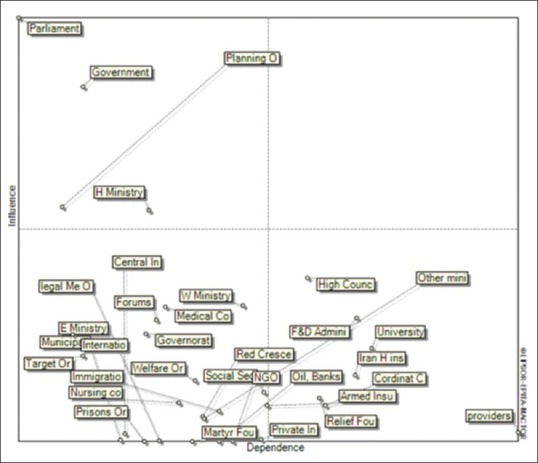
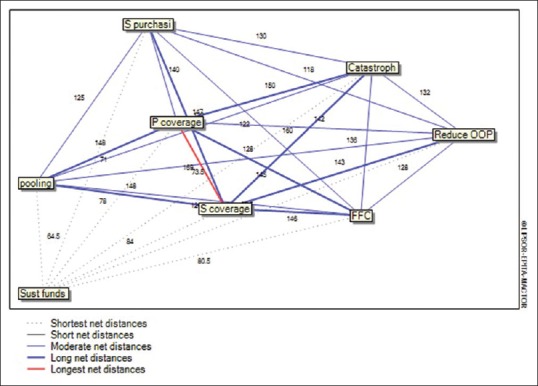
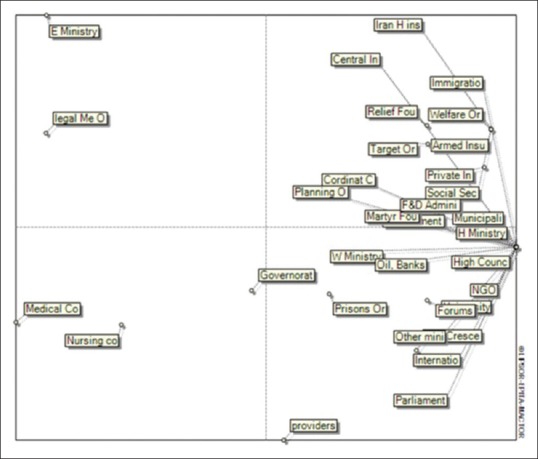
A total of 34 stakeholders were identified that were involved in nine main activities of HInS. Major stakeholders have governmental nature. The Government, the Planning and Budget Organization, the Ministry of Health, the Welfare Ministry, the Higher Health Insurance Council, and the Medical Council were stakeholders who have high financial, decision-making, and political power simultaneously. The Parliament and the Health Commission, the Government, the Planning and Budget Organization, and the Ministry of Health were stakeholders that had the most influence on other stakeholders. Most of stakeholders have same position to the objectives of the HInS. The insurer organizations had opposed position with the objective of integrity of the funds.
Stakeholders of Iran's HInS are multiple and involved in various activities that sometimes they are overlapping and parallel. Regarding the same position of the majority of stakeholders to the objectives, reforms are possible, provided that influential stakeholders participate in policies making.
本研究旨在识别和分析伊朗医疗保险系统(HInS)中的利益相关者。
本研究为混合方法研究。研究背景为实地环境,涵盖HInS中的所有组织。研究步骤依据卡米·施米尔利益相关者分析模型设计。通过与16位利益相关者代表进行半结构化和结构化访谈收集信息。数据收集工具为确定利益相关者特征的清单和矩阵。数据由Maxqda和Mactor软件进行分析。
共识别出34个参与HInS九项主要活动的利益相关者。主要利益相关者具有政府性质。政府、计划与预算组织、卫生部、福利部、高级医疗保险委员会和医学委员会是同时拥有高财务、决策和政治权力的利益相关者。议会和卫生委员会、政府、计划与预算组织以及卫生部是对其他利益相关者影响最大的利益相关者。大多数利益相关者对HInS的目标持相同立场。保险公司组织在资金完整性目标上持反对立场。
伊朗HInS的利益相关者众多,参与各种活动,有时这些活动相互重叠且并行。鉴于大多数利益相关者对目标持相同立场,只要有影响力的利益相关者参与政策制定,改革是可行的。