Molecular Plant Breeding, Institute of Agricultural Sciences, ETH Zürich, Universitätsstrasse 2, 8092, Zurich, Switzerland.
Molecular Ecology, Agroscope, Reckenholzstrasse 191, 8046, Zurich, Switzerland.
Theor Appl Genet. 2019 Apr;132(4):947-958. doi: 10.1007/s00122-018-3250-z. Epub 2018 Nov 30.
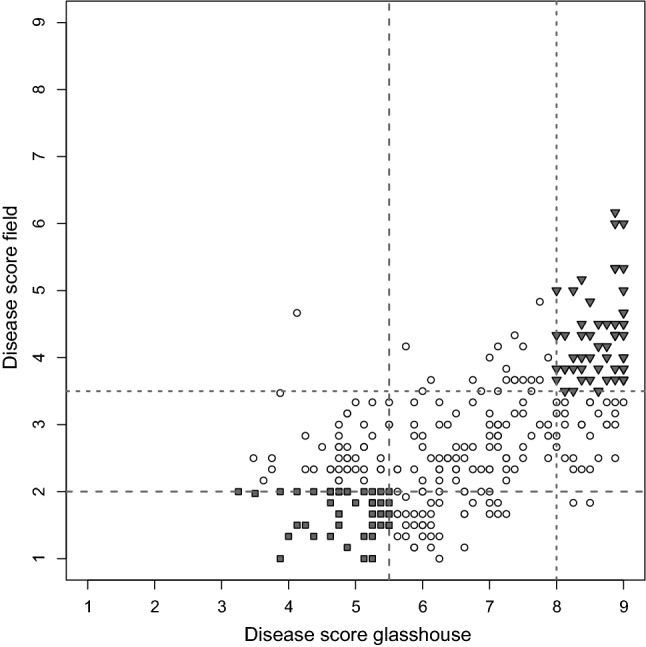
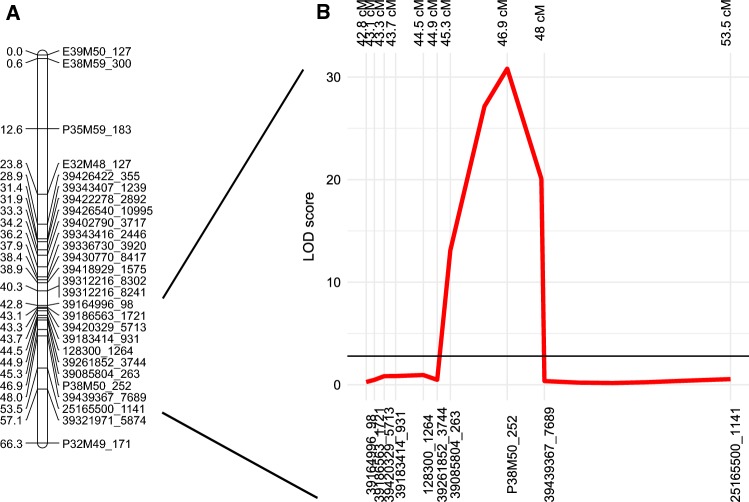
SNPs and candidate genes associated with bacterial wilt resistance in Italian ryegrass were identified by sequencing the parental plants and pooled F progeny of a segregating population. Italian ryegrass (Lolium multiflorum Lam.) is one of the most important forage grass species in temperate regions. Its yield, quality and persistency can significantly be reduced by bacterial wilt, a serious disease caused by Xanthomonas translucens pv. graminis. Although a major QTL for bacterial wilt resistance has previously been reported, detailed knowledge on underlying genes and DNA markers to allow for efficient resistance breeding strategies is currently not available. We used pooled DNA sequencing to characterize a major QTL for bacterial wilt resistance of Italian ryegrass and to develop inexpensive sequence-based markers to efficiently target resistance alleles for marker-assisted recurrent selection. From the mapping population segregating for the QTL, DNA of 44 of the most resistant and 44 of the most susceptible F individuals was pooled and sequenced using the Illumina HiSeq 2000 platform. Allele frequencies of 18 × 10 single nucleotide polymorphisms (SNP) were determined in the resistant and susceptible pool. A total of 271 SNPs on 140 scaffold sequences of the reference parental genome showed significantly different allele frequencies in both pools. We converted 44 selected SNPs to KASP™ markers, genetically mapped these proximal to the major QTL and thus validated their association with bacterial wilt resistance. This study highlights the power of pooled DNA sequencing to efficiently target binary traits in biparental mapping populations. It delivers genome sequence data, SNP markers and potential candidate genes which will allow to implement marker-assisted strategies to fix bacterial wilt resistance in outcrossing breeding populations of Italian ryegrass.
通过对分离群体的亲本植物和混合 F 后代进行测序,鉴定出与意大利黑麦草细菌性萎蔫病抗性相关的 SNPs 和候选基因。意大利黑麦草(Lolium multiflorum Lam.)是温带地区最重要的牧草之一。细菌性萎蔫病由黄单胞菌 Xanthomonas translucens pv. graminis 引起,会显著降低其产量、质量和持久性。尽管先前已经报道了一个主要的细菌性萎蔫病抗性 QTL,但目前还缺乏有关潜在基因和 DNA 标记的详细知识,无法实现有效的抗性育种策略。我们使用混合 DNA 测序来描述意大利黑麦草细菌性萎蔫病抗性的一个主要 QTL,并开发廉价的基于序列的标记,以有效地针对抗性等位基因进行标记辅助轮回选择。从分离 QTL 的作图群体中,将 44 个最抗和 44 个最感的 F 个体的 DNA 混合并使用 Illumina HiSeq 2000 平台进行测序。在抗性和敏感池中确定了 18×10 个单核苷酸多态性(SNP)的等位基因频率。参考亲本基因组的 140 个支架序列上的 271 个 SNP 在两个池中显示出明显不同的等位基因频率。我们将 44 个选定的 SNP 转换为 KASP™标记,将这些标记遗传映射到主要 QTL 附近,从而验证它们与细菌性萎蔫病抗性的关联。本研究突出了混合 DNA 测序在双亲作图群体中有效针对二元性状的优势。它提供了基因组序列数据、SNP 标记和潜在的候选基因,这将使我们能够实施标记辅助策略,固定意大利黑麦草杂交育种群体中的细菌性萎蔫病抗性。