Department of Marine Sciences, Tjärnö Marine Laboratory, University of Gothenburg, Strömstad, 45296, Gothenburg, Sweden.
Department of Geology, Lund University, 22362, Lund, Sweden.
Ambio. 2019 Aug;48(8):831-854. doi: 10.1007/s13280-018-1110-3. Epub 2018 Dec 1.
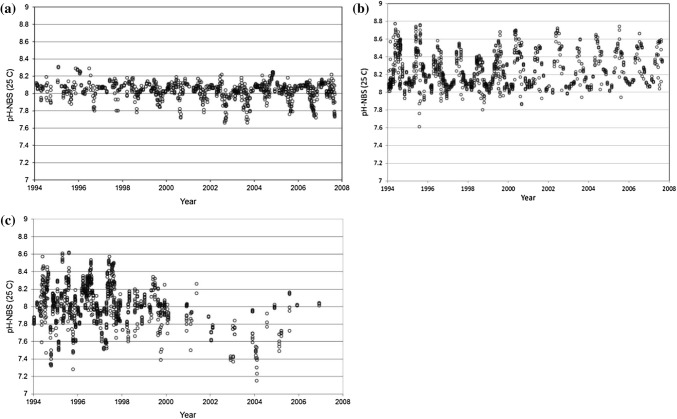
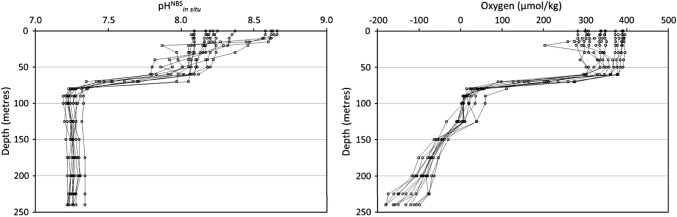
Ocean temperatures are rising; species are shifting poleward, and pH is falling (ocean acidification, OA). We summarise current understanding of OA in the brackish Baltic-Skagerrak System, focussing on the direct, indirect and interactive effects of OA with other anthropogenic drivers on marine biogeochemistry, organisms and ecosystems. Substantial recent advances reveal a pattern of stronger responses (positive or negative) of species than ecosystems, more positive responses at lower trophic levels and strong indirect interactions in food-webs. Common emergent themes were as follows: OA drives planktonic systems toward the microbial loop, reducing energy transfer to zooplankton and fish; and nutrient/food availability ameliorates negative impacts of OA. We identify several key areas for further research, notably the need for OA-relevant biogeochemical and ecosystem models, and understanding the ecological and evolutionary capacity of Baltic-Skagerrak ecosystems to respond to OA and other anthropogenic drivers.
海洋温度正在升高;物种向极地迁移,pH 值下降(海洋酸化,OA)。我们总结了当前对波罗的海-斯卡格拉克系统中 OA 的理解,重点关注 OA 与其他人为驱动因素对海洋生物地球化学、生物和生态系统的直接、间接和交互影响。最近的大量进展揭示了一个物种比生态系统有更强反应(正面或负面)的模式,较低营养级别的反应更积极,食物网中有强烈的间接相互作用。共同出现的主题如下:OA 使浮游生物系统向微生物环发展,减少能量向浮游动物和鱼类的传递;营养/食物的可用性减轻了 OA 的负面影响。我们确定了几个需要进一步研究的关键领域,特别是需要与 OA 相关的生物地球化学和生态系统模型,并了解波罗的海-斯卡格拉克生态系统对 OA 和其他人为驱动因素的生态和进化能力。