Department of Biochemistry, University of Calcutta, 35, Ballygunge Circular Road, Kolkata, West Bengal, 700 019, India.
School of Studies in Anthropology, Pt. Ravishankar Shukla University, Raipur, Chhattisgarh, 492010, India.
Malar J. 2018 Dec 3;17(1):447. doi: 10.1186/s12936-018-2592-y.
Despite its immunogenicity, the polymorphic nature of merozoite surface protein 1, an important vaccine candidate for Plasmodium falciparum malaria, remains a concern. This study analyses the impact of genetic variability and parasite population structure on epitope organization of different MSP1 segments.
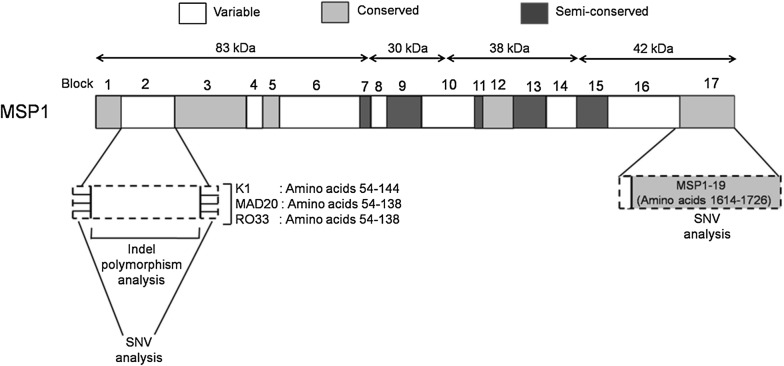
Altogether 98 blood samples collected from P. falciparum infected mild and severe malaria patients of Chhattisgarh and West Bengal were used to sequence regions encoding block 2 and MSP1-19 of msp1. Sequences were analysed using MEGA7, DnaSPv5, Arlequin3.5 and BepiPred.
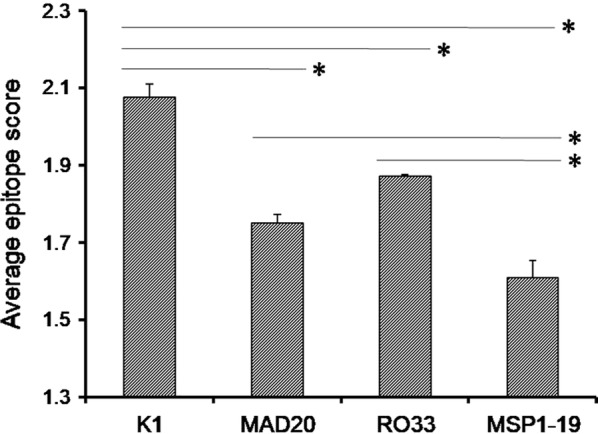
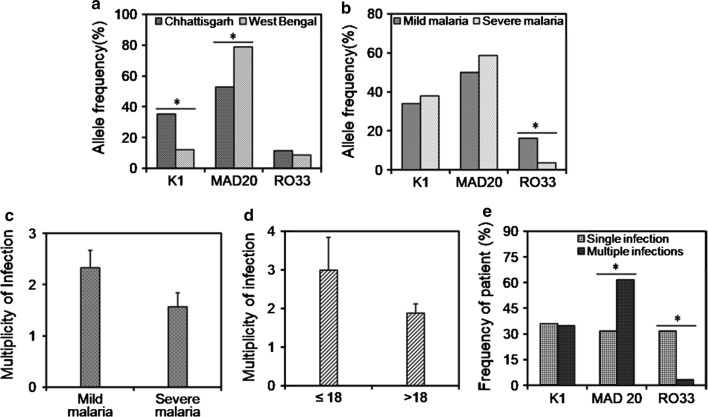
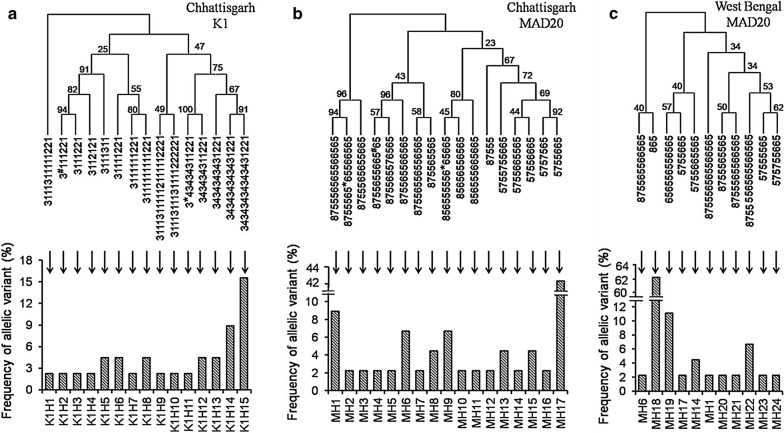
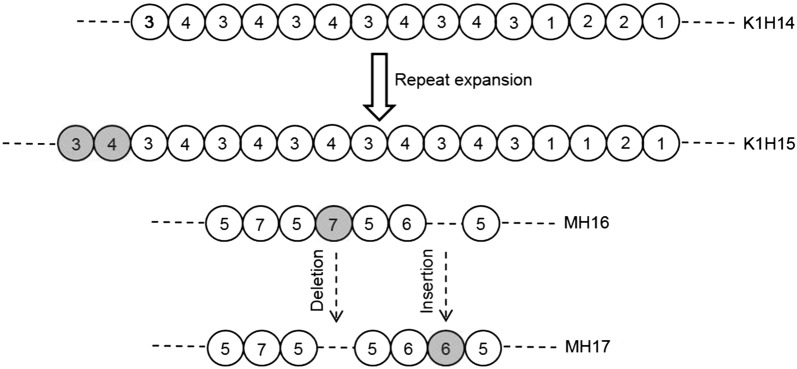
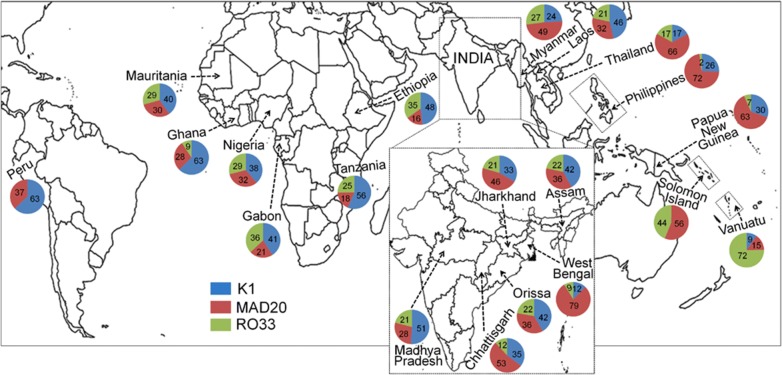
All three major MSP1 block 2 allele families namely K1, MAD20 and RO33 were detected in the samples and they together resulted in 41 indel variants. Chhattisgarh samples displayed an average MOI of 2.07 ± 1.59 which was higher in mild malaria and in age group < 18 years. Ultra-structure of block 2 alleles revealed that mutation and repeat expansion were two major mechanisms responsible for allelic variability of K1 and MAD20. Regions flanking block 2 were highly variable in Chhattisgarh with average mismatch differences (k) ranging from 1.198 to 5.156 for three families. In contrast, region encompassing MSP1-19 exhibited limited heterogeneity (k = 1.45, k = 1.363). Of the 50 possible B cell linear epitopes predicted from block 2 variants, 94.9% (131 of 138) of the parasites could be represented by three conserved antigens.
Present data indicates that natural selection and transmission intensity jointly play a role in controlling allelic diversity of MSP1 in Indian parasite isolates. Despite remarkable genetic variability, a limited number of predominant and conserved epitopes are present in Indian parasite isolates reinstating the importance of MSP1 as a promising malaria vaccine candidate.
尽管疟原虫表面蛋白 1(PfMSP1)具有免疫原性,但它是恶性疟原虫疫苗的重要候选抗原,其多态性仍然令人担忧。本研究分析了遗传变异和寄生虫种群结构对不同 MSP1 片段表位组织的影响。
本研究共使用了来自恰蒂斯加尔邦和西孟加拉邦感染轻中度疟疾的 98 个血样,用于测序编码 MSP1 第 2 块和 MSP1-19 的区域。使用 MEGA7、DnaSPv5、Arlequin3.5 和 BepiPred 分析序列。
在样本中检测到了三种主要的 MSP1 第 2 块等位基因家族,即 K1、MAD20 和 RO33,它们共同导致了 41 个缺失变异。恰蒂斯加尔邦样本的平均 MOI 为 2.07±1.59,轻度疟疾和年龄组<18 岁的样本中 MOI 更高。第 2 块等位基因的超微结构表明,突变和重复扩展是导致 K1 和 MAD20 等位基因变异性的两个主要机制。恰蒂斯加尔邦第 2 块侧翼区域高度可变,三个家族的平均错配差异(k)范围为 1.198 至 5.156。相比之下,包含 MSP1-19 的区域表现出有限的异质性(k=1.45,k=1.363)。在从第 2 块变异体预测的 50 个可能的 B 细胞线性表位中,有 94.9%(131 个中的 138 个)的寄生虫可以由三个保守抗原代表。
目前的数据表明,自然选择和传播强度共同作用于控制印度寄生虫分离株中 MSP1 的等位基因多样性。尽管存在显著的遗传变异性,但印度寄生虫分离株中存在数量有限的主要和保守表位,再次证明 MSP1 作为有前途的疟疾疫苗候选物的重要性。