Francis Crick Institute, 1 Midland Road, London, NW1 1AT, United Kingdom.
Aix-Marseille University, Inserm GIMP, Labex ParaFrap, Marseille, 13385, France.
Sci Rep. 2018 Dec 3;8(1):17527. doi: 10.1038/s41598-018-35944-w.
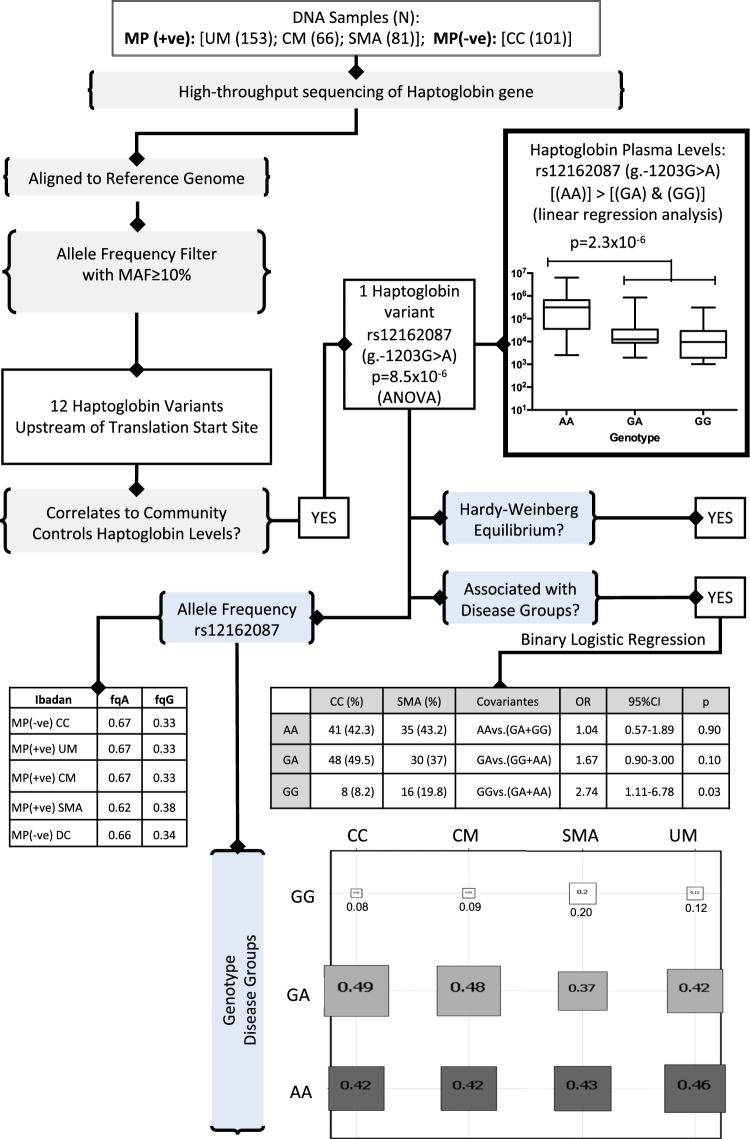
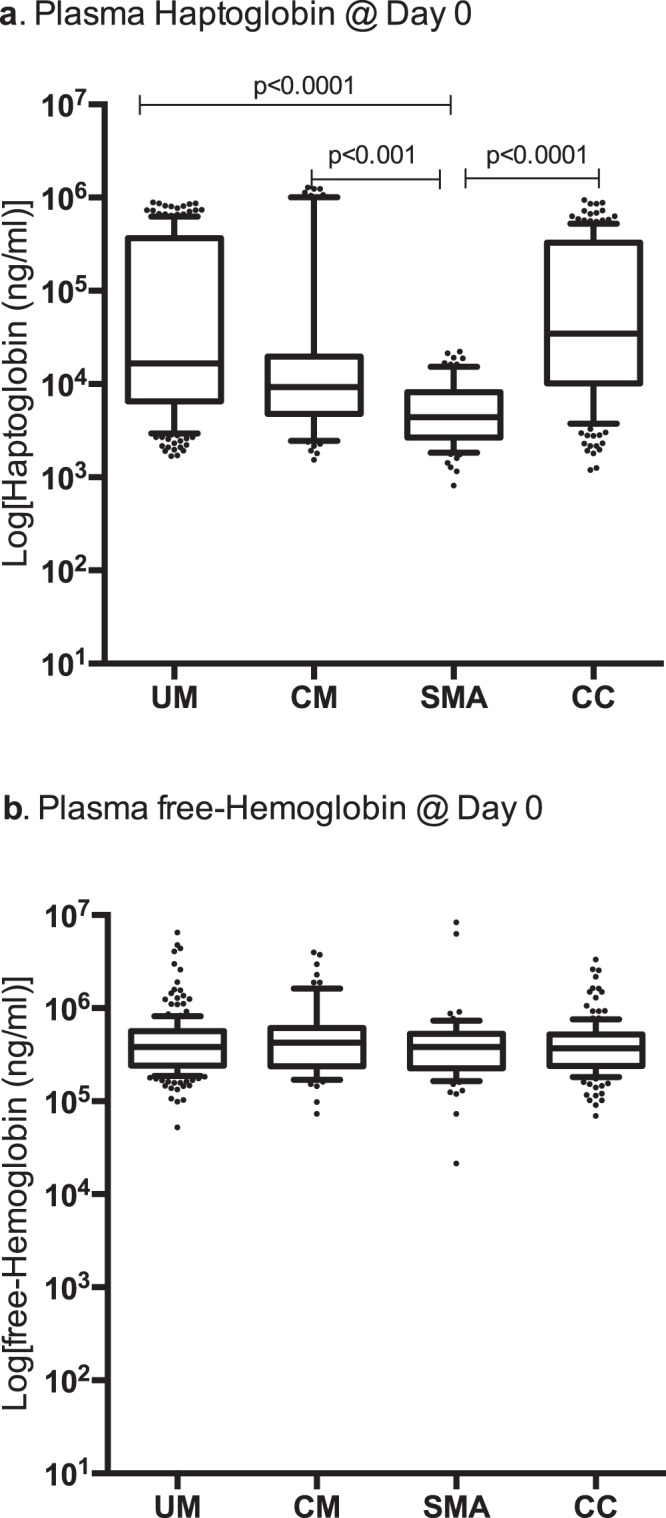
Severe Malarial Anemia (SMA), a life-threatening childhood Plasmodium falciparum malaria syndrome requiring urgent blood transfusion, exhibits inflammatory and hemolytic pathology. Differentiating between hypo-haptoglobinemia due to hemolysis or that of genetic origin is key to understand SMA pathogenesis. We hypothesized that while malaria-induced hypo-haptoglobinemia should reverse at recovery, that of genetic etiology should not. We carried-out a case-control study of children living under hyper-endemic holoendemic malaria burden in the sub-Saharan metropolis of Ibadan, Nigeria. We show that hypo-haptoglobinemia is a risk factor for childhood SMA and not solely due to intravascular hemolysis from underlying schizogony. In children presenting with SMA, hypo-haptoglobinemia remains through convalescence to recovery suggesting a genetic cause. We identified a haptoglobin gene variant, rs12162087 (g.-1203G > A, frequency = 0.67), to be associated with plasma haptoglobin levels (p = 8.5 × 10). The Homo-Var:(AA) is associated with high plasma haptoglobin while the reference Homo-Ref:(GG) is associated with hypo-haptoglobinemia (p = 2.3 × 10). The variant is associated with SMA, with the most support for a risk effect for Homo-Ref genotype. Our insights on regulatory haptoglobin genotypes and hypo-haptoglobinemia suggest that haptoglobin screening could be part of risk-assessment algorithms to prevent rapid disease progression towards SMA in regions with no-access to urgent blood transfusion where SMA accounts for high childhood mortality rates.
严重疟疾性贫血(SMA)是一种危及生命的儿童恶性疟原虫疟疾综合征,需要紧急输血,表现出炎症和溶血性病理。区分由溶血或遗传原因引起的低结合珠蛋白血症对于了解 SMA 发病机制至关重要。我们假设,虽然疟疾引起的低结合珠蛋白血症在恢复时应该逆转,但遗传病因引起的低结合珠蛋白血症不应逆转。我们在尼日利亚的撒哈拉以南大都市伊巴丹开展了一项针对生活在高度流行的全环疟疾负担下的儿童的病例对照研究。我们表明,低结合珠蛋白血症是儿童 SMA 的危险因素,不仅仅是由于潜在的裂殖体引起的血管内溶血。在患有 SMA 的儿童中,低结合珠蛋白血症在恢复期仍然存在,表明存在遗传原因。我们发现了一个结合珠蛋白基因变体 rs12162087(g.-1203G > A,频率 = 0.67),与血浆结合珠蛋白水平相关(p = 8.5 × 10)。等位基因 Homo-Var:(AA)与高血浆结合珠蛋白相关,而参考等位基因 Homo-Ref:(GG)与低结合珠蛋白血症相关(p = 2.3 × 10)。该变体与 SMA 相关,Homo-Ref 基因型的风险效应最受支持。我们对调节性结合珠蛋白基因型和低结合珠蛋白血症的见解表明,结合珠蛋白筛查可能成为预防无法获得紧急输血地区 SMA 快速疾病进展的风险评估算法的一部分,在这些地区 SMA 导致儿童死亡率很高。