Department of Pediatric Newborn Medicine, Brigham and Women's Hospital, Boston, MA 02115, USA.
Division of Maternal Fetal Medicine, University of Utah Health, Salt Lake City, UT 84132, USA.
Nutrients. 2018 Dec 4;10(12):1908. doi: 10.3390/nu10121908.
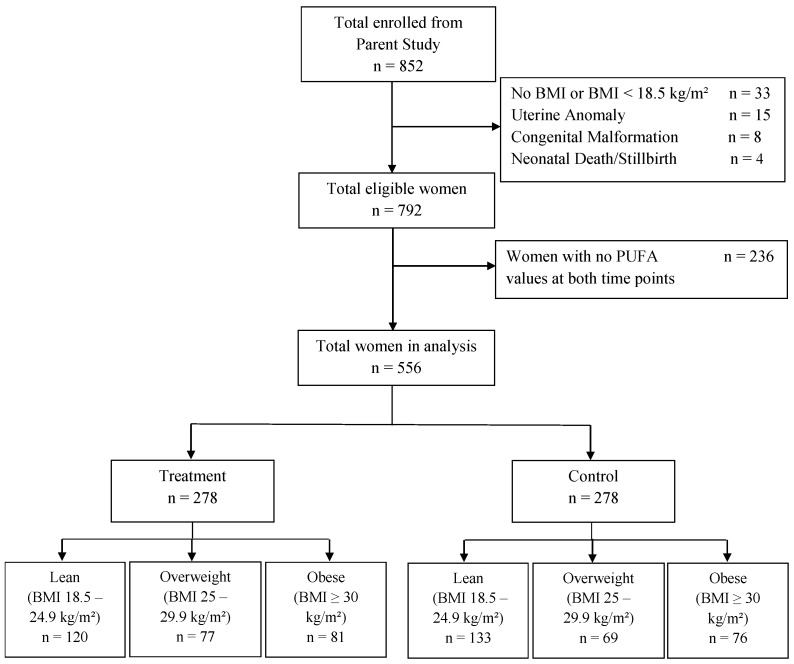
Maternal obesity is associated with adverse offspring outcomes. Inflammation and deficiency of anti-inflammatory nutrients like omega(n)-3 polyunsaturated fatty acids (PUFA) may contribute to these associations. Fetal supply of n-3 PUFA is dependent on maternal levels and studies have suggested that improved offspring outcomes are associated with higher maternal intake. However, little is known about how maternal obesity affects the response to n-3 supplementation during pregnancy. We sought to determine (1) the associations of obesity with PUFA concentrations and (2) if the systemic response to n-3 supplementation differs by body mass index (BMI). This was a secondary analysis of 556 participants (46% lean, 28% obese) in the Maternal-Fetal Medicine Units Network trial of n-3 (Docosahexaenoic acid (DHA) + Eicosapentaenoic acid (EPA)) supplementation, in which participants had 2g/day of n-3 ( = 278) or placebo ( = 278) from 19 to 22 weeks until delivery. At baseline, obese women had higher plasma n-6 arachidonic acid concentrations (: 0.96% total fatty acids; 95% Confidence Interval (CI): 0.13, 1.79) and n-6/n-3 ratio (: 0.26 unit; 95% CI: 0.05, 0.48) compared to lean women. In the adjusted analysis, women in all BMI groups had higher n-3 concentrations following supplementation, although obese women had attenuated changes ( = -2.04%, CI: -3.19, -0.90, interaction = 0.000) compared to lean women, resulting in a 50% difference in the effect size. Similarly, obese women also had an attenuated reduction ( = 0.94 units, CI: 0.40, 1.47, interaction = 0.046) in the n-6/n-3 ratio (marker of inflammatory status), which was 65% lower compared to lean women. Obesity is associated with higher inflammation and with an attenuated response to n-3 supplementation in pregnancy.
母体肥胖与不良后代结局相关。炎症和抗炎营养素(如ω(n)-3 多不饱和脂肪酸(PUFA))的缺乏可能导致这些关联。胎儿的 n-3 PUFA 供应取决于母体水平,研究表明,较高的母体摄入量与改善后代结局相关。然而,对于母体肥胖如何影响妊娠期间对 n-3 补充的反应知之甚少。我们旨在确定(1)肥胖与 PUFA 浓度的关联,以及(2)母体 BMI 是否会影响对 n-3 补充的系统反应。这是 Maternal-Fetal Medicine Units Network 试验中 n-3(二十二碳六烯酸(DHA)+二十碳五烯酸(EPA))补充的二次分析,其中参与者从 19 周到 22 周每天服用 2 克 n-3(=278)或安慰剂(=278),直到分娩。在基线时,与瘦女性相比,肥胖女性的血浆 n-6 花生四烯酸浓度更高(:0.96%总脂肪酸;95%置信区间(CI):0.13,1.79)和 n-6/n-3 比值更高(:0.26 单位;95% CI:0.05,0.48)。在调整分析中,所有 BMI 组的女性在补充 n-3 后 n-3 浓度均升高,尽管肥胖女性的变化幅度较小(= -2.04%,CI:-3.19,-0.90,交互作用=0.000)与瘦女性相比,导致效应大小的差异为 50%。同样,肥胖女性的 n-6/n-3 比值(炎症状态标志物)也呈减弱趋势(=0.94 单位,CI:0.40,1.47,交互作用=0.046),与瘦女性相比降低了 65%。肥胖与更高的炎症水平以及妊娠期间对 n-3 补充的反应减弱相关。