Zhang Xiaohui, Teng Yuanjun, Yang Xinxin, Li Rui, Ma Chongwen, Wang Hong, Han Hua, Geng Bin, Xia Yayi
Department of Orthopaedics, Lanzhou University Second Hospital, Lanzhou University, No. 82 Cuiyingmen, Chengguan District, Lanzhou City, Gansu Province, 730030, People's Republic of China.
Orthopedics Key Laboratory of Gansu Province, Lanzhou University Second Hospital, Lanzhou University, No. 82 Cuiyingmen, Chengguan District, Lanzhou City, Gansu Province, 730030, People's Republic of China.
BMC Musculoskelet Disord. 2018 Dec 6;19(1):436. doi: 10.1186/s12891-018-2348-4.
"Killer turn" effect is a critical explanation for the recurrent posterior laxity following transtibial posterior cruciate ligament (PCL) reconstruction, which affected by the angle of the tibial tunnel. Meanwhile, excessive tunnel angle would have an adverse impact on the healing of tendon to bone. The purpose was to evaluate the theoretical optimal angle of the tibial tunnel in transtibial anatomic PCL reconstruction.
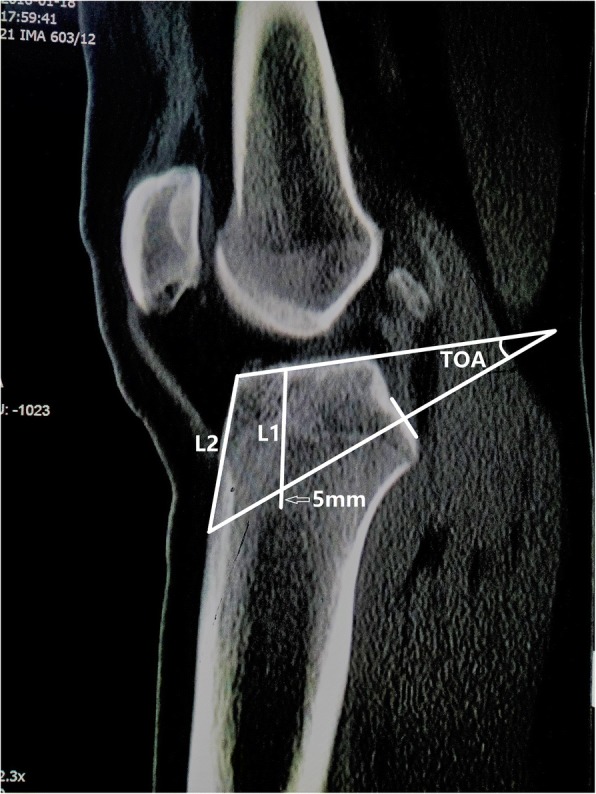
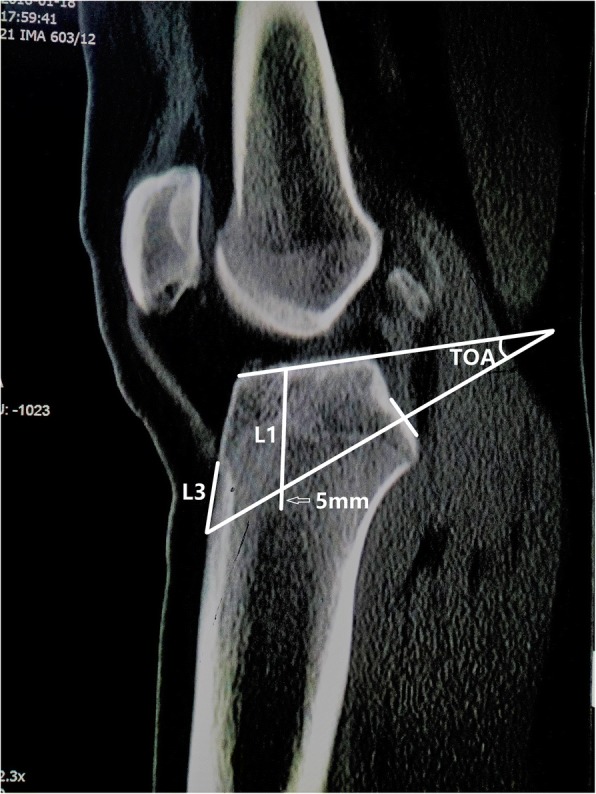
The measurements were performed on CT sagittal plane, including the thickness of cancellous bone (L1), the theoretical optimal angle of the tibial tunnel (TOA, which was measured between tibial plateau and the extension cord connecting the center of PCL insertion site with a point 5 mm superior from marrow cavity vertex), L2 - the distance from anterior tunnel aperture to anterior end of tibial plateau, L3 - the distance from anterior tunnel aperture to tibial tuberosity (lowest edge of patellar ligament attachment).
The value of TOA and L3 were 35.4 ± 7.9 ° and 26.8 ± 11.4 mm, respectively. L1 and L2 were higher in males than females (L1, P = 0.002; L2, P = 0.046). Regarding age, L1, TOA, L2 and L3 were higher in the 46-60 years group than 31-45 years group (P = 0.02, P = 0.001, P = 0.038, P = 0.032, respectively). With regard to height, L1 was lower in group I - < 1.66 m than group II - 1.66 to 1.75 m and group III - > 1.75 m (I v II, P = 0.015, I v III, P = 0.026). L2 was also lower in group I than group II and group III (I v II, P = 0.026, I v III, P = 0.006). TOA and L3 showed no significant differences among sex and height groups (P > 0.05).
TOA (35.4 ° ± 7.9 °) and L3 (26.8 ± 11.4 mm) could be used as a reference for ideal tibial tunnel placement in transtibial anatomic PCL reconstruction, so as to prevent recurrent PCL laxity and ensure good graft healing. However, further clinical validation is needed.
“杀手转弯”效应是经胫骨后交叉韧带(PCL)重建术后反复出现后方松弛的关键解释,这受胫骨隧道角度的影响。同时,隧道角度过大对肌腱与骨的愈合会产生不利影响。本研究旨在评估经胫骨解剖学PCL重建中胫骨隧道的理论最佳角度。
在CT矢状面上进行测量,包括松质骨厚度(L1)、胫骨隧道的理论最佳角度(TOA,在胫骨平台与连接PCL插入位点中心与骨髓腔顶点上方5mm处一点的延长线之间测量)、L2 - 隧道前开口到胫骨平台前端的距离、L3 - 隧道前开口到胫骨结节(髌韧带附着的最低边缘)的距离。
TOA和L3的值分别为35.4±7.9°和26.8±11.4mm。L1和L2男性高于女性(L1,P = 0.002;L2,P = 0.046)。在年龄方面,46 - 60岁组的L1、TOA、L2和L3高于31 - 45岁组(分别为P = 0.02、P = 0.001、P = 0.038、P = 0.032)。在身高方面,身高<1.66m的I组的L1低于身高在1.66至1.75m的II组和身高>1.75m的III组(I与II比较,P = 0.015,I与III比较,P = 0.026)。I组的L2也低于II组和III组(I与II比较,P = 0.026,I与III比较,P = 0.006)。TOA和L3在性别和身高组之间无显著差异(P>0.05)。
TOA(35.4°±7.9°)和L3(26.8±11.4mm)可作为经胫骨解剖学PCL重建中理想胫骨隧道置入的参考,以防止PCL反复松弛并确保移植物良好愈合。然而,尚需进一步的临床验证。