Department of Public Health Sciences, Karolinska Institutet, Stockholm, Sweden.
The Public Health Agency of Sweden, Stockholm, Sweden.
Int J Equity Health. 2018 Dec 6;17(1):180. doi: 10.1186/s12939-018-0879-9.
In Europe and elsewhere there is rising concern about inequality in health and increased prevalence of mental ill-health. Structural determinants such as welfare state arrangements may impact on levels of mental health and social inequalities. This systematic review aims to assess the current evidence on whether structural determinants are associated with inequalities in mental health outcomes.
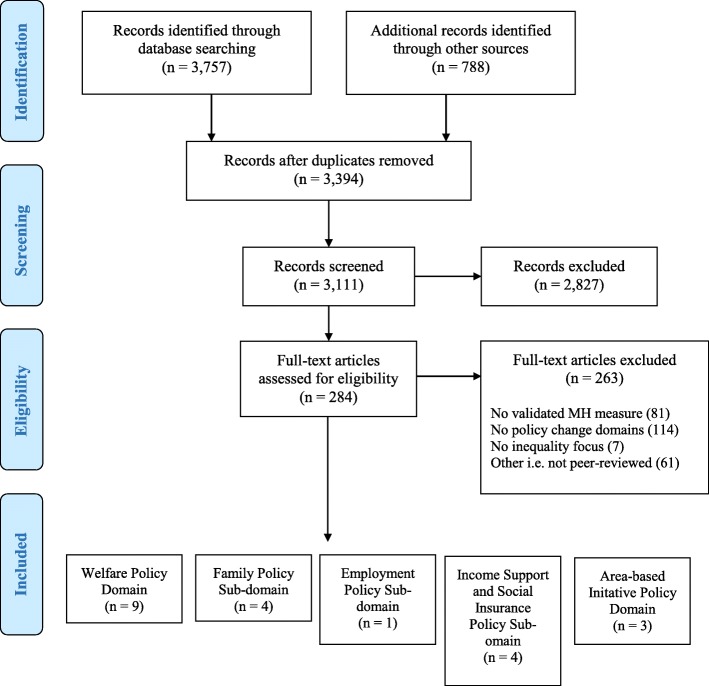
We conducted a systematic review of quantitative studies published between 1996 and 2017 based on search results from the following databases Medline, Embase, PsychInfo, Web of Science, Sociological Abstracts and Eric. Studies were included if they focused on inequalities (measured by socio-economic position and gender), structural determinants (i.e. public policies affecting the whole population) and showed a change or comparison in mental health status in one (or more) of the Organisation for Economic Cooperation and Development (OECD) countries. All studies were assessed for inclusion and study quality by two independent reviewers. Data were extracted and synthesised using narrative analysis.
Twenty-one articles (17 studies) met the inclusion criteria. Studies were heterogeneous with regards to methodology, mental health outcomes and policy settings. More comprehensive and gender inclusive welfare states (e.g. Nordic welfare states) had better mental health outcomes, especially for women, and less gender-related inequality. Nordic welfare regimes may also decrease inequalities between lone and couple mothers. A strong welfare state does not buffer against socio-economic inequalities in mental health outcomes. Austerity measures tended to worsen mental health and increase inequalities. Area-based initiatives and educational policy are understudied.
Although the literature on structural determinants and inequalities in mental health is limited, our review shows some evidence supporting the causal effects of structural determinants on mental health inequalities. The lack of evidence should not be interpreted as lack of effect. Future studies should apply innovative methods to overcome the inherent methodological challenges in this area, as structural determinants potentially affect both levels of mental health and social inequalities.
在欧洲和其他地区,人们对健康不平等和心理健康问题的普遍增加感到担忧。结构性决定因素,如福利国家的安排,可能会对心理健康水平和社会不平等产生影响。本系统评价旨在评估结构性决定因素与心理健康结果不平等之间是否存在关联的现有证据。
我们根据 Medline、Embase、PsychInfo、Web of Science、Sociological Abstracts 和 Eric 数据库的搜索结果,对 1996 年至 2017 年期间发表的定量研究进行了系统评价。如果研究关注不平等(通过社会经济地位和性别来衡量)、结构性决定因素(即影响整个人口的公共政策),并显示出经合组织(OECD)国家之一(或多个)的心理健康状况发生了变化或比较,则纳入研究。两名独立评审员对所有研究进行了纳入和研究质量评估。使用叙述性分析提取和综合数据。
21 篇文章(17 项研究)符合纳入标准。这些研究在方法学、心理健康结果和政策背景方面存在差异。更全面和性别包容的福利国家(如北欧福利国家)具有更好的心理健康结果,尤其是对女性而言,且性别不平等程度较低。北欧福利制度也可能减少单身母亲和夫妻母亲之间的不平等。强大的福利国家并不能缓冲社会经济不平等对心理健康结果的影响。紧缩措施往往会恶化心理健康状况并加剧不平等。基于区域的倡议和教育政策的研究相对较少。
尽管关于结构性决定因素和心理健康不平等的文献有限,但我们的综述表明,有一些证据支持结构性决定因素对心理健康不平等的因果影响。缺乏证据不应被解释为缺乏影响。未来的研究应应用创新方法来克服该领域固有的方法学挑战,因为结构性决定因素可能会同时影响心理健康水平和社会不平等。