Plastic Surgery Service, Hospital Universitario Central de Asturias (HUCA), Oviedo, Asturias, Spain.
Infectious Diseases Unit, Hospital de Galdácano, Galdacano, Vizcaya, Spain.
BMC Infect Dis. 2018 Dec 7;18(1):635. doi: 10.1186/s12879-018-3550-6.
Osteomyelitis is a difficult-to-cure infection with a high relapse rate despite combined medical and surgical therapies. Some severity factors, duration of antimicrobial therapy and type of surgical procedure might influence osteomyelitis relapse.
116 patients with osteomyelitis were followed for ≥1 year after hospital discharge. Demographic, microbiological and clinical data, eight severity factors and treatment (surgical and antibiotic) were analyzed.
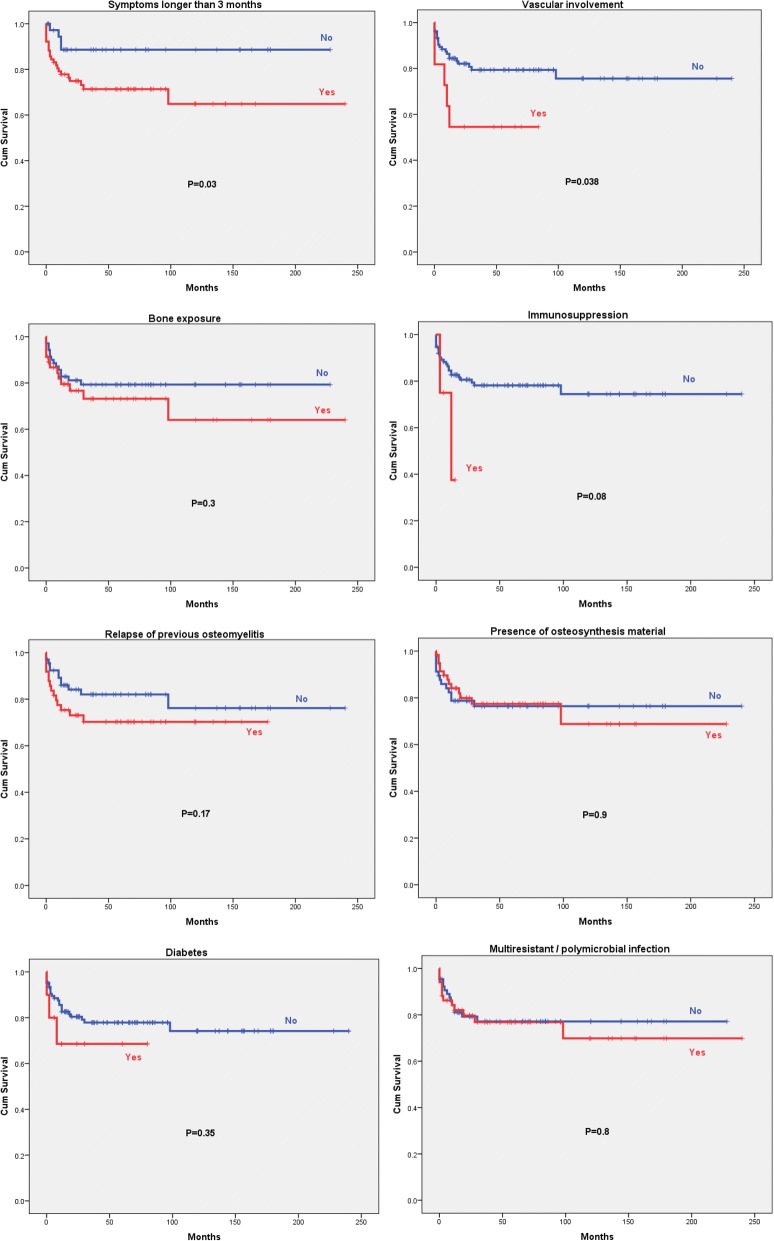
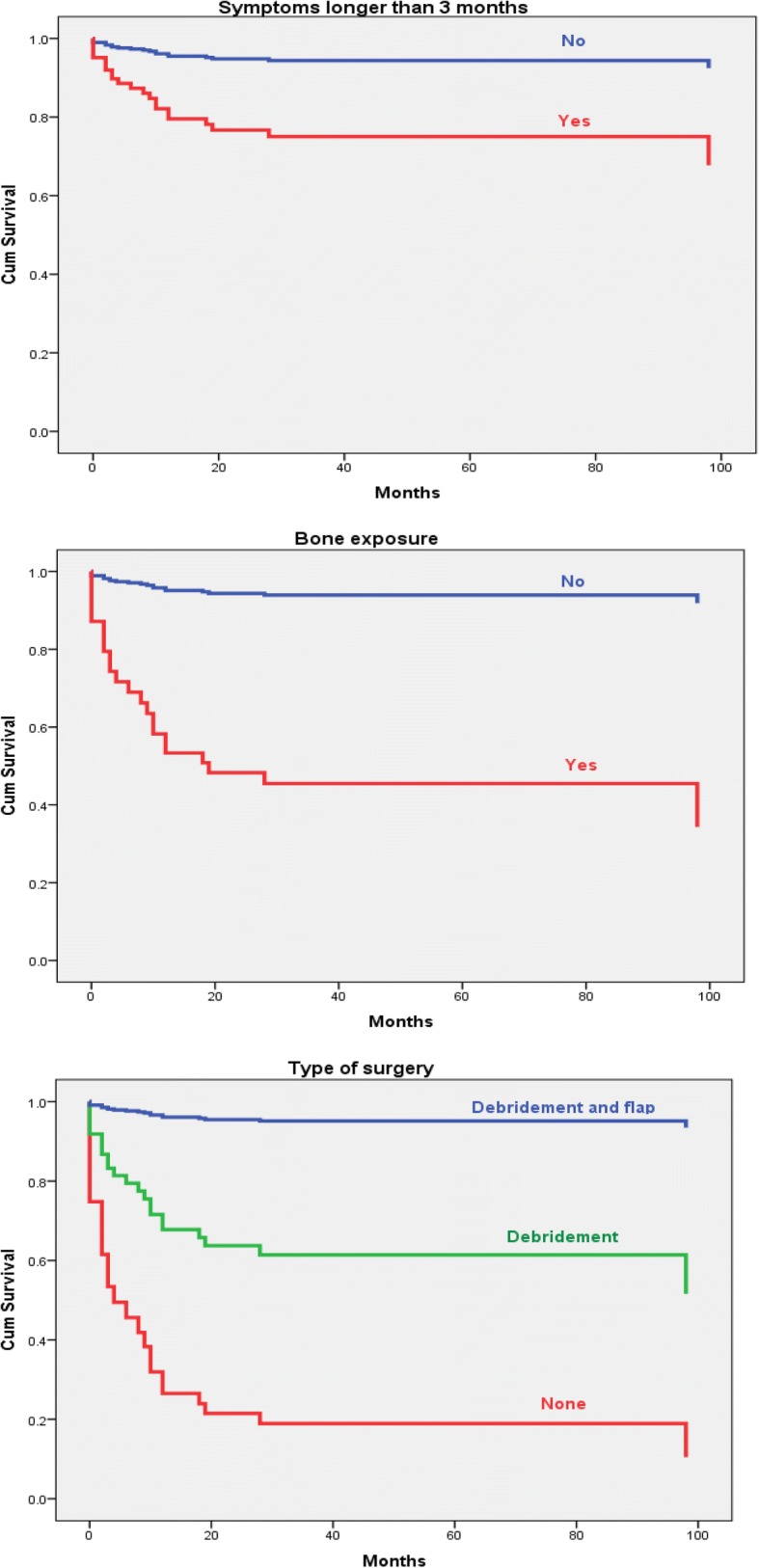
Mean age was 53 years and 74.1% were men. Tibia (62.1%) and S. aureus (58.5%) were the most commonly involved bone and bacteria, respectively. Mean follow-up was 67.1 months. Forty-six patients underwent bone debridement, 61 debridement plus flap coverage and 9 antimicrobial therapy only. Twenty-six patients (22.4%) relapsed, at a mean of 11.2 months since hospital discharge. Duration > 3 months (p = 0.025), number of severity factors (P = 0.02) and absence of surgery (P = 0.004) were associated with osteomyelitis relapse in the univariate analysis. In the Cox regression analysis, osteomyelitis duration > 3 months (P = 0.012), bone exposure (P = 0.0003) and type of surgery (P < 0.0001) were associated with relapse. Regarding the surgical modalities, bone debridement with muscle flap was associated with better osteomyelitis outcomes, as compared with no surgery (P < 0.0001) and debridement only (P = 0.004).
Osteomyelitis extending for > 3 months, bone exposure and treatment other than surgical debridement with muscular flap are risk factors for osteomyelitis relapse.
骨髓炎是一种难以治愈的感染,尽管采用了联合药物和手术治疗,但复发率仍然很高。一些严重程度因素、抗生素治疗持续时间和手术类型可能会影响骨髓炎的复发。
对 116 例骨髓炎患者进行了随访,随访时间在出院后至少 1 年。分析了患者的人口统计学、微生物学和临床资料、8 个严重程度因素和治疗(手术和抗生素)。
患者的平均年龄为 53 岁,74.1%为男性。最常受累的骨骼分别为胫骨(62.1%)和金黄色葡萄球菌(58.5%)。平均随访时间为 67.1 个月。46 例患者行骨清创术,61 例患者行清创术加皮瓣覆盖术,9 例患者仅行抗菌治疗。26 例(22.4%)患者复发,平均在出院后 11.2 个月时复发。单因素分析显示,治疗持续时间>3 个月(P=0.025)、严重程度因素个数(P=0.02)和未行手术(P=0.004)与骨髓炎复发相关。在 Cox 回归分析中,骨髓炎持续时间>3 个月(P=0.012)、骨暴露(P=0.0003)和手术类型(P<0.0001)与复发相关。关于手术方式,与未行手术(P<0.0001)和仅行清创术(P=0.004)相比,骨清创术加肌瓣更有利于骨髓炎的转归。
骨髓炎持续时间>3 个月、骨暴露以及除手术清创术加肌瓣以外的治疗方法是骨髓炎复发的危险因素。