Centre for Public Health Data Science, Institute of Health Informatics, University College London, London, UK.
Institute of Infection and Immunity, St George's, University of London, London, UK; International Health Unit, Section of Infectious Diseases, Imperial College London, London, UK.
Lancet. 2018 Dec 15;392(10164):2553-2566. doi: 10.1016/S0140-6736(18)32781-8. Epub 2018 Dec 5.
258 million people reside outside their country of birth; however, to date no global systematic reviews or meta-analyses of mortality data for these international migrants have been done. We aimed to review and synthesise available mortality data on international migrants.
In this systematic review and meta-analysis, we searched MEDLINE, Embase, the Cochrane Library, and Google Scholar databases for observational studies, systematic reviews, and randomised controlled trials published between Jan 1, 2001, and March 31, 2017, without language restrictions. We included studies reporting mortality outcomes for international migrants of any age residing outside their country of birth. Studies that recruited participants exclusively from intensive care or high dependency hospital units, with an existing health condition or status, or a particular health exposure were excluded. We also excluded studies limited to maternal or perinatal outcomes. We screened studies using systematic review software and extracted data from published reports. The main outcomes were all-cause and International Classification of Diseases, tenth revision (ICD-10) cause-specific standardised mortality ratios (SMRs) and absolute mortality rates. We calculated summary estimates using random-effects models. This study is registered with PROSPERO, number CRD42017073608.
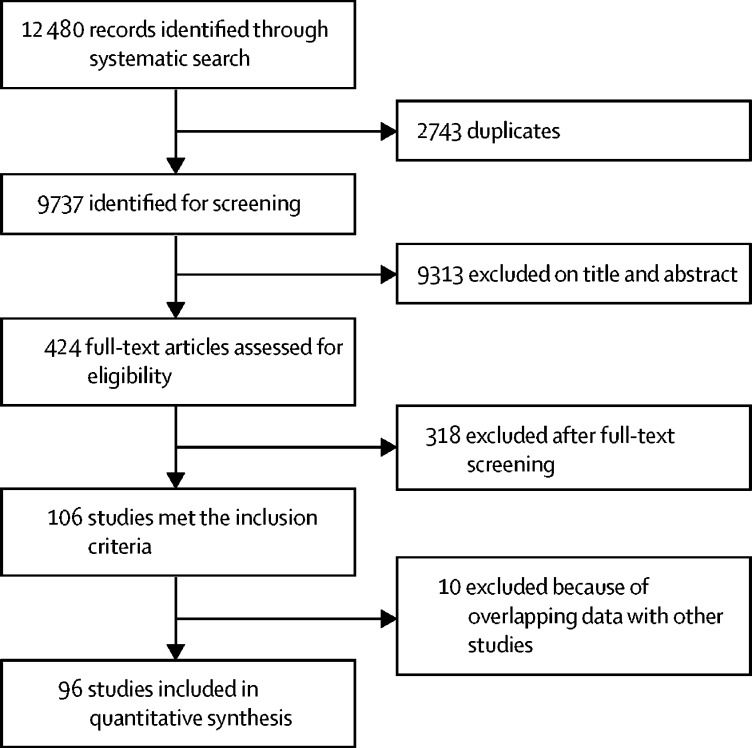
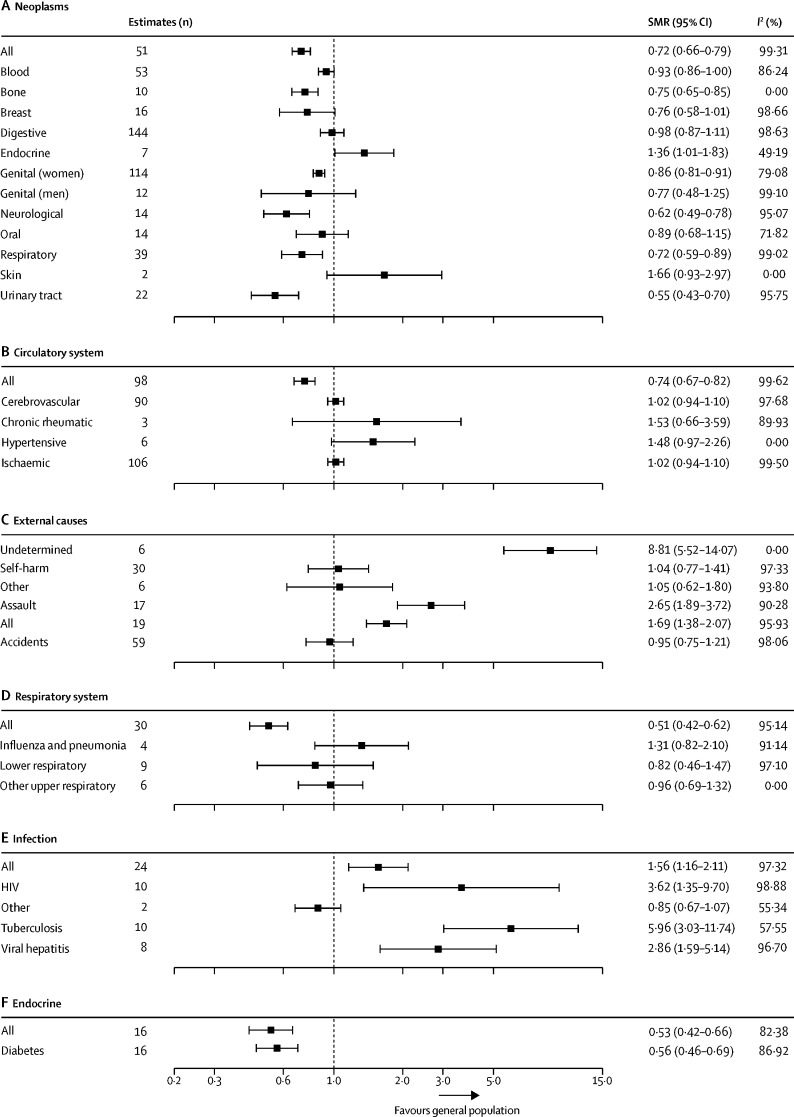
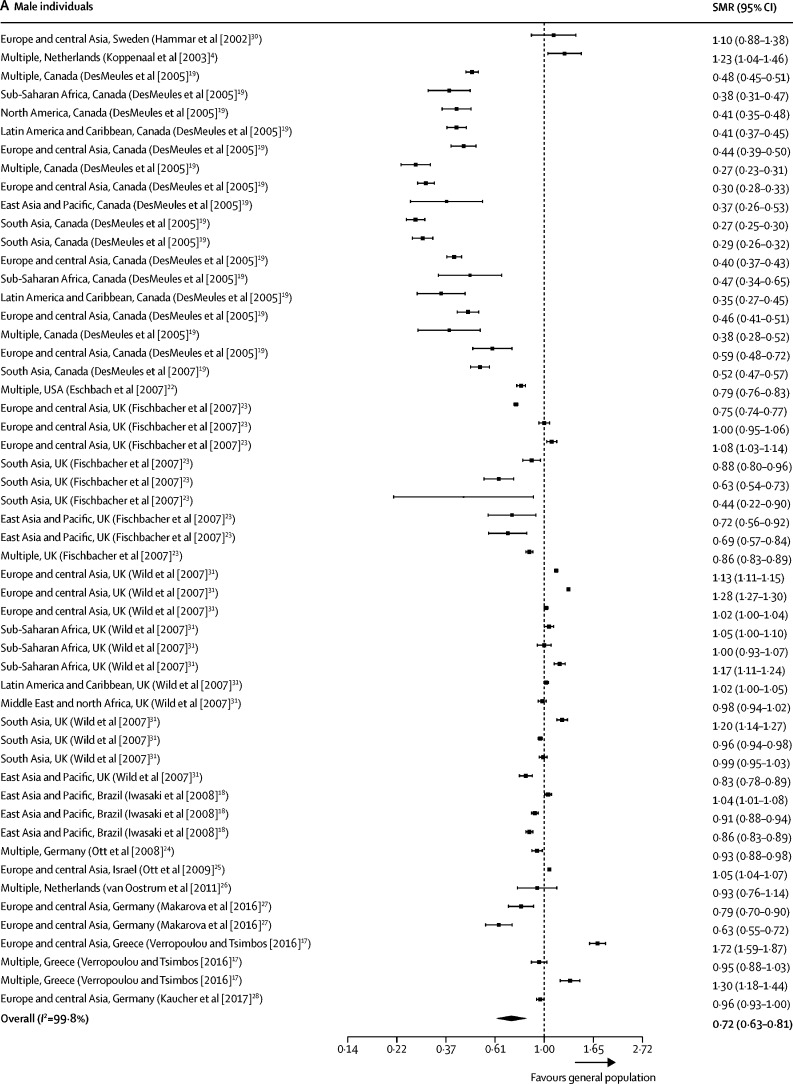
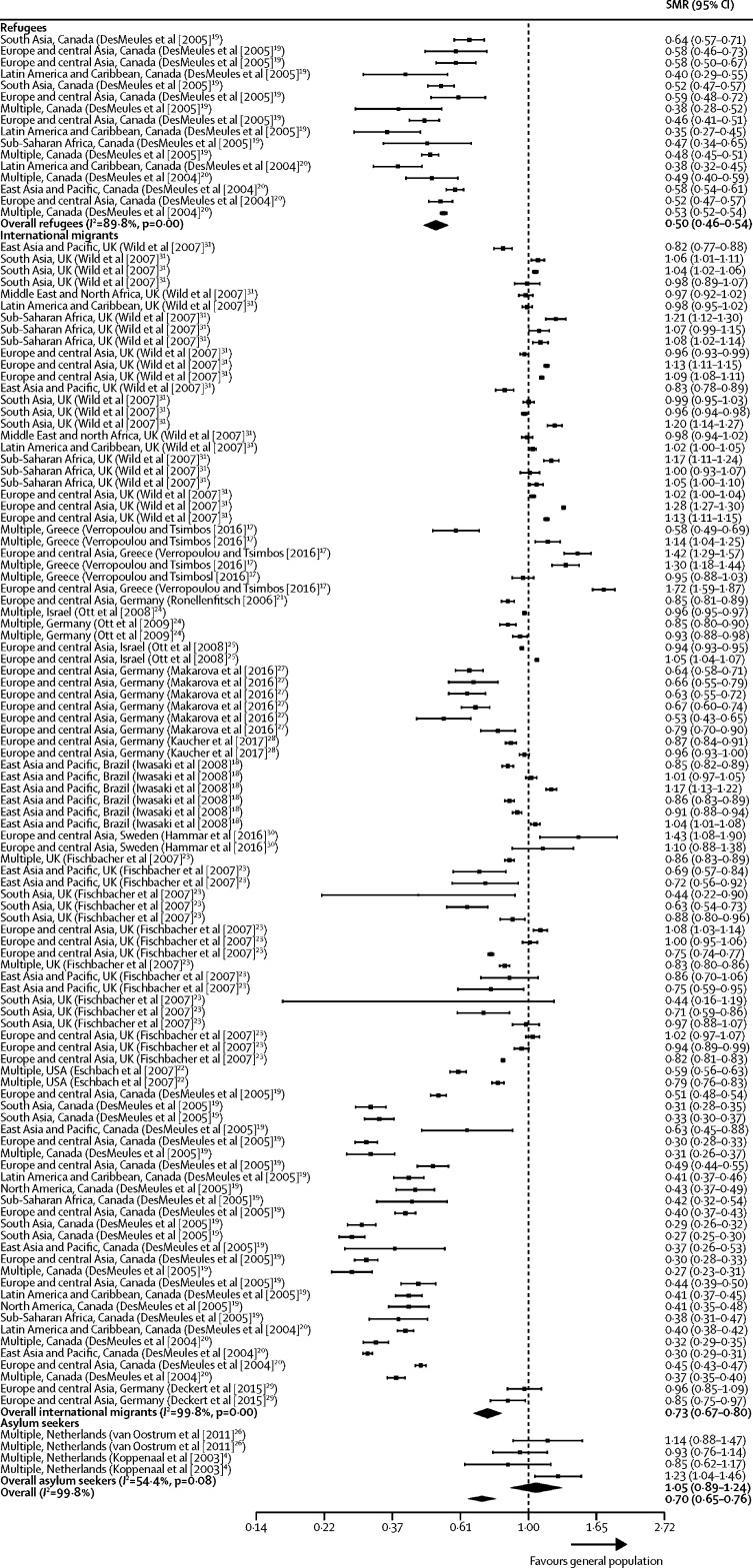
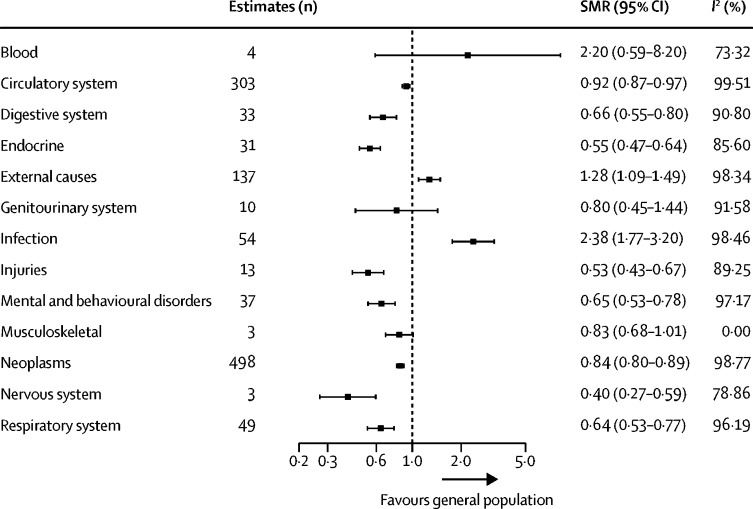
Of the 12 480 articles identified by our search, 96 studies were eligible for inclusion. The studies were geographically diverse and included data from all global regions and for 92 countries. 5464 mortality estimates for more than 15·2 million migrants were included, of which 5327 (97%) were from high-income countries, 115 (2%) were from middle-income countries, and 22 (<1%) were from low-income countries. Few studies included mortality estimates for refugees (110 estimates), asylum seekers (144 estimates), or labour migrants (six estimates). The summary estimate of all-cause SMR for international migrants was lower than one when compared with the general population in destination countries (0·70 [95% CI 0·65-0·76]; I=99·8%). All-cause SMR was lower in both male migrants (0·72 [0·63-0·81]; I=99·8%) and female migrants (0·75 [0·67-0·84]; I=99·8%) compared with the general population. A mortality advantage was evident for refugees (SMR 0·50 [0·46-0·54]; I=89·8%), but not for asylum seekers (1·05 [0·89-1·24]; I=54·4%), although limited data was available on these groups. SMRs for all causes of death were lower in migrants compared with the general populations in the destination country across all 13 ICD-10 categories analysed, with the exception of infectious diseases and external causes. Heterogeneity was high across the majority of analyses. Point estimates of all-cause age-standardised mortality in migrants ranged from 420 to 874 per 100 000 population.
Our study showed that international migrants have a mortality advantage compared with general populations, and that this advantage persisted across the majority of ICD-10 disease categories. The mortality advantage identified will be representative of international migrants in high-income countries who are studying, working, or have joined family members in these countries. However, our results might not reflect the health outcomes of more marginalised groups in low-income and middle-income countries because little data were available for these groups, highlighting an important gap in existing research. Our results present an opportunity to reframe the public discourse on international migration and health in high-income countries.
Wellcome Trust, National Institute for Health Research, Medical Research Council, Alliance for Health Policy and Systems Research, Department for International Development, Fogarty International Center, Grand Challenges Canada, International Development Research Centre Canada, Inter-American Institute for Global Change Research, National Cancer Institute, National Heart, Lung and Blood Institute, National Institute of Mental Health, Swiss National Science Foundation, World Diabetes Foundation, UK National Institute for Health Research Imperial Biomedical Research Centre, Imperial College Healthcare Charity, and European Society for Clinical Microbiology and Infectious Diseases (ESCMID) Study Group Research Funding for the ESCMID Study Group for Infections in Travellers and Migrants.
目前有 2.58 亿人居住在出生地以外的国家/地区;然而,迄今为止,尚无针对这些国际移民的死亡率数据的全球系统评价或荟萃分析。我们旨在对国际移民的死亡率数据进行审查和综合。
在这项系统评价和荟萃分析中,我们在 2001 年 1 月 1 日至 2017 年 3 月 31 日期间,无语言限制地在 MEDLINE、Embase、Cochrane 图书馆和 Google Scholar 数据库中搜索了观察性研究、系统评价和随机对照试验。我们纳入了报告国际移民死亡率结果的研究,无论其年龄大小,只要他们居住在出生地以外的国家/地区。排除仅从重症监护或高度依赖病房单位招募参与者、存在现有健康状况或状态或特定健康暴露的研究。我们还排除了仅限于产妇或围产期结果的研究。我们使用系统评价软件筛选研究并从已发表的报告中提取数据。主要结局是全因和国际疾病分类,第十版(ICD-10)病因特异性标准化死亡率比(SMR)和绝对死亡率。我们使用随机效应模型计算汇总估计值。这项研究在 PROSPERO 注册,编号为 CRD42017073608。
我们的搜索共确定了 12480 篇文章,其中 96 项研究符合纳入标准。这些研究在地理上分布广泛,包括来自所有全球区域和 92 个国家的数据。纳入了超过 1520 万移民的 5464 项死亡率估计值,其中 5327 项(97%)来自高收入国家,115 项(2%)来自中等收入国家,22 项(<1%)来自低收入国家。很少有研究包括难民(110 项估计值)、寻求庇护者(144 项估计值)或劳务移民(6 项估计值)的死亡率估计值。与目的地国的一般人群相比,国际移民的全因 SMR 汇总估计值低于 1(0.70 [95%CI 0.65-0.76];I=99.8%)。男性移民(0.72 [0.63-0.81];I=99.8%)和女性移民(0.75 [0.67-0.84];I=99.8%)的全因 SMR 均低于一般人群。难民的死亡率优势明显(SMR 0.50 [0.46-0.54];I=89.8%),但寻求庇护者的死亡率优势并不明显(1.05 [0.89-1.24];I=54.4%),尽管关于这些群体的数据有限。在所有分析的 13 个 ICD-10 死亡原因类别中,与目的地国的一般人群相比,移民的所有原因死亡率 SMR 均较低,除传染病和外部原因外。大多数分析的异质性都很高。移民全因年龄标准化死亡率的点估计值范围为每 10 万人 420 至 874 人。
我们的研究表明,与一般人群相比,国际移民的死亡率具有优势,而且这种优势在大多数 ICD-10 疾病类别中都存在。确定的死亡率优势将代表在高收入国家学习、工作或加入这些国家家庭成员的国际移民。然而,由于有关这些群体的数据很少,我们的结果可能无法反映低收入和中等收入国家中更边缘化群体的健康结果,这突显了现有研究中的一个重要差距。我们的研究结果为重新构建高收入国家对国际移民和健康的公共话语提供了机会。
韦尔科姆信托基金会、国家卫生研究院、医学研究理事会、卫生政策和系统研究联盟、国际发展部、福格蒂国际中心、大挑战加拿大、国际发展研究中心、泛美全球变化研究协会、美国国立癌症研究所、美国国家心肺血液研究所、美国国家心理健康研究所、瑞士国家科学基金会、世界糖尿病基金会、英国国家卫生研究院帝国生物医学研究中心、帝国学院医疗慈善机构和欧洲临床微生物学和传染病学会(ESCMID)研究组 为 ESCMID 研究组的旅行和移民感染者研究提供资金。