Department of Systems BioMedicine, Graduate School of Medical and Dental Sciences.
Department of Respiratory Medicine, Graduate School of Medical and Dental Sciences, and.
Blood Adv. 2018 Dec 11;2(23):3483-3491. doi: 10.1182/bloodadvances.2018017954.
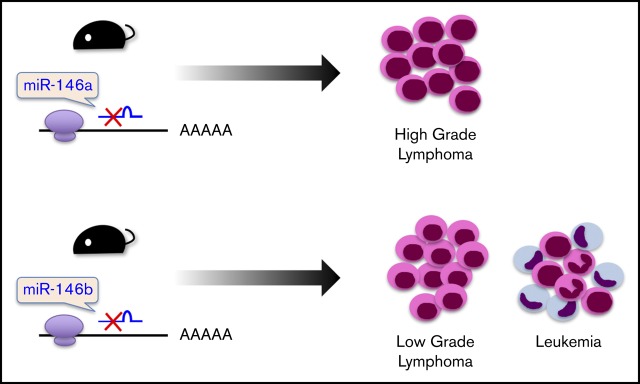
Excessive and constitutive activation of nuclear factor-κB (NF-κB) leads to abnormal cell proliferation and differentiation, leading to the development of malignant tumors, including lymphoma. MicroRNA 146a (miR-146a) and miR-146b, both of which carry an identical seed sequence, have been shown to contribute to inflammatory diseases and tumors by suppressing the expression of key molecules required for NF-κB activation. However, the functional and physiological differences between miR-146a and miR-146b in disease onset have not been fully elucidated. In this study, we generated miR-146b-knockout (KO) and miR-146a-KO mice by genome editing and found that both strains developed hematopoietic malignancies such as B-cell lymphoma and acute myeloid leukemia during aging. However, the B-cell lymphomas observed in miR-146a- and miR-146b-KO mice were histologically different in their morphology, and the malignancy rate is lower in miR-146b mice than miR-146a mice. Upon mitogenic stimulation, the expression of miR-146a and miR-146b was increased, but miR-146b expression was lower than that of miR-146a. Using a previously developed screening system for microRNA targets, we observed that miR-146a and miR-146b could target the same mRNAs, including , and inhibit subsequent NF-κB activity. Consistent with these findings, both miR-146a- and miR-146b-KO B cells showed a high proliferative capacity. Taken together, sustained NF-κB activation in miR-146b KO mice could lead to the development of hematopoietic malignancy with aging.
核因子-κB(NF-κB)的过度和组成性激活导致异常的细胞增殖和分化,导致包括淋巴瘤在内的恶性肿瘤的发展。微小 RNA 146a(miR-146a)和 miR-146b 都携带有相同的种子序列,它们通过抑制 NF-κB 激活所需的关键分子的表达,有助于炎症性疾病和肿瘤的发生。然而,miR-146a 和 miR-146b 在疾病发病机制中的功能和生理差异尚未完全阐明。在这项研究中,我们通过基因组编辑生成了 miR-146b 敲除(KO)和 miR-146a-KO 小鼠,并发现这两种品系在衰老过程中都会发展出造血恶性肿瘤,如 B 细胞淋巴瘤和急性髓系白血病。然而,在 miR-146a 和 miR-146b-KO 小鼠中观察到的 B 细胞淋巴瘤在形态学上存在差异,miR-146b 小鼠的恶性程度低于 miR-146a 小鼠。在有丝分裂刺激下,miR-146a 和 miR-146b 的表达增加,但 miR-146b 的表达低于 miR-146a。使用先前开发的 microRNA 靶标筛选系统,我们观察到 miR-146a 和 miR-146b 可以靶向相同的 mRNAs,包括 IRAK1、 TRAF6 和 TNFRSF11A,并抑制随后的 NF-κB 活性。与这些发现一致,miR-146a 和 miR-146b-KO B 细胞均表现出高增殖能力。综上所述,miR-146b KO 小鼠中持续的 NF-κB 激活可能导致造血恶性肿瘤随年龄增长而发展。