Program in Physical Therapy (K.S.R., M.E.M., R.P.D., J.S.P., G.M.E.), Department of Neurology (M.E.M., R.P.D., J.S.P., G.M.E.), Department of Neuroscience (J.S.P., G.M.E.), Department of Radiology (J.S.P.), and Program in Occupational Therapy (J.S.P.), Washington University School of Medicine in Saint Louis, Missouri; and Department of Kinesiology and Occupational Therapy Program, University of Wisconsin-Madison (K.A.P.).
J Neurol Phys Ther. 2019 Jan;43(1):26-32. doi: 10.1097/NPT.0000000000000245.
Impaired gait, balance, and motor function are common in Parkinson disease (PD) and may lead to falls and injuries. Different forms of exercise improve motor function in persons with PD, but determining which form of exercise is most effective requires a direct comparison of various approaches. In this prospective, controlled trial, we evaluated the impact of tango, treadmill walking, and stretching on gait, balance, motor function, and quality of life. We hypothesized tango and treadmill would improve forward walking and motor symptom severity, and tango would also improve backward walking, balance, and quality of life.
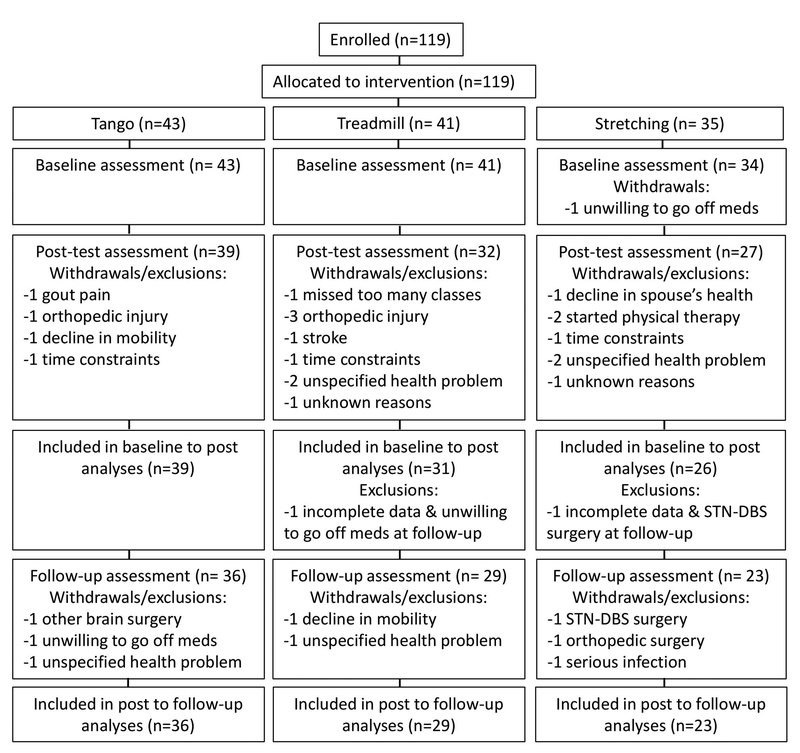
Ninety-six participants (age: 67.2 ± 8.9 years, 42% female) with mild to moderate idiopathic PD were serially assigned to tango, treadmill walking, or stretching (active control group) and attended 1-hour classes twice weekly for 12 weeks. Assessments occurred OFF anti-PD medication before and after the intervention and at follow-up 12 weeks after the intervention.
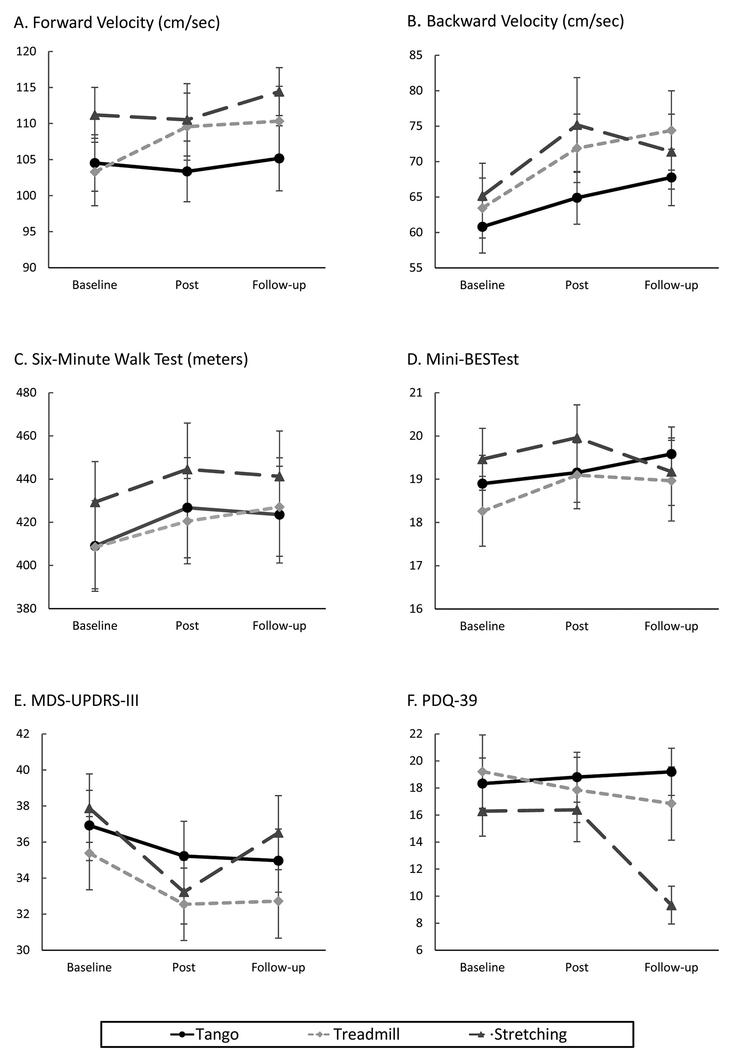
Forward velocity and backward velocity improved for the treadmill group from baseline to posttest and improvements persisted at follow-up. Backward velocity and motor functioning improved for the stretching group from baseline to posttest, but results did not persist at follow-up. There were no significant changes in the tango group across time points.
Contrary to our hypotheses, only treadmill improved forward walking, while backward walking improved with treadmill and stretching. Future research should examine combinations of exercises with a focus on optimizing dosing and examining whether specific characteristics of people with PD correlate with different types of exercise.Video Abstract available for more insights from the authors (see Video, Supplemental Digital Content 1, available at: http://links.lww.com/JNPT/A237).
步态、平衡和运动功能受损在帕金森病(PD)中很常见,可能导致跌倒和受伤。不同形式的运动可以改善 PD 患者的运动功能,但要确定哪种运动形式最有效,需要直接比较各种方法。在这项前瞻性、对照试验中,我们评估了探戈、跑步机行走和伸展运动对步态、平衡、运动功能和生活质量的影响。我们假设探戈和跑步机可以改善向前行走和运动症状严重程度,探戈还可以改善向后行走、平衡和生活质量。
96 名(年龄:67.2±8.9 岁,42%为女性)轻度至中度特发性 PD 患者被连续分配到探戈、跑步机行走或伸展运动(主动对照组),并每周参加 2 次、每次 1 小时的课程,共 12 周。评估在干预前和干预后停用抗 PD 药物时以及干预后 12 周的随访时进行。
从基线到后测,跑步机组的前进速度和后退速度都有所提高,且这些改善在随访时仍持续存在。从基线到后测,伸展组的后退速度和运动功能都有所改善,但随访时没有持续改善。探戈组在各时间点没有显著变化。
与我们的假设相反,只有跑步机改善了向前行走,而向后行走则通过跑步机和伸展运动得到改善。未来的研究应该检查多种运动的组合,重点优化剂量,并研究 PD 患者的特定特征是否与不同类型的运动相关。视频摘要可供作者提供更多见解(请观看视频,补充数字内容 1,可在以下网址获取:http://links.lww.com/JNPT/A237)。