Department of Chemistry, The University of Chicago, Chicago, IL, USA.
Grossman Institute of Neuroscience, Quantitative Biology and Human Behavior, The University of Chicago, Chicago, IL, USA.
Nat Chem Biol. 2019 Dec;15(12):1165-1172. doi: 10.1038/s41589-018-0176-3. Epub 2018 Dec 10.
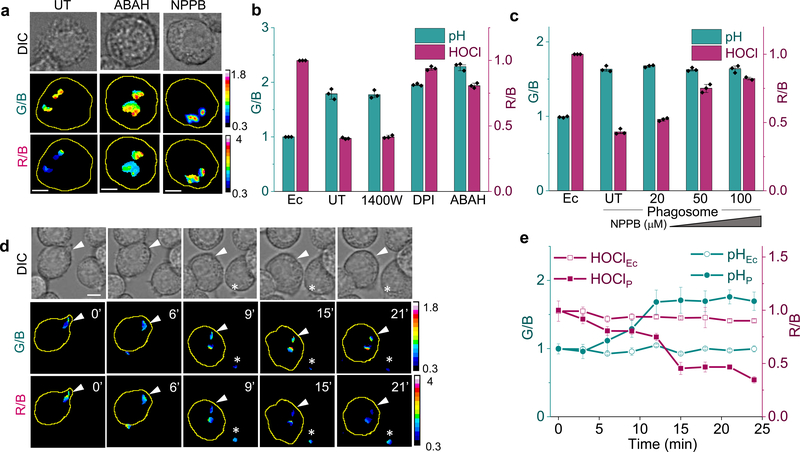
Phagocytes destroy pathogens by trapping them in a transient organelle called the phagosome, where they are bombarded with reactive oxygen species (ROS) and reactive nitrogen species (RNS). Imaging reactive species within the phagosome would directly reveal the chemical dynamics underlying pathogen destruction. Here we introduce a fluorescent, DNA-based combination reporter, cHOClate, which simultaneously images hypochlorous acid (HOCl) and pH quantitatively. Using cHOClate targeted to phagosomes in live cells, we successfully map phagosomal production of a specific ROS, HOCl, as a function of phagosome maturation. We found that phagosomal acidification was gradual in macrophages and upon completion, HOCl was released in a burst. This revealed that phagosome-lysosome fusion was essential not only for phagosome acidification, but also for providing the chloride necessary for myeloperoxidase activity. This method can be expanded to image several kinds of ROS and RNS and be readily applied to identify how resistant pathogens evade phagosomal killing.
吞噬细胞通过将病原体困在一个称为吞噬体的短暂细胞器中来破坏病原体,在那里它们会受到活性氧 (ROS) 和活性氮 (RNS) 的攻击。在吞噬体内对活性物质进行成像可以直接揭示病原体破坏的化学动力学。在这里,我们引入了一种荧光、基于 DNA 的组合报告器 cHOClate,它可以定量同时成像次氯酸 (HOCl) 和 pH 值。使用靶向活细胞中吞噬体的 cHOClate,我们成功地绘制了吞噬体产生特定 ROS(HOCl)的图谱,作为吞噬体成熟的函数。我们发现,巨噬细胞中的吞噬体酸化是逐渐进行的,酸化完成后,HOCl 会突然释放。这表明吞噬体-溶酶体融合不仅对于吞噬体酸化是必要的,而且对于提供髓过氧化物酶活性所需的氯也是必要的。该方法可以扩展到成像几种 ROS 和 RNS,并可用于识别具有抗药性的病原体如何逃避吞噬体杀伤。