Computational Earth Science (EES-16), Los Alamos National Laboratory, Los Alamos, New Mexico, United States of America.
Department of Computer Science and Electrical Engineering, University of Maryland, Baltimore County, Maryland, United States of America.
PLoS One. 2018 Dec 10;13(12):e0206653. doi: 10.1371/journal.pone.0206653. eCollection 2018.
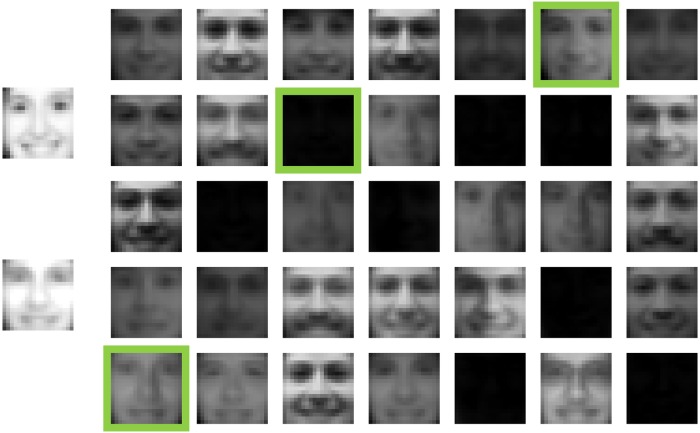
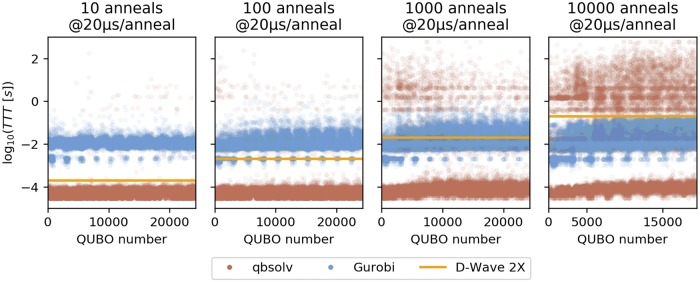
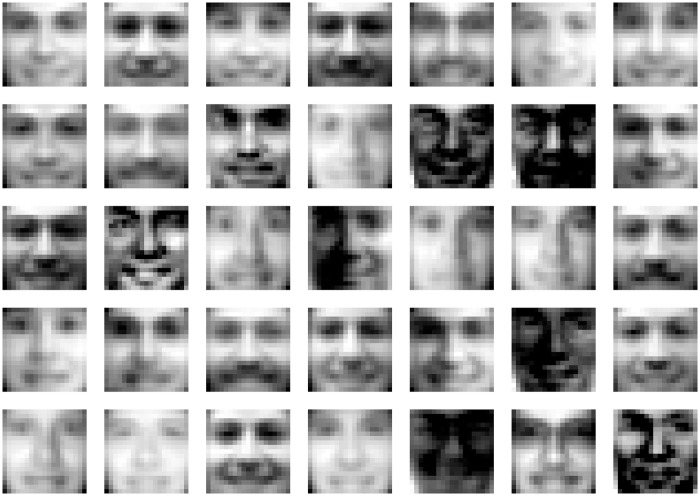
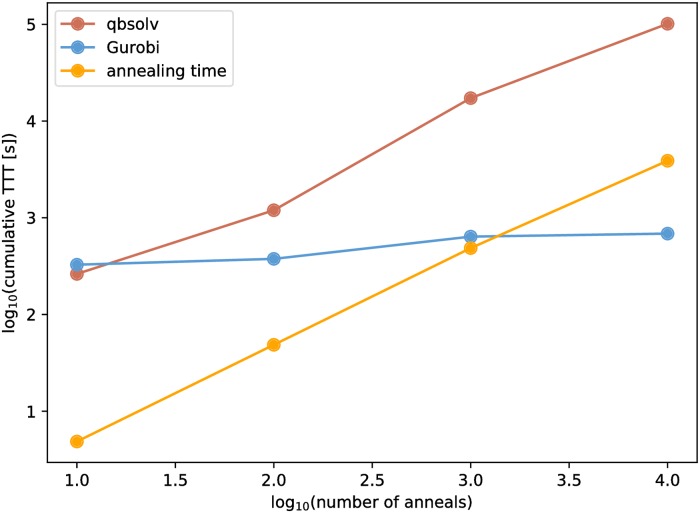
D-Wave quantum annealers represent a novel computational architecture and have attracted significant interest. Much of this interest has focused on the quantum behavior of D-Wave machines, and there have been few practical algorithms that use the D-Wave. Machine learning has been identified as an area where quantum annealing may be useful. Here, we show that the D-Wave 2X can be effectively used as part of an unsupervised machine learning method. This method takes a matrix as input and produces two low-rank matrices as output-one containing latent features in the data and another matrix describing how the features can be combined to approximately reproduce the input matrix. Despite the limited number of bits in the D-Wave hardware, this method is capable of handling a large input matrix. The D-Wave only limits the rank of the two output matrices. We apply this method to learn the features from a set of facial images and compare the performance of the D-Wave to two classical tools. This method is able to learn facial features and accurately reproduce the set of facial images. The performance of the D-Wave shows some promise, but has some limitations. It outperforms the two classical codes in a benchmark when only a short amount of computational time is allowed (200-20,000 microseconds), but these results suggest heuristics that would likely outperform the D-Wave in this benchmark.
D-Wave 量子退火器代表了一种新颖的计算架构,引起了广泛关注。人们的兴趣主要集中在 D-Wave 机器的量子行为上,而很少有实际的算法利用 D-Wave。机器学习已被确定为量子退火可能有用的领域之一。在这里,我们展示了 D-Wave 2X 可以有效地用作无监督机器学习方法的一部分。该方法将矩阵作为输入,并产生两个低秩矩阵作为输出——一个包含数据中的潜在特征,另一个矩阵描述如何组合特征以近似再现输入矩阵。尽管 D-Wave 硬件中的位数有限,但该方法能够处理大型输入矩阵。D-Wave 仅限制两个输出矩阵的秩。我们将此方法应用于从一组面部图像中学习特征,并将 D-Wave 的性能与两个经典工具进行比较。该方法能够学习面部特征并准确再现面部图像集。D-Wave 的性能显示出一些希望,但存在一些限制。当只允许较短的计算时间(200-20,000 微秒)时,它在基准测试中优于两个经典代码,但这些结果表明,在该基准测试中,启发式方法可能会优于 D-Wave。