Ryu Seung Min, Park Sam-Guk, Kim Ji-Hoon, Yang Han Seok, Na Ho Dong, Seo Jae-Sung
Department of Orthopedic Surgery, Yeungnam University Medical Center, Daegu, Korea.
Department of Orthopedic Surgery, W Hospital, Daegu, Korea.
Indian J Orthop. 2018 Nov-Dec;52(6):590-595. doi: 10.4103/ortho.IJOrtho_537_16.
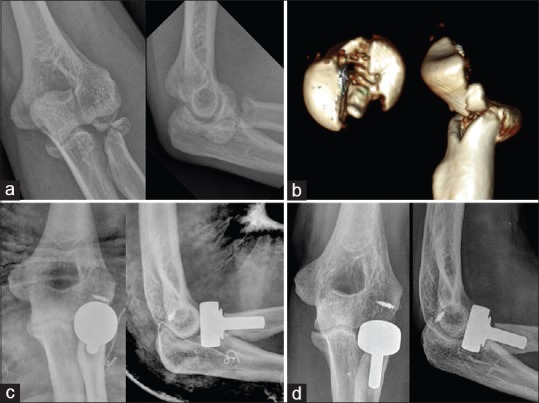
The treatment of modified Mason Type III or IV fractures is controversial. Many authors report open reduction and internal fixation (ORIF) with reconstruction of the radial head, but others advocate radial head arthroplasty (RHA). This study compares the clinical and radiological outcomes of ORIF and RHA in modified Mason Type III or IV radial head fracture and evaluates correlations between prognostic factors and postoperative clinical outcomes.
42 patients with modified Mason Type III or IV radial head fractures who were surgically treated between January 2010 and January 2014 were retrospectively analyzed (20 patients with RHA and 22 patients with ORIF group were selected). Clinically, the patient rated elbow evaluation (PREE), the disabilities of the arm, shoulder and hand (DASH), and the range of motion (ROM) were measured. Radiologically, plain radiographs and computed tomography scans were taken.
The mean PREE scores were 13.9 for the RHA group and 13.0 for the ORIF group, and mean DASH scores were 9.5 and 10.7, respectively. The differences were not statistically significant. When comparing ROM, the patients in the RHA group showed greater movement at all measured angles. In multiple regression analysis, age was the only variable significantly associated with both PREE and DASH.
Overall, there were no significant differences in clinical outcomes of modified Mason Type III or IV radial head fractures treated with ORIF or RHA. However, a subgroup of younger patients had better clinical outcomes with ORIF treatment. Therefore, ORIF should be the First line of treatment, particularly if the reduction is possible.
改良梅森III型或IV型骨折的治疗存在争议。许多作者报告采用切开复位内固定术(ORIF)并重建桡骨头,但也有其他作者主张进行桡骨头置换术(RHA)。本研究比较了ORIF和RHA治疗改良梅森III型或IV型桡骨头骨折的临床和影像学结果,并评估预后因素与术后临床结果之间的相关性。
回顾性分析2010年1月至2014年1月期间接受手术治疗的42例改良梅森III型或IV型桡骨头骨折患者(选择20例接受RHA治疗的患者和22例接受ORIF治疗的患者)。临床上,测量患者的肘部评估评分(PREE)、上肢、肩部和手部功能障碍评分(DASH)以及活动范围(ROM)。影像学上,拍摄X线平片和计算机断层扫描。
RHA组的平均PREE评分为13.9,ORIF组为13.0,平均DASH评分分别为9.5和10.7。差异无统计学意义。比较ROM时,RHA组患者在所有测量角度的活动度更大。在多元回归分析中,年龄是唯一与PREE和DASH均显著相关的变量。
总体而言,采用ORIF或RHA治疗改良梅森III型或IV型桡骨头骨折的临床结果无显著差异。然而,一组年轻患者接受ORIF治疗的临床结果更好。因此,ORIF应作为首选治疗方法,尤其是在有可能进行复位的情况下。