Huang Haohai, Liao Dan, Pu Rong, Cui Yejia
Department of Clinical Pharmacy, Dongguan Third People's Hospital, Affiliated Dongguan Shilong People's Hospital of Southern Medical University, Dongguan, Guangdong, China,
Department of Gynaecology, Dongguan Third People's Hospital, Affiliated Dongguan Shilong People's Hospital of Southern Medical University, Dongguan, Guangdong, China.
Diabetes Metab Syndr Obes. 2018 Nov 14;11:729-742. doi: 10.2147/DMSO.S185672. eCollection 2018.
Spirulina is generally used as a nutraceutical food supplement due to its nutrient profile, lack of toxicity, and therapeutic effects. Clinical trials have investigated the influence of spirulina on metabolic-related risk factors but have yielded conflicting results in humans. Here, we summarize the evidence of the effects of spirulina on serum lipid profile, glucose management, BP, and body weight by conducting a meta-analysis.
Relevant studies were retrieved by systematic search of MEDLINE, EMBASE, Scopus databases, and reference lists of relevant original studies from inception to July 2018. Data were extracted following a standardized protocol. Two investigators independently extracted study characteristics, outcomes measures, and appraised methodological quality. Effect sizes were performed using a random-effects model, with weighted mean differences (WMDs) and 95% CIs between the means for the spirulina intervention and control arms. Subgroup analyses were conducted to explore the possible influences of study characteristics. Publication bias and sensitivity analysis were also performed.
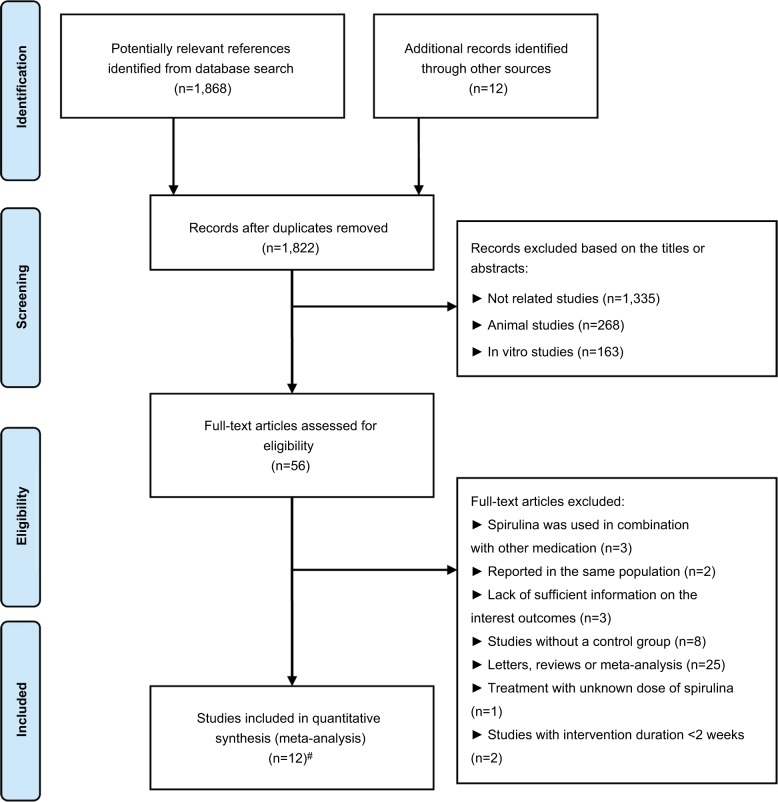
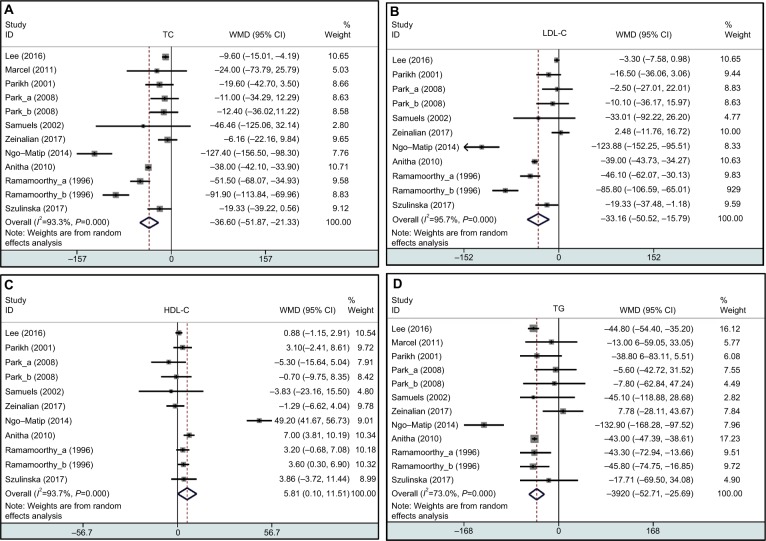
A total of 1,868 records were identified of which 12 trials with 14 arms were eligible. The amount of spirulina ranged from 1 to 19 g/d, and intervention durations ranged from 2 to 48 weeks. Overall, data synthesis showed that spirulina supplements significantly lowered total cholesterol (WMD = -36.60 mg/dL; 95% CI: -51.87 to -21.33; =0.0001), low-density lipoprotein cholesterol (WMD = -33.16 mg/dL; 95% CI: -50.52 to -15.75; =0.0002), triglycerides (WMD = -39.20 mg/dL; 95% CI: -52.71 to -25.69; =0.0001), very-low-density lipoprotein cholesterol (WMD = -8.02 mg/dL; 95% CI: -8.77 to -7.26; =0.0001), fasting blood glucose (WMD = -5.01 mg/dL; 95% CI: -9.78 to -0.24; =0.04), and DBP (WMD = -7.17 mmHg; 95% CI: -8.57 to -5.78; =0.001). These findings remained stable in the sensitivity analysis, and no obvious publication bias was detected.
Our findings provide substantial evidence that spirulina supplementation has favorable effect on select cardiovascular and metabolic biomarkers in humans, including lipid, glucose, and DBP management.
螺旋藻因其营养成分、无毒性及治疗作用,通常被用作营养食品补充剂。临床试验已对螺旋藻对代谢相关危险因素的影响进行了研究,但在人体试验中得出了相互矛盾的结果。在此,我们通过进行一项荟萃分析,总结螺旋藻对血清脂质谱、血糖管理、血压和体重影响的证据。
通过系统检索MEDLINE、EMBASE、Scopus数据库以及相关原始研究从创刊至2018年7月的参考文献列表,检索相关研究。按照标准化方案提取数据。两名研究人员独立提取研究特征、结局指标并评估方法学质量。使用随机效应模型计算效应量,得出螺旋藻干预组与对照组均值之间的加权平均差(WMDs)及95%置信区间(CIs)。进行亚组分析以探讨研究特征可能产生的影响。还进行了发表偏倚分析和敏感性分析。
共识别出1868条记录,其中12项试验(14个研究组)符合条件。螺旋藻的用量为1至19克/天,干预持续时间为2至48周。总体而言,数据综合分析表明,补充螺旋藻可显著降低总胆固醇(WMD = -36.60毫克/分升;95% CI:-51.87至-21.33;P = 0.0001)、低密度脂蛋白胆固醇(WMD = -33.16毫克/分升;95% CI:-50.52至-15.75;P = 0.0002)、甘油三酯(WMD = -39.20毫克/分升;95% CI:-52.71至-25.69;P = 0.0001)、极低密度脂蛋白胆固醇(WMD = -8.02毫克/分升;95% CI:-8.77至-7.26;P = 0.0001)、空腹血糖(WMD = -5.01毫克/分升;95% CI:-9.78至-0.24;P = 0.04)和舒张压(WMD = -7.17毫米汞柱;95% CI:-8.57至-5.78;P = 0.001)。这些结果在敏感性分析中保持稳定,未检测到明显的发表偏倚。
我们的研究结果提供了充分证据,表明补充螺旋藻对人体某些心血管和代谢生物标志物具有有益影响,包括脂质、血糖和舒张压管理。