Department of Orthopedics and Trauma Surgery, Medical University of Vienna, Austria.
Department of Anesthesiology, General Intensive Care and Pain Management, Medical University of Vienna, Austria.
Biomed Res Int. 2018 Nov 6;2018:2687584. doi: 10.1155/2018/2687584. eCollection 2018.
The incidence of acute kidney injury (AKI) considerably increases the mortality rate in polytrauma victims. Undoubtedly, early identification of patients at risk is crucial for timely implementation of preventive strategies in order to improve their prognosis. Therefore, we aimed to investigate if serum neutrophil gelatinase-associated lipocalin (sNGAL) may serve as a diagnostic biomarker of early AKI in polytrauma victims, especially considering patients needing renal replacement theory (RRT).
Forty consecutive polytrauma victims (ISS ≥ 16, AIS ≥ 1, age ≥ 18 years, survival time ≥ 48 hours), directly admitted to our level I trauma center within one posttraumatic hour, were enrolled in our prospective study. sNGAL-levels were assessed at admission (initial) and on day 2 after trauma. AKI was diagnosed by an increase of serum creatinine (sCr) level of at least 0.3 mg/dl within 48 hours.
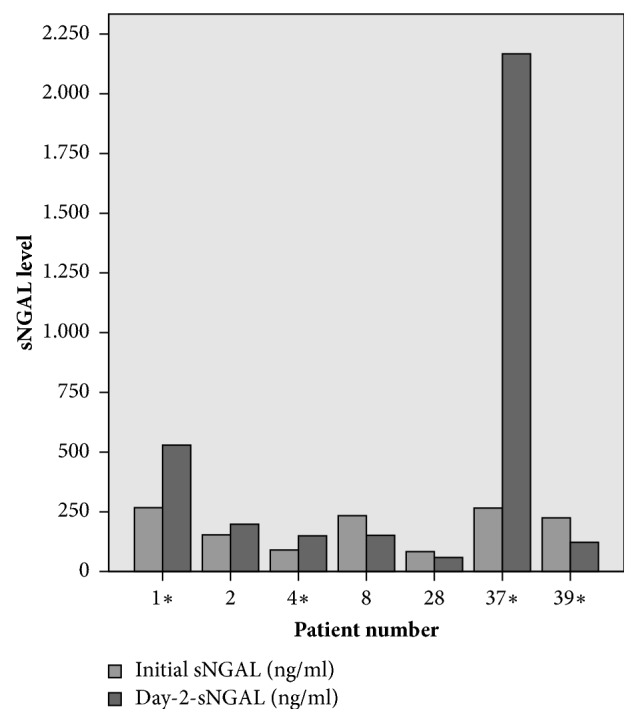
Out of 30 men and 10 women (mean age, 43 years; mean ISS, 29), seven patients developed AKI, four of them needing RRT. AKI was diagnosed in 86% of the affected individuals until day 2. Day2-sNGAL-levels were higher in the AKI-group, compared to the no-AKI-group (p=0.049), and in patients treated with RRT than in individuals not needing RRT (p=0.037). Noteworthy, in patients not needing RRT sNGAL-levels significantly decreased from initial to day2-measurement (p=0.040). Furthermore, at any time point during our observation period polytraumatized patients with AKI and day2-sNGAL-levels of at least 181.0 ng/mL presented with higher sCr-levels compared to polytraumatized patients without AKI and day2-sNGAL-levels lower than 181.0 ng/mL (p≤0.029).
In polytrauma victims suffering AKI an increase in sNGAL-level from initial to day2-assessment may signalize deterioration in kidney function and thus indicate AKI progression. Unlike initial sNGAL-levels day2-sNGAL-levels might be an appropriate tool to define AKI and to signify the need of RRT in polytraumatized patients.
急性肾损伤 (AKI) 的发生率大大增加了多发伤患者的死亡率。毫无疑问,早期识别高危患者对于及时实施预防策略至关重要,以改善其预后。因此,我们旨在研究血清中性粒细胞明胶酶相关脂质运载蛋白 (sNGAL) 是否可作为多发伤患者早期 AKI 的诊断生物标志物,特别是考虑需要肾脏替代治疗 (RRT) 的患者。
连续纳入 40 例多发伤患者(ISS≥16,AIS≥1,年龄≥18 岁,生存时间≥48 小时),于创伤后 1 小时内直接收入我院 I 级创伤中心。在入院时(初始)和创伤后第 2 天评估 sNGAL 水平。AKI 的诊断标准为 48 小时内血清肌酐 (sCr) 水平至少升高 0.3mg/dl。
30 名男性和 10 名女性(平均年龄 43 岁;平均 ISS 29)中,有 7 名患者发生 AKI,其中 4 名需要 RRT。AKI 在发病后 2 天内诊断出 86%的患者。与无 AKI 组相比,AKI 组第 2 天 sNGAL 水平较高(p=0.049),与不需要 RRT 的患者相比,需要 RRT 的患者 sNGAL 水平较高(p=0.037)。值得注意的是,在不需要 RRT 的患者中,sNGAL 水平从初始值到第 2 天测量值显著降低(p=0.040)。此外,在我们的观察期内,任何时间点患有 AKI 的多发伤患者和第 2 天 sNGAL 水平至少为 181.0ng/ml 的患者 sCr 水平均高于无 AKI 且第 2 天 sNGAL 水平低于 181.0ng/ml 的多发伤患者(p≤0.029)。
在发生 AKI 的多发伤患者中,从初始值到第 2 天评估的 sNGAL 水平升高可能表明肾功能恶化,从而提示 AKI 进展。与初始 sNGAL 水平相比,第 2 天 sNGAL 水平可能是确定 AKI 和表明多发伤患者需要 RRT 的合适工具。