Marrelli Massimo, Codispoti Bruna, Shelton Richard M, Scheven Ben A, Cooper Paul R, Tatullo Marco, Paduano Francesco
Stem Cells Unit, Biomedical Section, Tecnologica Research Institute and Marrelli Health, Crotone, Italy.
School of Dentistry, Institute of Clinical Sciences, College of Medical and Dental Sciences, The University of Birmingham, Birmingham, United Kingdom.
Front Physiol. 2018 Nov 26;9:1685. doi: 10.3389/fphys.2018.01685. eCollection 2018.
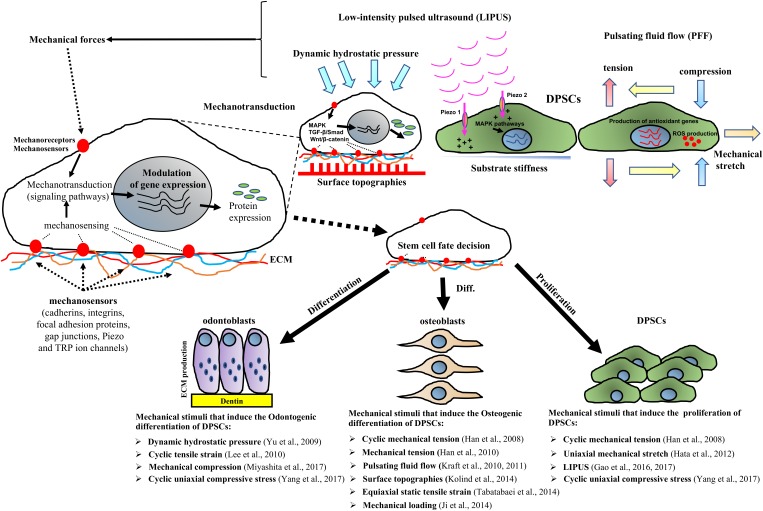
Dental pulp is known to be an accessible and important source of multipotent mesenchymal progenitor cells termed dental pulp stem cells (DPSCs). DPSCs can differentiate into odontoblast-like cells and maintain pulp homeostasis by the formation of new dentin which protects the underlying pulp. DPSCs similar to other mesenchymal stem cells (MSCs) reside in a niche, a complex microenvironment consisting of an extracellular matrix, other local cell types and biochemical stimuli that influence the decision between stem cell (SC) self-renewal and differentiation. In addition to biochemical factors, mechanical factors are increasingly recognized as key regulators in DPSC behavior and function. Thus, microenvironments can significantly influence the role and differentiation of DPSCs through a combination of factors which are biochemical, biomechanical and biophysical in nature. Under conditions, it has been shown that DPSCs are sensitive to different types of force, such as uniaxial mechanical stretch, cyclic tensile strain, pulsating fluid flow, low-intensity pulsed ultrasound as well as being responsive to biomechanical cues presented in the form of micro- and nano-scale surface topographies. To understand how DPSCs sense and respond to the mechanics of their microenvironments, it is essential to determine how these cells convert mechanical and physical stimuli into function, including lineage specification. This review therefore covers some aspects of DPSC mechanoresponsivity with an emphasis on the factors that influence their behavior. An in-depth understanding of the physical environment that influence DPSC fate is necessary to improve the outcome of their therapeutic application for tissue regeneration.
牙髓是一种易于获取且重要的多能间充质祖细胞来源,这些细胞被称为牙髓干细胞(DPSCs)。DPSCs 可分化为成牙本质细胞样细胞,并通过形成新的牙本质来维持牙髓稳态,新牙本质可保护下方的牙髓。与其他间充质干细胞(MSCs)类似,DPSCs 存在于一个生态位中,这是一个复杂的微环境,由细胞外基质、其他局部细胞类型以及影响干细胞(SC)自我更新和分化抉择的生化刺激组成。除生化因素外,机械因素也日益被视为 DPSC 行为和功能的关键调节因子。因此,微环境可通过生化、生物力学和生物物理性质的多种因素组合,显著影响 DPSCs 的作用和分化。在某些条件下,已表明 DPSCs 对不同类型的力敏感,如单轴机械拉伸、循环拉伸应变、脉动流体流动、低强度脉冲超声,并且对以微米和纳米尺度表面形貌形式呈现的生物力学线索有反应。为了解 DPSCs 如何感知并响应其微环境的力学,确定这些细胞如何将机械和物理刺激转化为功能,包括谱系特化,至关重要。因此,本综述涵盖了 DPSC 机械反应性的一些方面,重点是影响其行为的因素。深入了解影响 DPSC 命运的物理环境对于改善其在组织再生治疗应用中的效果是必要的。