Woloszyk Anna, Holsten Dircksen Sabrina, Bostanci Nagihan, Müller Ralph, Hofmann Sandra, Mitsiadis Thimios A
Orofacial Development and Regeneration, Institute of Oral Biology, Centre of Dental Medicine, University of Zurich, Zurich, Switzerland.
Institute for Biomechanics, ETH Zurich, Zurich, Switzerland.
PLoS One. 2014 Oct 29;9(10):e111010. doi: 10.1371/journal.pone.0111010. eCollection 2014.
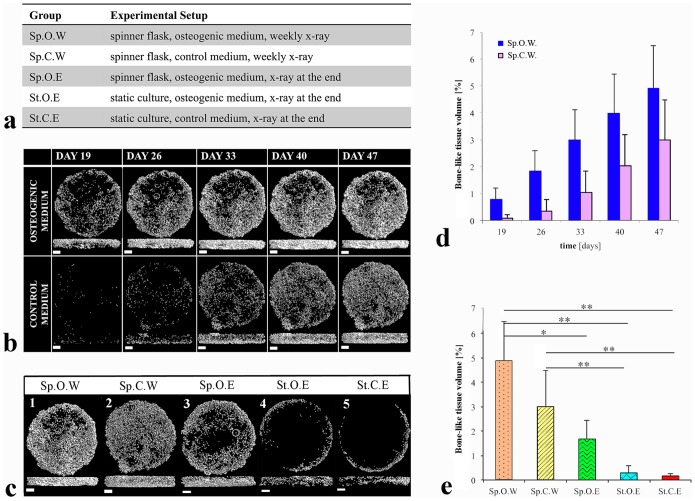
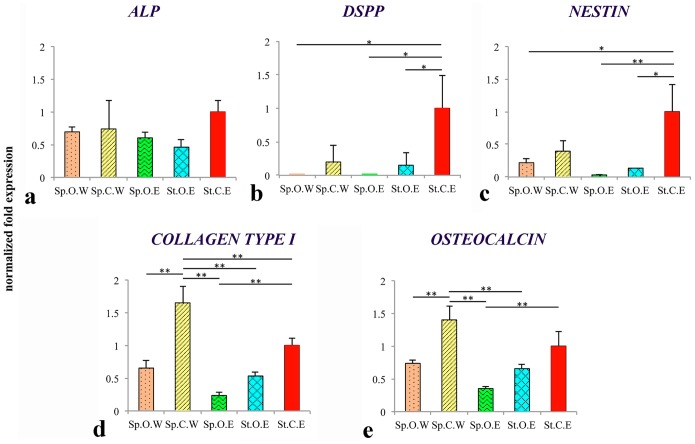
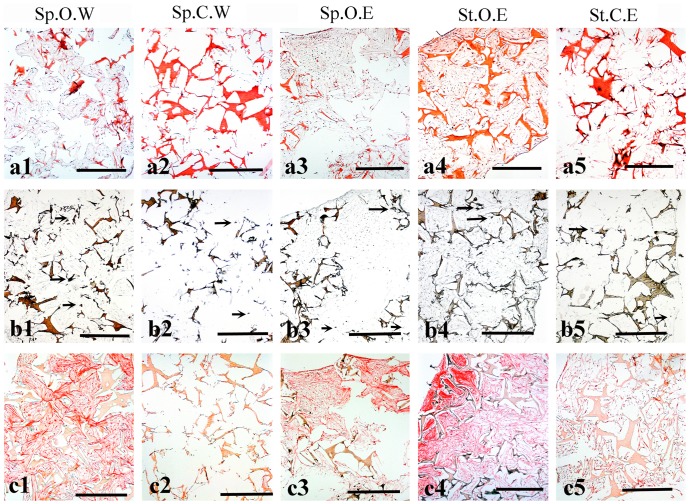
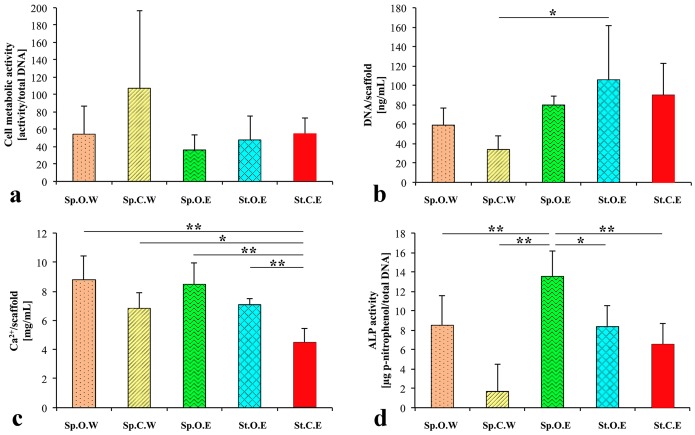
Teeth constitute a promising source of stem cells that can be used for tissue engineering and regenerative medicine purposes. Bone loss in the craniofacial complex due to pathological conditions and severe injuries could be treated with new materials combined with human dental pulp stem cells (hDPSCs) that have the same embryonic origin as craniofacial bones. Optimising combinations of scaffolds, cells, growth factors and culture conditions still remains a great challenge. In the present study, we evaluate the mineralisation potential of hDPSCs seeded on porous silk fibroin scaffolds in a mechanically dynamic environment provided by spinner flask bioreactors. Cell-seeded scaffolds were cultured in either standard or osteogenic media in both static and dynamic conditions for 47 days. Histological analysis and micro-computed tomography of the samples showed low levels of mineralisation when samples were cultured in static conditions (0.16±0.1 BV/TV%), while their culture in a dynamic environment with osteogenic medium and weekly µCT scans (4.9±1.6 BV/TV%) significantly increased the formation of homogeneously mineralised structures, which was also confirmed by the elevated calcium levels (4.5±1.0 vs. 8.8±1.7 mg/mL). Molecular analysis of the samples showed that the expression of tooth correlated genes such as Dentin Sialophosphoprotein and Nestin were downregulated by a factor of 6.7 and 7.4, respectively, in hDPSCs when cultured in presence of osteogenic medium. This finding indicates that hDPSCs are able to adopt a non-dental identity by changing the culture conditions only. Also an increased expression of Osteocalcin (1.4x) and Collagen type I (1.7x) was found after culture under mechanically dynamic conditions in control medium. In conclusion, the combination of hDPSCs and silk scaffolds cultured under mechanical loading in spinner flask bioreactors could offer a novel and promising approach for bone tissue engineering where appropriate and rapid bone regeneration in mechanically loaded tissues is required.
牙齿是干细胞的一个有前景的来源,可用于组织工程和再生医学目的。由于病理状况和严重损伤导致的颅面复合体骨质流失,可以通过结合人类牙髓干细胞(hDPSCs)的新材料来治疗,这些干细胞与颅面骨具有相同的胚胎起源。优化支架、细胞、生长因子和培养条件的组合仍然是一个巨大的挑战。在本研究中,我们评估了在转瓶生物反应器提供的机械动态环境中,接种在多孔丝素蛋白支架上的hDPSCs的矿化潜力。接种细胞的支架在静态和动态条件下,分别在标准培养基或成骨培养基中培养47天。对样本的组织学分析和微型计算机断层扫描显示,在静态条件下培养的样本矿化水平较低(0.16±0.1%骨体积/总体积),而在动态环境中使用成骨培养基培养并每周进行微型计算机断层扫描时(4.9±1.6%骨体积/总体积),矿化结构均匀形成的情况显著增加,钙水平升高也证实了这一点(4.5±1.0对8.8±1.7毫克/毫升)。对样本的分子分析表明,在成骨培养基存在的情况下培养时,hDPSCs中牙相关基因如牙本质涎磷蛋白和巢蛋白的表达分别下调了6.7倍和7.4倍。这一发现表明,hDPSCs仅通过改变培养条件就能获得非牙身份。在对照培养基中机械动态条件下培养后,还发现骨钙素(1.4倍)和I型胶原蛋白(1.7倍)的表达增加。总之,在转瓶生物反应器中机械加载条件下培养的hDPSCs和丝素支架的组合,对于需要在机械加载组织中实现适当且快速骨再生的骨组织工程而言,可能提供一种新颖且有前景的方法。