Naik Lokesh Gudda, Shon Won Yong, Clarke I C, Moon Jun-Gyu, Mukund Piyush, Kim Sang-Min
Department of Arthroplasty, Korea University Guro Hospital, Seoul, Korea.
Donaldson Arthritis Research Foundation, Colton, CA, USA.
Hip Pelvis. 2018 Dec;30(4):276-281. doi: 10.5371/hp.2018.30.4.276. Epub 2018 Dec 6.
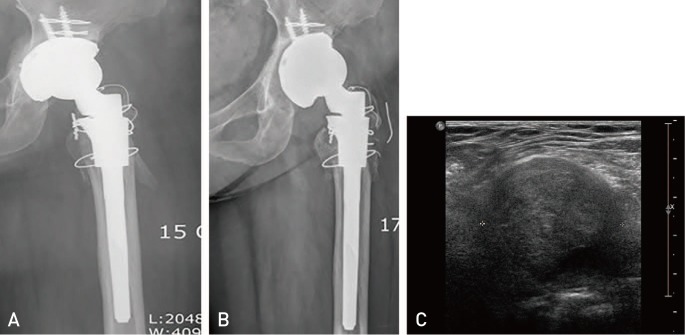
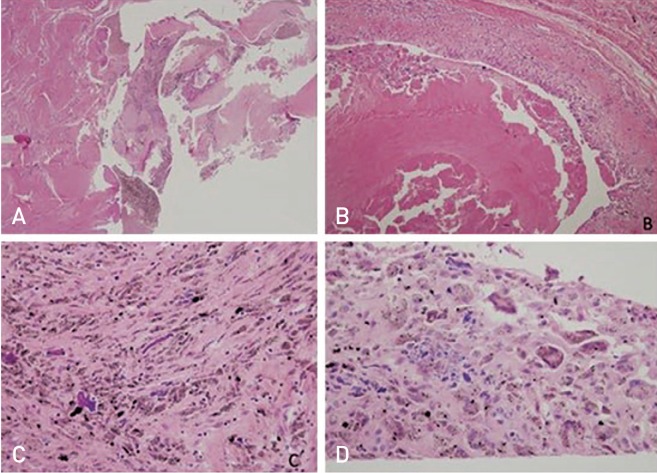
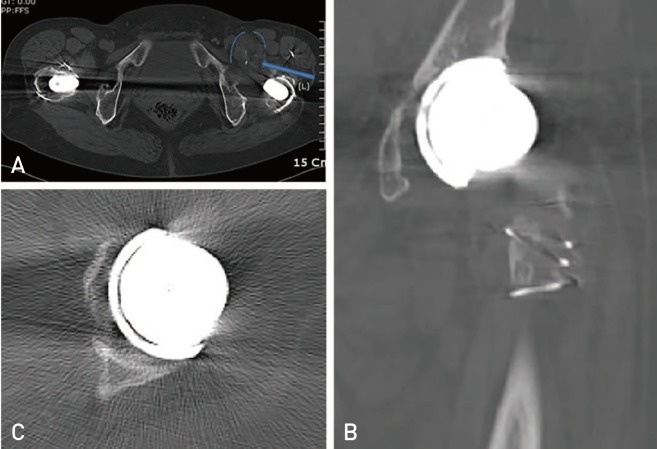
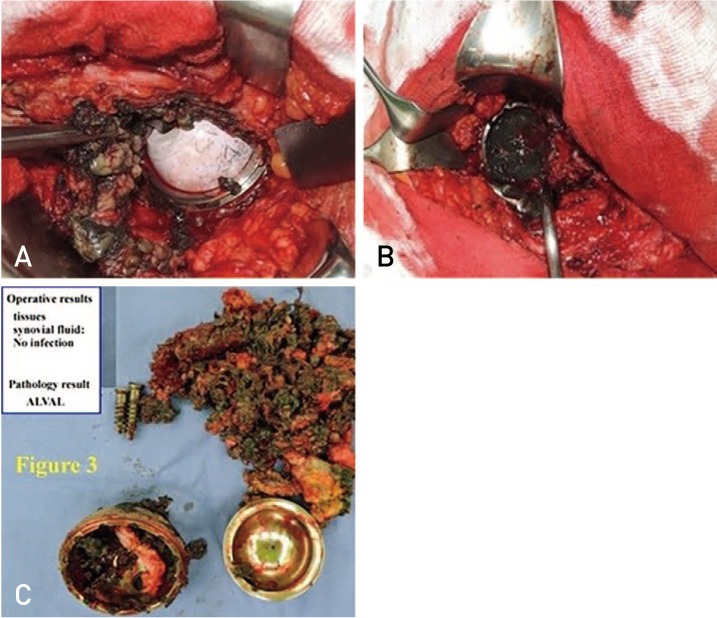
Pseudotumors are not uncommon complications after total hip arthroplasty (THA) and may occur due to differences in bearing surfaces of the head and the liner ranging from soft to hard articulation. The most common causes of pseudotumors are foreign-body reaction, hypersensitivity and wear debris. The spectrum of pseudotumor presentation following THA varies greatly-from completely asymptomatic to clear implant failure. We report a case of pseudo-tumor formation with acetabular cup aseptic loosening after revision ceramic-on-metal hip arthroplasty. The patient described herein underwent pseudotumor excision and re-revision complex arthroplasty using a trabecular metal shell and buttress with ceramic-on-polyethylene THA. Surgeons should be aware of the possibility of a pseudotumor when dealing with revisions to help prevent rapid progression of cup loosening and implant failure, and should intervene early to avoid complex arthroplasty procedures.
假肿瘤是全髋关节置换术(THA)后并不罕见的并发症,可能由于股骨头与髋臼内衬之间的关节面差异(从软关节到硬关节)而发生。假肿瘤最常见的原因是异物反应、超敏反应和磨损碎屑。THA后假肿瘤的表现范围差异很大——从完全无症状到明显的植入物失败。我们报告一例翻修陶瓷对金属髋关节置换术后髋臼杯无菌性松动伴假肿瘤形成的病例。本文所述患者接受了假肿瘤切除及再次翻修的复杂关节置换术,采用小梁金属杯和支撑结构以及陶瓷对聚乙烯THA。外科医生在处理翻修手术时应意识到假肿瘤的可能性,以帮助防止髋臼杯松动和植入物失败的快速进展,并应尽早干预以避免复杂的关节置换手术。