Ishida Tsunehito, Tateiwa Toshiyuki, Takahashi Yasuhito, Nishikawa Yohei, Shishido Takaaki, Masaoka Toshinori, Sano Keiji, Yamamoto Kengo
Department of Orthopedic Surgery, Tokyo Medical University, Tokyo, Japan.
Department of Bone and Joint Biomaterial Research, Tokyo Medical University, Tokyo, Japan.
Arthroplast Today. 2020 Jul 23;6(3):526-531. doi: 10.1016/j.artd.2020.06.006. eCollection 2020 Sep.
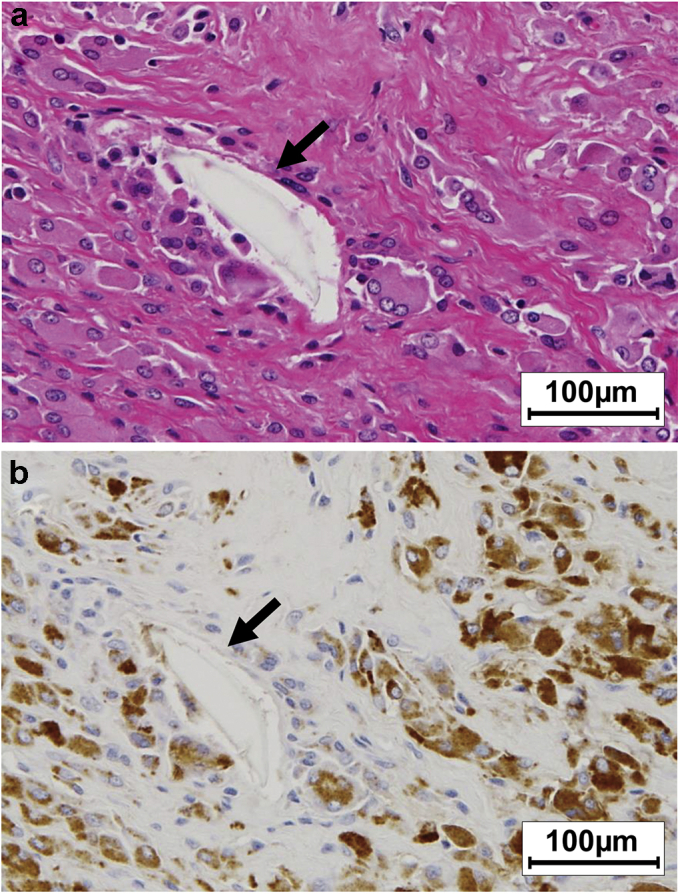
We describe 2 cases of pseudotumors induced by an unusual size of polyethylene wear particle after metal-on-polyethylene total hip arthroplasty (MoP THA). The supra-macroparticles of size >100 μm originated from a polyethylene liner with relatively small cup anteversion, potentially leading to excessive loading and increased wear of the anterior edge of the polyethylene liner. Histopathology showed a foreign-body reaction to the polyethylene particles without an adverse reaction to metal debris and with no severe signs of corrosion at the head-neck junction, which have been noted in past reports of pseudotumors in MoP THA. It has been suggested that the large polyethylene wear particles might be the cause of pseudotumor formation in MoP THA.
我们描述了2例金属对聚乙烯全髋关节置换术(MoP THA)后因聚乙烯磨损颗粒尺寸异常而诱发假瘤的病例。尺寸大于100μm的超大颗粒源自髋臼前倾角相对较小的聚乙烯衬垫,这可能导致聚乙烯衬垫前缘负荷过大和磨损增加。组织病理学显示对聚乙烯颗粒有异物反应,对金属碎屑无不良反应,头颈交界处无严重腐蚀迹象,这在以往MoP THA假瘤报告中已有提及。有人提出,大尺寸聚乙烯磨损颗粒可能是MoP THA中假瘤形成的原因。