Université Lille, INSERM, CHR Lille, Lille Inflammation Research International Center, U995, Lille, France.
INSERM U1043, CNRS U5282, Centre de Physiopathologie de Toulouse Purpan, Université de Toulouse UPS, Toulouse, France.
Cell Mol Gastroenterol Hepatol. 2018 Sep 20;7(1):185-196. doi: 10.1016/j.jcmgh.2018.09.012. eCollection 2019.
BACKGROUND & AIMS: Irritable bowel syndrome (IBS) is a multifactorial disease arising from a complex interplay between genetic predisposition and environmental influences. To date, environmental triggers are not well known. Aluminum is commonly present in food, notably by its use as food additive. We investigated the effects of aluminum ingestion in rodent models of visceral hypersensitivity, and the mechanisms involved.
Visceral hypersensitivity was recorded by colorectal distension in rats administered with oral low doses of aluminum. Inflammation was analyzed in the colon of aluminum-treated rats by quantitative PCR for cytokine expression and by immunohistochemistry for immune cells quantification. Involvement of mast cells in the aluminum-induced hypersensitivity was determined by cromoglycate administration of rats and in mast cell-deficient mice (Kit). Proteinase-activated receptor-2 (PAR2) activation in response to aluminum was evaluated and its implication in aluminum-induced hypersensitivity was assessed in PAR2 knockout mice.
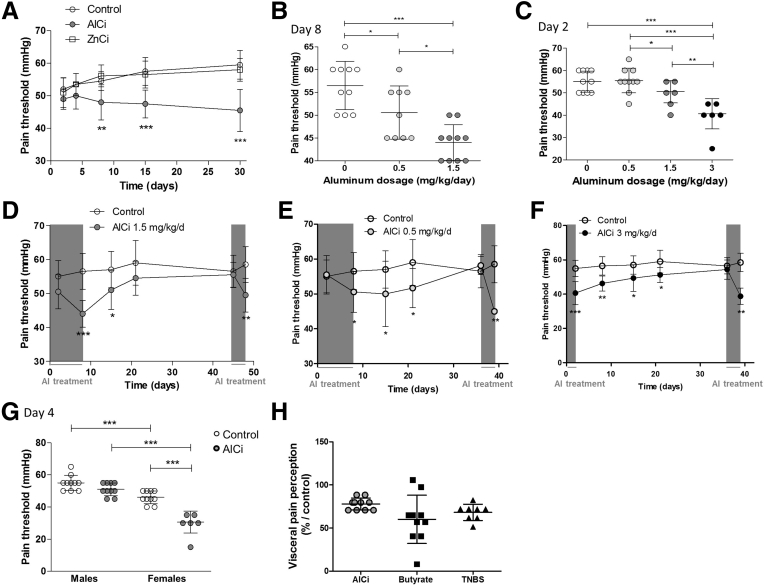
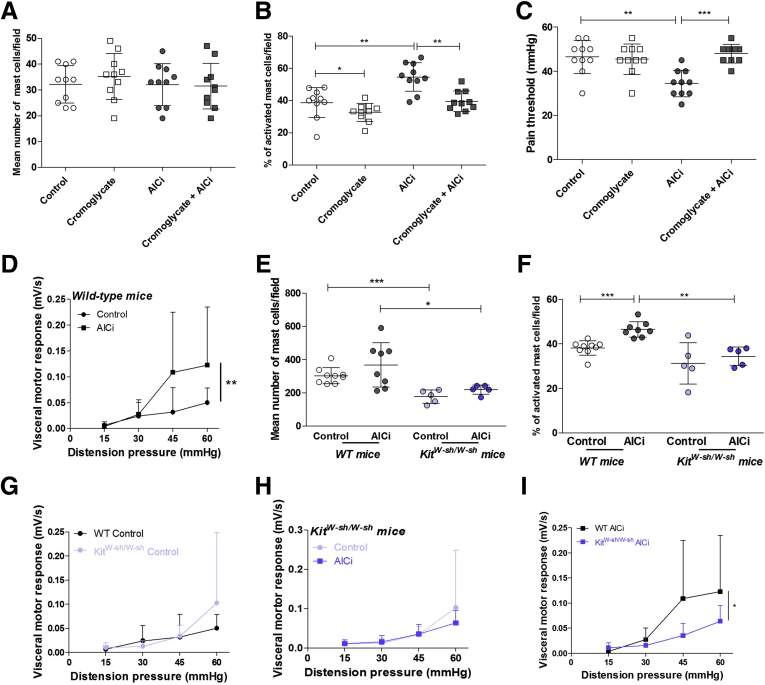
Orally administered low-dose aluminum induced visceral hypersensitivity in rats and mice. Visceral pain induced by aluminum persisted over time even after cessation of treatment, reappeared and was amplified when treatment resumed. As observed in humans, female animals were more sensitive than males. Major mediators of nociception were up-regulated in the colon by aluminum. Activation of mast cells and PAR2 were required for aluminum-induced hypersensitivity.
These findings indicate that oral exposure to aluminum at human dietary level reproduces clinical and molecular features of IBS, highlighting a new pathway of prevention and treatment of visceral pain in some susceptible patients.
肠易激综合征(IBS)是一种多因素疾病,由遗传易感性和环境影响之间的复杂相互作用引起。迄今为止,环境诱因尚不清楚。铝在食品中很常见,特别是作为食品添加剂使用。我们研究了铝在内脏高敏感的啮齿动物模型中的摄入作用及其相关机制。
通过对给予口服低剂量铝的大鼠进行结肠扩张来记录内脏高敏感。通过定量聚合酶链反应分析铝处理大鼠结肠中的炎症,通过免疫组化分析免疫细胞的定量来分析炎症。通过给予大鼠色甘酸钠和肥大细胞缺陷型小鼠(Kit)来确定肥大细胞在铝诱导的高敏反应中的作用。评估了蛋白水解酶激活受体 2(PAR2)对铝的反应及其在铝诱导的高敏感反应中的作用。
口服低剂量铝可诱导大鼠和小鼠内脏高敏感。铝引起的内脏疼痛随着时间的推移持续存在,即使在停止治疗后也会持续存在,当治疗重新开始时,疼痛会再次出现并加剧。与人类一样,雌性动物比雄性动物更敏感。铝在结肠中上调了主要的疼痛介质。肥大细胞和 PAR2 的激活是铝诱导高敏感所必需的。
这些发现表明,人类饮食水平的铝口服暴露可重现 IBS 的临床和分子特征,突出了一些易感患者预防和治疗内脏疼痛的新途径。