Escapa Isabel F, Chen Tsute, Huang Yanmei, Gajare Prasad, Dewhirst Floyd E, Lemon Katherine P
The Forsyth Institute (Microbiology), Cambridge, Massachusetts, USA.
Department of Oral Medicine, Infection & Immunity, Harvard School of Dental Medicine, Boston, Massachusetts, USA.
mSystems. 2018 Dec 4;3(6). doi: 10.1128/mSystems.00187-18. eCollection 2018 Nov-Dec.
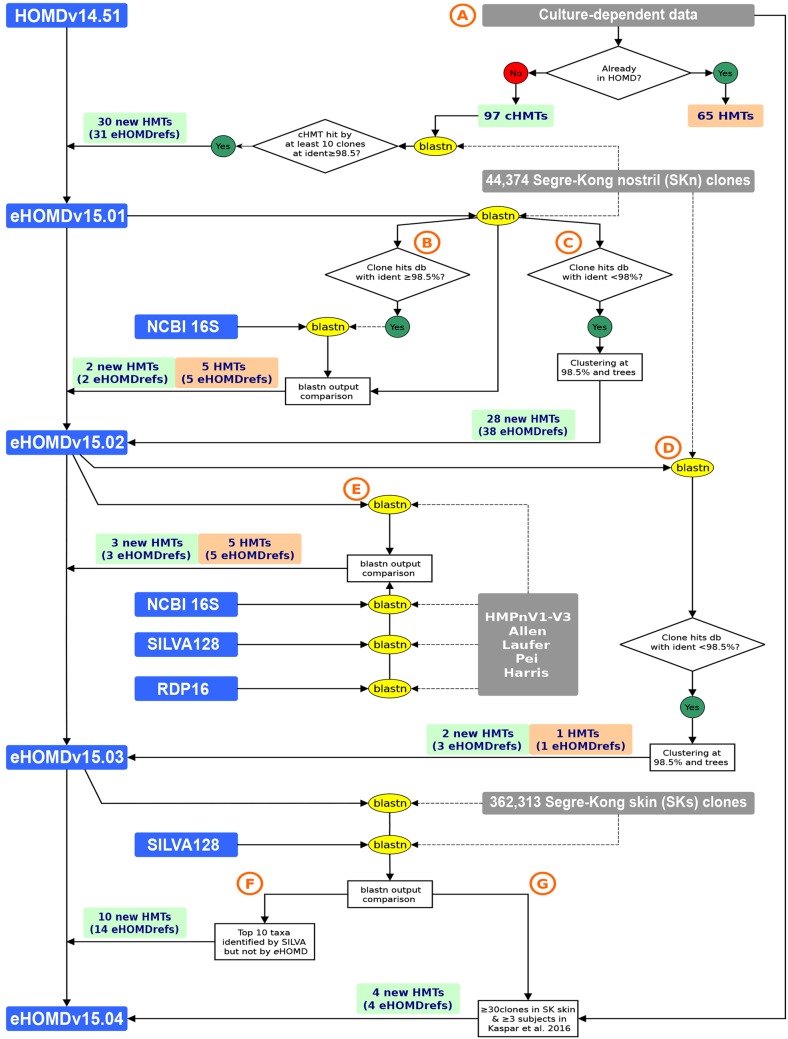
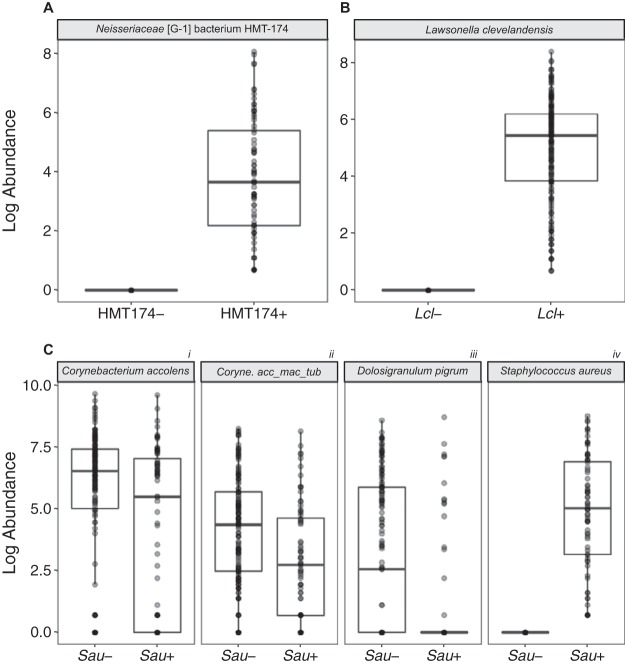
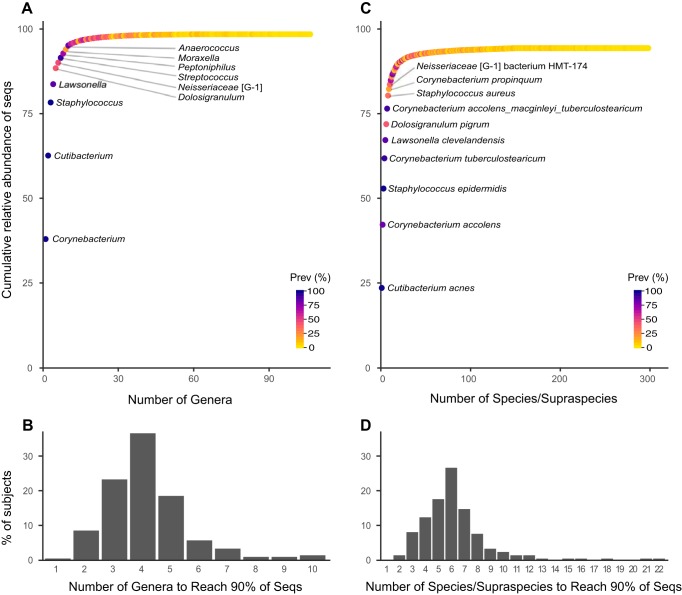
The expanded Human Oral Microbiome Database (eHOMD) is a comprehensive microbiome database for sites along the human aerodigestive tract that revealed new insights into the nostril microbiome. The eHOMD provides well-curated 16S rRNA gene reference sequences linked to available genomes and enables assignment of species-level taxonomy to most next-generation sequences derived from diverse aerodigestive tract sites, including the nasal passages, sinuses, throat, esophagus, and mouth. Using minimum entropy decomposition coupled with the RDP Classifier and our eHOMD V1-V3 training set, we reanalyzed 16S rRNA V1-V3 sequences from the nostrils of 210 Human Microbiome Project participants at the species level, revealing four key insights. First, we discovered that Lawsonella clevelandensis, a recently named bacterium, and [G-1] HMT-174, a previously unrecognized bacterium, are common in adult nostrils. Second, just 19 species accounted for 90% of the total sequences from all participants. Third, 1 of these 19 species belonged to a currently uncultivated genus. Fourth, for 94% of the participants, 2 to 10 species constituted 90% of their sequences, indicating that the nostril microbiome may be represented by limited consortia. These insights highlight the strengths of the nostril microbiome as a model system for studying interspecies interactions and microbiome function. Also, in this cohort, three common nasal species (Dolosigranulum pigrum and two species) showed positive differential abundance when the pathobiont Staphylococcus aureus was absent, generating hypotheses regarding colonization resistance. By facilitating species-level taxonomic assignment to microbes from the human aerodigestive tract, the eHOMD is a vital resource enhancing clinical relevance of microbiome studies. The eHOMD (http://www.ehomd.org) is a valuable resource for researchers, from basic to clinical, who study the microbiomes and the individual microbes in body sites in the human aerodigestive tract, which includes the nasal passages, sinuses, throat, esophagus, and mouth, and the lower respiratory tract, in health and disease. The eHOMD is an actively curated, web-based, open-access resource. eHOMD provides the following: (i) species-level taxonomy based on grouping 16S rRNA gene sequences at 98.5% identity, (ii) a systematic naming scheme for unnamed and/or uncultivated microbial taxa, (iii) reference genomes to facilitate metagenomic, metatranscriptomic, and proteomic studies and (iv) convenient cross-links to other databases (e.g., PubMed and Entrez). By facilitating the assignment of species names to sequences, the eHOMD is a vital resource for enhancing the clinical relevance of 16S rRNA gene-based microbiome studies, as well as metagenomic studies.
扩展后的人类口腔微生物组数据库(eHOMD)是一个针对人类呼吸道消化道各部位的综合微生物组数据库,它为鼻孔微生物组提供了新的见解。eHOMD提供了精心整理的与现有基因组相关联的16S rRNA基因参考序列,并能够对源自呼吸道消化道不同部位(包括鼻腔、鼻窦、咽喉、食道和口腔)的大多数新一代序列进行物种水平的分类。使用最小熵分解结合RDP分类器和我们的eHOMD V1 - V3训练集,我们在物种水平上重新分析了来自210名人类微生物组计划参与者鼻孔的16S rRNA V1 - V3序列,得出了四个关键见解。第一,我们发现最近命名的克利夫兰劳森菌和之前未被识别的细菌[G - 1] HMT - 174在成人鼻孔中很常见。第二,仅19个物种就占了所有参与者序列总数的90%。第三,这19个物种中有1个属于目前未培养的属。第四,对于94%的参与者,2至10个物种构成了其序列的90%,这表明鼻孔微生物组可能由有限的菌群组成。这些见解突出了鼻孔微生物组作为研究种间相互作用和微生物组功能的模型系统的优势。此外,在这个队列中,当致病共生菌金黄色葡萄球菌不存在时,三种常见的鼻腔物种(猪多尔西格菌和另外两种物种)显示出正的差异丰度,从而产生了关于定植抗性的假设。通过促进对人类呼吸道消化道微生物的物种水平分类,eHOMD是增强微生物组研究临床相关性的重要资源。eHOMD(http://www.ehomd.org)是从基础研究到临床研究的研究人员的宝贵资源,这些研究人员研究人类呼吸道消化道(包括鼻腔、鼻窦、咽喉、食道和口腔以及下呼吸道)在健康和疾病状态下的微生物组和个体微生物。eHOMD是一个经过积极整理的基于网络的开放获取资源。eHOMD提供以下内容:(i)基于将16S rRNA基因序列按98.5%的同一性进行分组的物种水平分类,(ii)针对未命名和/或未培养微生物分类群的系统命名方案,(iii)有助于宏基因组学、宏转录组学和蛋白质组学研究的参考基因组,以及(iv)与其他数据库(如PubMed和Entrez)的便捷交叉链接。通过促进对序列进行物种命名,eHOMD是增强基于16S rRNA基因的微生物组研究以及宏基因组学研究临床相关性的重要资源。