1 Division of Critical Care Medicine, Cincinnati Children's Hospital Medical Center, USA.
2 Division of Immunobiology, Cincinnati Children's Hospital Medical Center, USA.
Innate Immun. 2019 Jan;25(1):22-33. doi: 10.1177/1753425918817611. Epub 2018 Dec 11.
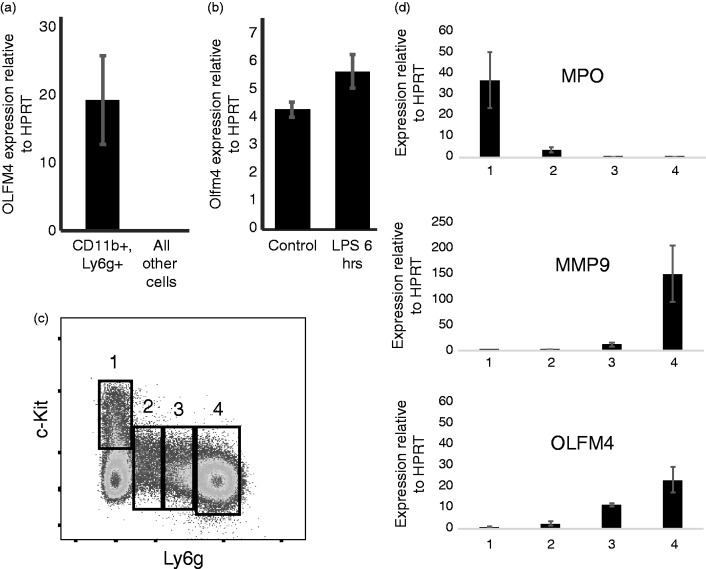
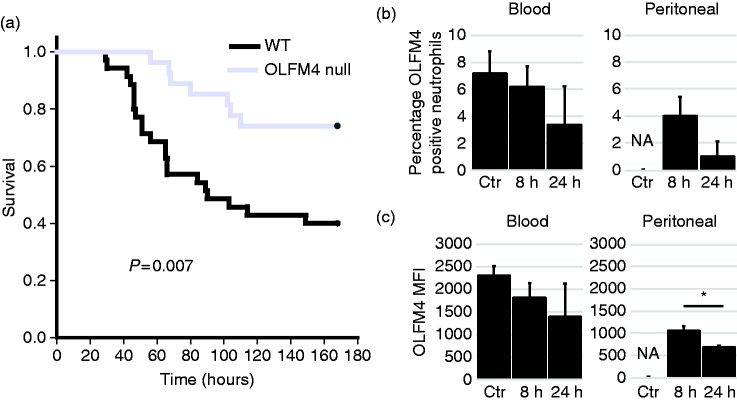
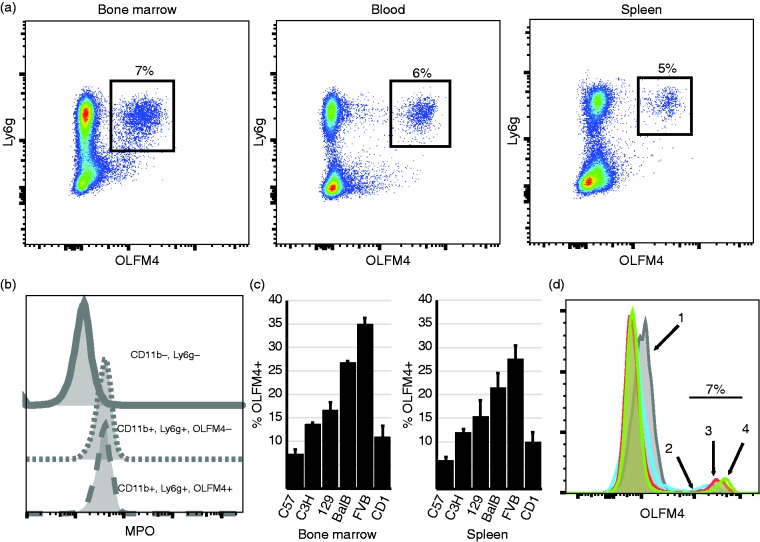
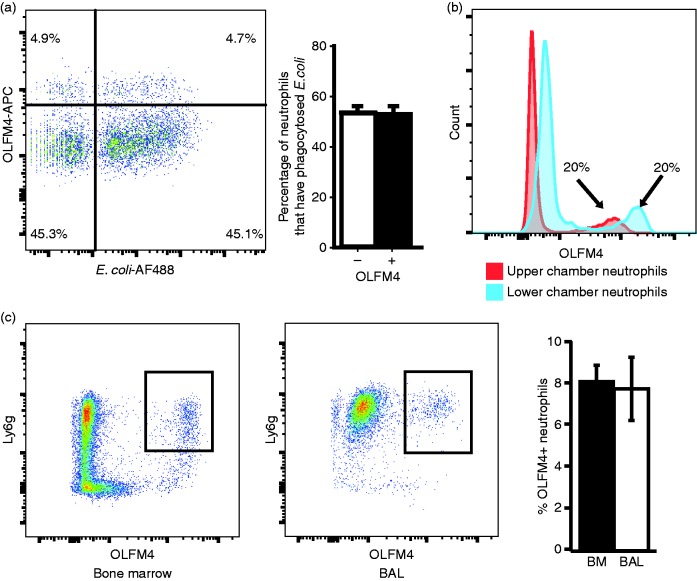
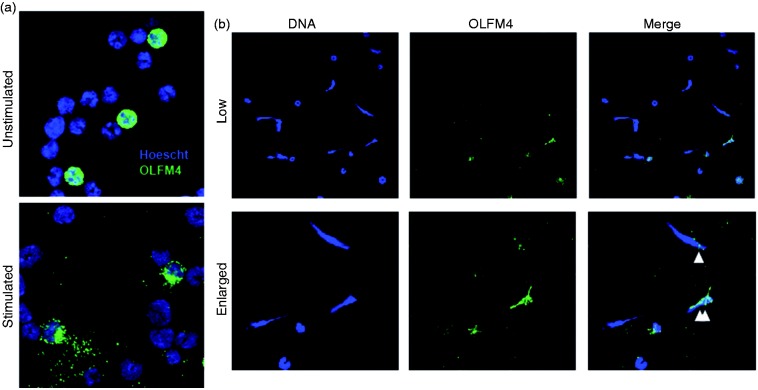
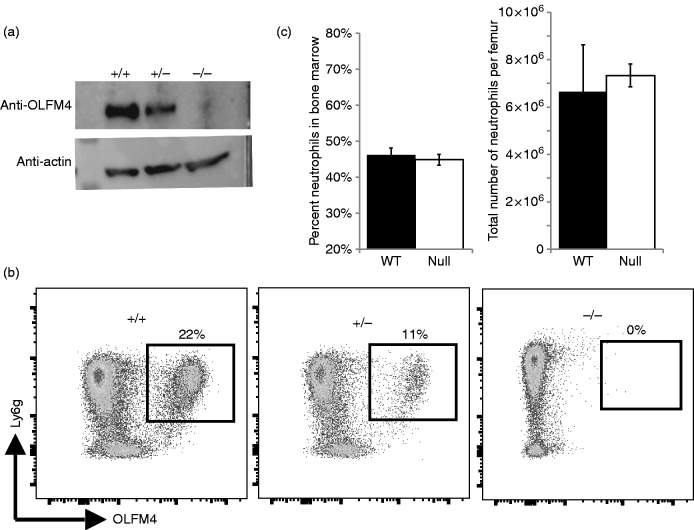
Neutrophils are the most abundant immune cell of the innate immune system and participate in essential immune functions. Heterogeneity within neutrophils has been documented, but it is difficult to distinguish if these are altered activation states of a single population or separate subpopulations of neutrophils determined at the time of differentiation. Several groups have identified a subset of human neutrophils that express olfactomedin 4 (OLFM4) and increased OLFM4+ neutrophils during sepsis is correlated with worse outcome, suggesting these neutrophils or the OLFM4 they secrete may be pathogenic. We tested if mice could be used as a model to study OLFM4+ neutrophils. We found the OLFM4 expressing subset of neutrophils is conserved in mice. Depending on the strain, 7-35% of murine neutrophils express OLFM4 and expression is determined early in neutrophil differentiation. OLFM4+ neutrophils phagocytose and transmigrate with similar efficiency as OLFM4- neutrophils. Here we show that within neutrophil extracellular traps (NETs) OLFM4+ and OLFM4- neutrophils undergo NETosis and OLFM4 colocalizes. Finally, we generated an OLFM4 null mouse and show that these mice are protected from death when challenged with sepsis, providing further evidence that the OLFM4 expressing subpopulation of neutrophils, or the OLFM4 they secrete, may be pathogenic during overwhelming infection.
中性粒细胞是先天免疫系统中最丰富的免疫细胞,参与重要的免疫功能。中性粒细胞内的异质性已经得到证实,但尚难以区分这些是单一群体的改变激活状态,还是分化时决定的中性粒细胞的不同亚群。有几个研究小组已经鉴定出一部分人中性粒细胞表达嗅觉素 4(OLFM4),并且脓毒症期间 OLFM4+中性粒细胞增加与预后不良相关,这表明这些中性粒细胞或它们分泌的 OLFM4 可能具有致病性。我们测试了是否可以使用小鼠作为模型来研究 OLFM4+中性粒细胞。我们发现,OLFM4 表达的中性粒细胞亚群在小鼠中是保守的。根据品系的不同,7-35%的小鼠中性粒细胞表达 OLFM4,表达在中性粒细胞分化的早期确定。OLFM4+中性粒细胞的吞噬作用和迁移与 OLFM4-中性粒细胞相似。在这里,我们表明在中性粒细胞胞外诱捕网(NETs)中,OLFM4+和 OLFM4-中性粒细胞发生 NETosis,OLFM4 发生共定位。最后,我们生成了 OLFM4 缺失小鼠,并表明这些小鼠在脓毒症挑战时免于死亡,这进一步证明了表达 OLFM4 的中性粒细胞亚群或它们分泌的 OLFM4 在过度感染时可能具有致病性。