Kruger Philipp, Saffarzadeh Mona, Weber Alexander N R, Rieber Nikolaus, Radsak Markus, von Bernuth Horst, Benarafa Charaf, Roos Dirk, Skokowa Julia, Hartl Dominik
Sir William Dunn School of Pathology, University of Oxford, Oxford, United Kingdom.
Center for Thrombosis and Hemostasis (CTH), University Medical Center Mainz, Mainz, Germany.
PLoS Pathog. 2015 Mar 12;11(3):e1004651. doi: 10.1371/journal.ppat.1004651. eCollection 2015 Mar.
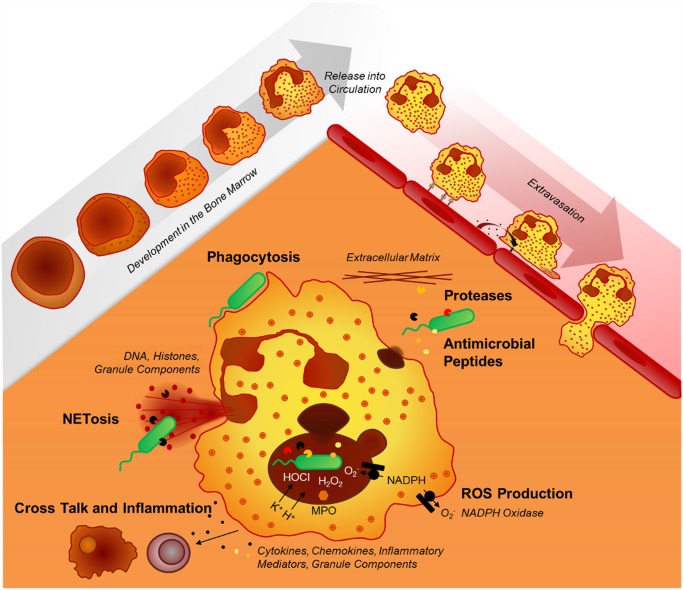
Neutrophils, the most abundant human immune cells, are rapidly recruited to sites of infection, where they fulfill their life-saving antimicrobial functions. While traditionally regarded as short-lived phagocytes, recent findings on long-term survival, neutrophil extracellular trap (NET) formation, heterogeneity and plasticity, suppressive functions, and tissue injury have expanded our understanding of their diverse role in infection and inflammation. This review summarises our current understanding of neutrophils in host-pathogen interactions and disease involvement, illustrating the versatility and plasticity of the neutrophil, moving between host defence, immune modulation, and tissue damage.
中性粒细胞是人类数量最多的免疫细胞,它们会迅速被招募到感染部位,在那里发挥其挽救生命的抗菌功能。虽然传统上被视为寿命短暂的吞噬细胞,但最近关于其长期存活、中性粒细胞胞外陷阱(NET)形成、异质性和可塑性、抑制功能以及组织损伤的研究结果,拓展了我们对它们在感染和炎症中多种作用的理解。这篇综述总结了我们目前对中性粒细胞在宿主-病原体相互作用和疾病中的理解,阐明了中性粒细胞在宿主防御、免疫调节和组织损伤之间转换的多功能性和可塑性。