Department of Plant and Microbial Biology, University of California, Berkeley, Berkeley, CA.
Department of Earth and Planetary Science, University of California, Berkeley, Berkeley, CA.
Mol Biol Evol. 2019 Mar 1;36(3):435-446. doi: 10.1093/molbev/msy234.
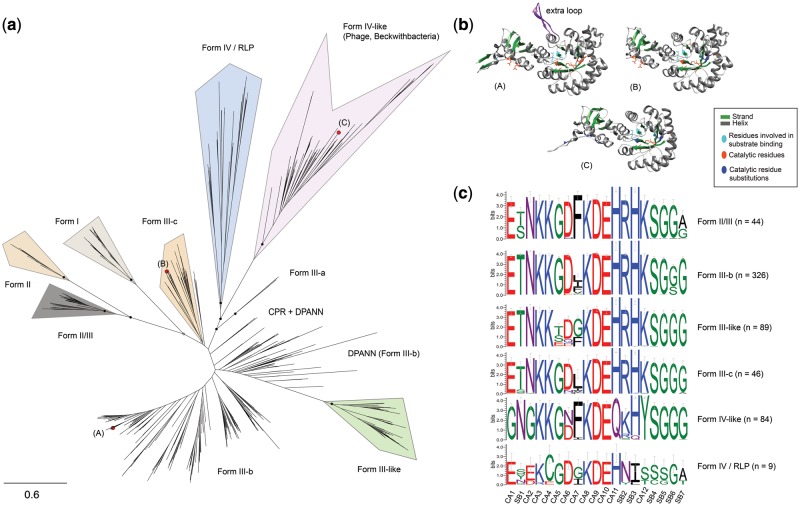
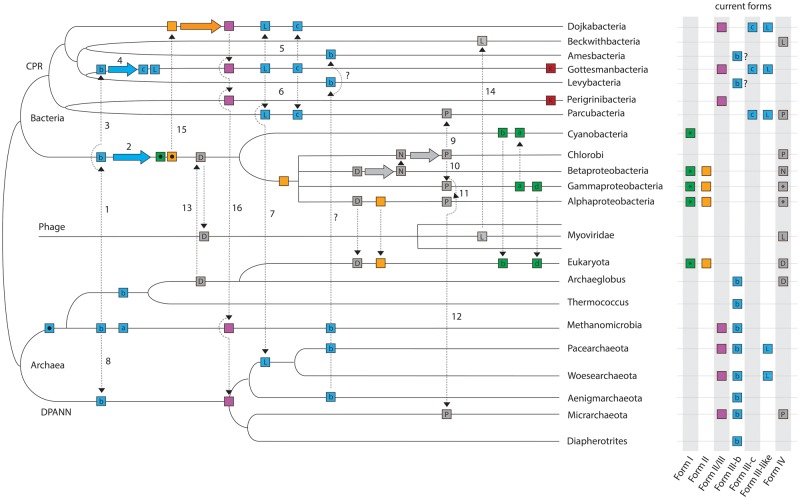
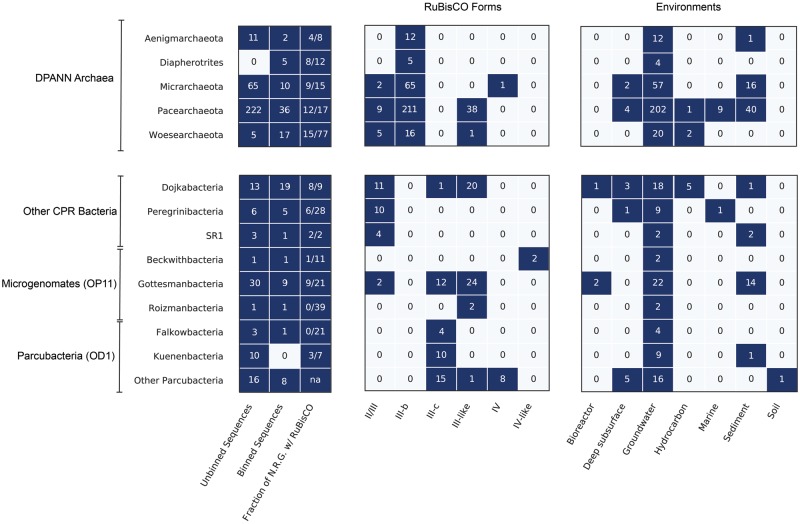
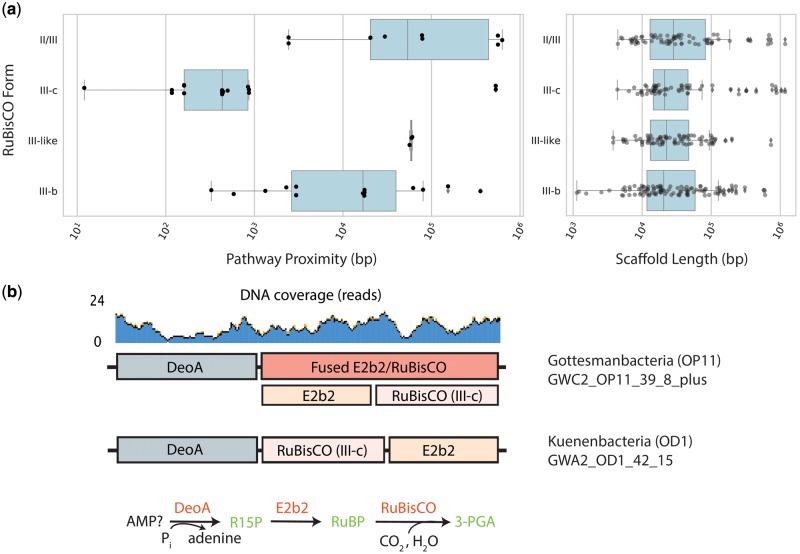
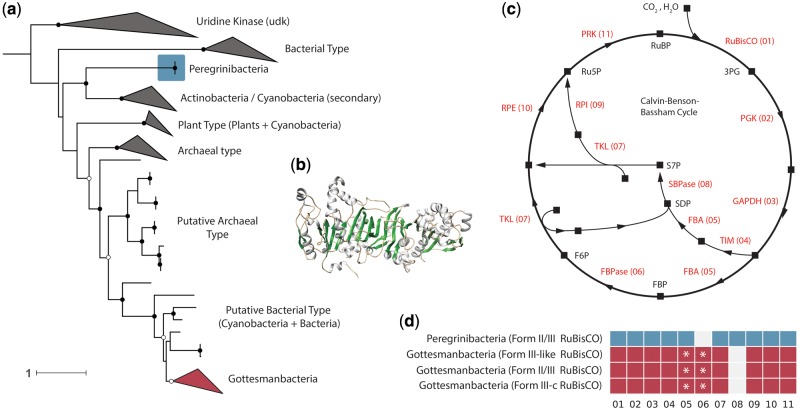
Ribulose-1,5-bisphosphate carboxylase/oxygenase (RuBisCO) is considered to be the most abundant enzyme on Earth. Despite this, its full diversity and distribution across the domains of life remain to be determined. Here, we leverage a large set of bacterial, archaeal, and viral genomes recovered from the environment to expand our understanding of existing RuBisCO diversity and the evolutionary processes responsible for its distribution. Specifically, we report a new type of RuBisCO present in Candidate Phyla Radiation (CPR) bacteria that is related to the archaeal Form III enzyme and contains the amino acid residues necessary for carboxylase activity. Genome-level metabolic analyses supported the inference that these RuBisCO function in a CO2-incorporating pathway that consumes nucleotides. Importantly, some Gottesmanbacteria (CPR) also encode a phosphoribulokinase that may augment carbon metabolism through a partial Calvin-Benson-Bassham cycle. Based on the scattered distribution of RuBisCO and its discordant evolutionary history, we conclude that this enzyme has been extensively laterally transferred across the CPR bacteria and DPANN archaea. We also report RuBisCO-like proteins in phage genomes from diverse environments. These sequences cluster with proteins in the Beckwithbacteria (CPR), implicating phage as a possible mechanism of RuBisCO transfer. Finally, we synthesize our metabolic and evolutionary analyses to suggest that lateral gene transfer of RuBisCO may have facilitated major shifts in carbon metabolism in several important bacterial and archaeal lineages.
核酮糖-1,5-二磷酸羧化酶/加氧酶(RuBisCO)被认为是地球上含量最丰富的酶。尽管如此,其在生命各领域的多样性和分布仍有待确定。在这里,我们利用从环境中回收的大量细菌、古菌和病毒基因组,扩展了我们对现有 RuBisCO 多样性的理解,并探讨了导致其分布的进化过程。具体来说,我们报告了一种存在于候选门辐射(CPR)细菌中的新型 RuBisCO,它与古菌的 Form III 酶有关,并包含羧化酶活性所必需的氨基酸残基。基于基因组水平的代谢分析,我们推断这些 RuBisCO 可能在一种消耗核苷酸的 CO2 掺入途径中发挥作用。重要的是,一些 Gottsegenbacteria(CPR)也编码磷酸核糖激酶,它可能通过部分卡尔文-本森-巴斯汉姆循环来增强碳代谢。基于 RuBisCO 的分散分布及其不一致的进化历史,我们得出结论,这种酶已在 CPR 细菌和 DPANN 古菌中广泛横向转移。我们还在来自不同环境的噬菌体基因组中报告了 RuBisCO 样蛋白。这些序列与 Beckwithbacteria(CPR)中的蛋白聚类,暗示噬菌体可能是 RuBisCO 转移的一种可能机制。最后,我们综合代谢和进化分析表明,RuBisCO 的横向基因转移可能促进了几个重要细菌和古菌谱系中碳代谢的重大转变。