Mateos Julieta Lisa, de Leone Maria José, Torchio Jeanette, Reichel Marlene, Staiger Dorothee
Fundación Instituto Leloir, Av. Patricias Argentinas, Buenos Aires C1405BWE, Argentina.
RNA Biology and Molecular Physiology, Faculty for Biology, Bielefeld University, Universitaetsstrasse 25, D-33615 Bielefeld, Germany.
Genes (Basel). 2018 Dec 10;9(12):616. doi: 10.3390/genes9120616.
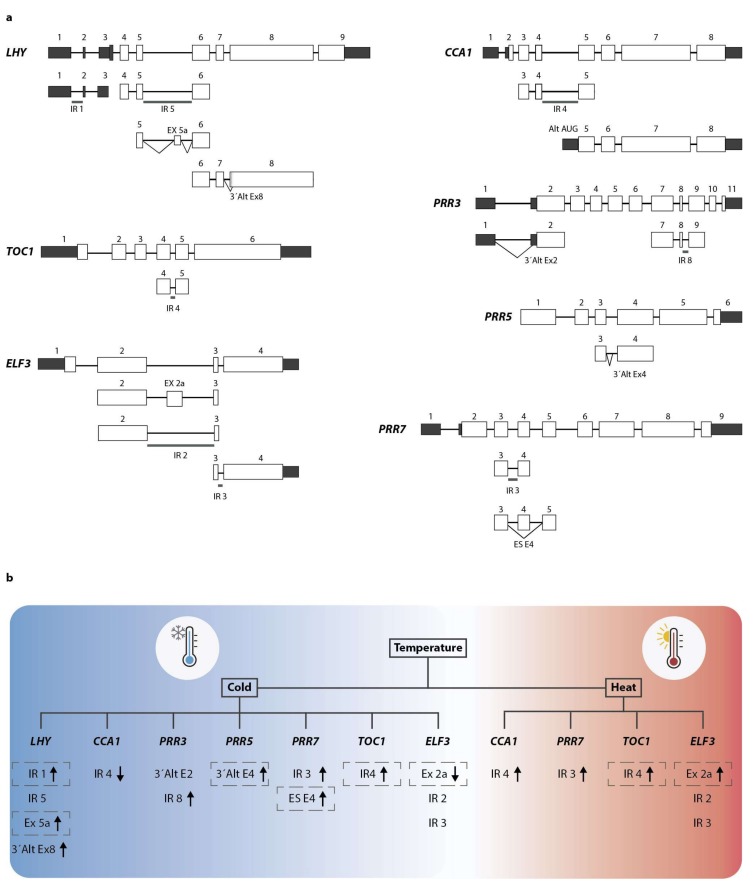
The circadian clock is an important endogenous timekeeper, helping plants to prepare for the periodic changes of light and darkness in their environment. The clockwork of this molecular timer is made up of clock proteins that regulate transcription of their own genes with a 24 h rhythm. Furthermore, the rhythmically expressed clock proteins regulate time-of-day dependent transcription of downstream genes, causing messenger RNA (mRNA) oscillations of a large part of the transcriptome. On top of the transcriptional regulation by the clock, circadian rhythms in mRNAs rely in large parts on post-transcriptional regulation, including alternative pre-mRNA splicing, mRNA degradation, and translational control. Here, we present recent insights into the contribution of post-transcriptional regulation to core clock function and to regulation of circadian gene expression in .
生物钟是一个重要的内源性计时机制,帮助植物为其环境中光暗的周期性变化做好准备。这个分子定时器的运转机制由时钟蛋白组成,这些蛋白以24小时节律调节自身基因的转录。此外,有节律表达的时钟蛋白调节下游基因的昼夜依赖性转录,导致转录组中很大一部分信使核糖核酸(mRNA)产生振荡。除了生物钟的转录调控外,mRNA中的昼夜节律在很大程度上依赖于转录后调控,包括前体mRNA可变剪接、mRNA降解和翻译控制。在此,我们展示了关于转录后调控对核心生物钟功能以及对[具体研究对象]中昼夜节律基因表达调控贡献的最新见解。