
小分子抗炎溶栓药物 SMTP-7 对猴栓塞性中风的疗效。
Efficacy of SMTP-7, a small-molecule anti-inflammatory thrombolytic, in embolic stroke in monkeys.
机构信息
Department of Applied Biological Science Tokyo Noko University (Tokyo University of Agriculture and Technology) Tokyo Japan.
Division of Research and Development TMS Co., Ltd. Tokyo Japan.
出版信息
Pharmacol Res Perspect. 2018 Dec 5;6(6):e00448. doi: 10.1002/prp2.448. eCollection 2018 Dec.
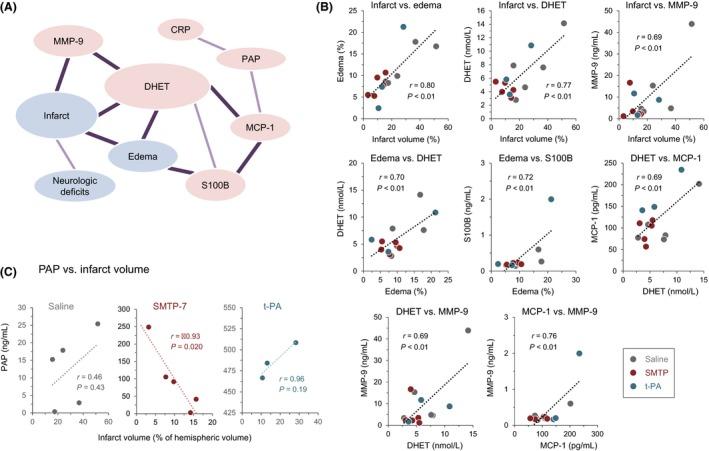
SMTP-7 ( triprenyl phenol-7) is a small molecule that promotes thrombolysis and suppresses inflammation possibly through plasminogen modulation and soluble epoxide hydrolase (sEH) inhibition, respectively. Here, we demonstrate an efficacy of SMTP-7 in a severe embolic stroke model in monkeys. The middle cerebral artery was embolized by an autologous blood clot. Saline, SMTP-7, or tissue-type plasminogen activator (t-PA) (n = 5 in each group) was given after 3 hours, and neurologic deficit scoring and infarct characterization were performed after 24 hours. Hemorrhagic infarct-accompanied premature death was observed for two animals in t-PA group. SMTP-7 treatment significantly reduced the sizes of infarct by 65%, edema by 37%, and clot by 55% compared to saline treatment. Plasma levels of the products of plasminogen activation (plasmin-α-antiplasmin complex) and sEH reaction (dihydroxyeicosatrienoic acid) in SMTP-7 group were 794% ( < 0.05) and 60% ( = 0.085) compared to saline group, respectively. No significant changes in the plasma levels of MMP-9, CRP, MCP-1, and S100B were found. There was an inverse correlation between plasmin-α-antiplasmin complex level and infarct volume ( = 0.93, < 0.05), suggesting a role of thrombolysis in the SMTP-7 action to limit infarct development. In conclusion, SMTP-7 is effective in treating severe embolic stroke in monkeys under conditions where t-PA treatment tends to cause hemorrhagic infarct-associated premature death.
SMTP-7(三萜酚-7)是一种小分子,通过分别调节纤溶酶原和抑制可溶性环氧化物水解酶(sEH),可能促进溶栓和抑制炎症。在这里,我们在猴子的严重栓塞性中风模型中证明了 SMTP-7 的疗效。通过自体血凝块栓塞大脑中动脉。在 3 小时后给予盐水、SMTP-7 或组织型纤溶酶原激活物(t-PA)(每组 5 只),并在 24 小时后进行神经功能缺损评分和梗死特征描述。在 t-PA 组中,有两只动物因出血性梗死相关的过早死亡。与盐水治疗相比,SMTP-7 治疗可使梗死体积缩小 65%,水肿缩小 37%,血栓缩小 55%。与盐水组相比,SMTP-7 组的纤溶酶原激活产物(纤溶酶-α-抗纤溶酶复合物)和 sEH 反应产物(二羟二十碳三烯酸)的血浆水平分别增加了 794%(<0.05)和 60%(=0.085)。未发现 MMP-9、CRP、MCP-1 和 S100B 的血浆水平有显著变化。纤溶酶-α-抗纤溶酶复合物水平与梗死体积呈负相关(=0.93,<0.05),表明溶栓作用在 SMTP-7 限制梗死发展的作用中起作用。总之,SMTP-7 在治疗 t-PA 治疗易引起出血性梗死相关过早死亡的情况下,在猴子的严重栓塞性中风中是有效的。


 Zotero 插件