Adams Tangeria R, Handley Elizabeth D, Manly Jody Todd, Cicchetti Dante, Toth Sheree L
Mt. Hope Family Center, University of Rochester.
Institute of Child Development, University of Minnesota.
Dev Psychopathol. 2019 Feb;31(1):83-93. doi: 10.1017/S0954579418001505. Epub 2018 Dec 17.
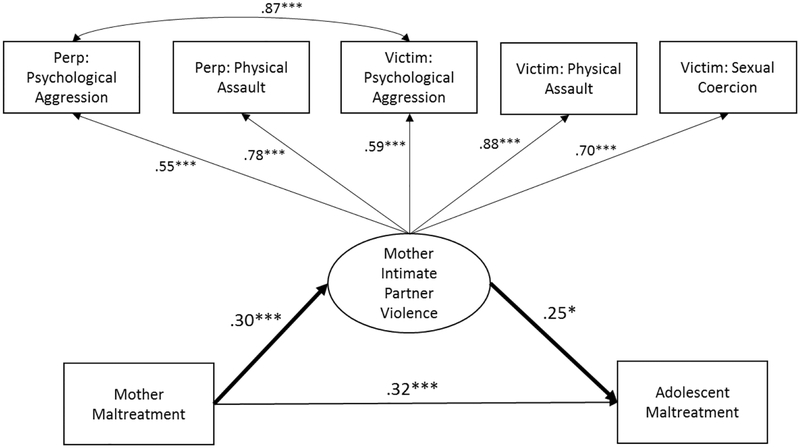
Child maltreatment represents a pervasive societal problem. Exposure to maltreatment is predictive of maladjustment across development with enduring negative effects found in adulthood. Compelling evidence suggests that some parents with a history of child abuse and neglect are at elevated risk for the maltreatment of their own children. However, a dearth of research currently exists on mediated mechanisms that may underlie this continuity. Ecological and transactional theories of child maltreatment propose that child maltreatment is multiply determined by various risk factors that exist across different ecological systems. Intimate partner violence (IPV) often co-occurs with child maltreatment and may represent a pathway through which risk for child abuse and neglect is transmitted across generations within a family. Informed by theories on the intergenerational transmission of child maltreatment and utilizing a community-based, cross-sectional sample of 245 racially and ethnically diverse, low-income mothers and daughters, the objective of this study was to investigate IPV as a propagating process through which risk of child abuse and neglect is conferred from parent to child. We found evidence suggesting that mothers' history of maltreatment is associated with both their IPV involvement and their adolescent daughters' maltreatment victimization (with exposure to IPV as a maltreatment subtype excluded for clarity). Maternal IPV also partially accounted for the continuity of maltreatment victimization from mother to adolescent. A secondary analysis that included the adolescent's own engagement in dating violence provided compelling but preliminary evidence of the emergence of a similar pattern of relational violence, whereby adolescent girls with maltreatment histories were likewise involved in abusive intimate relationships. Future directions and clinical implications of these findings are discussed.
儿童虐待是一个普遍存在的社会问题。遭受虐待预示着在整个成长过程中会出现适应不良,在成年后会产生持久的负面影响。有力证据表明,一些有虐待和忽视儿童历史的父母虐待自己孩子的风险更高。然而,目前对于可能构成这种连续性基础的中介机制的研究却很匮乏。儿童虐待的生态和交互理论提出,儿童虐待是由不同生态系统中存在的各种风险因素多重决定的。亲密伴侣暴力(IPV)常常与儿童虐待同时出现,可能代表了儿童虐待和忽视风险在家庭中跨代传递的一种途径。基于儿童虐待代际传递的理论,并利用一个以社区为基础的包含245名种族和民族多样的低收入母女的横断面样本,本研究的目的是调查IPV作为一种传播过程,通过它儿童虐待和忽视的风险从父母传递给孩子。我们发现证据表明,母亲的虐待史与她们参与IPV以及她们青春期女儿遭受虐待(为清晰起见,将接触IPV作为虐待亚型排除在外)都有关联。母亲的IPV也部分解释了虐待受害情况从母亲到青少年的连续性。一项包括青少年自身参与约会暴力的二次分析提供了令人信服但初步的证据,证明了一种类似的关系暴力模式的出现,即有虐待史的青春期女孩同样也卷入了虐待性的亲密关系。本文讨论了这些发现的未来方向和临床意义。