Hitzler Melissa, Bach Alexandra M, Köhler-Dauner Franziska, Gündel Harald, Kolassa Iris-Tatjana
Clinical and Biological Psychology, Institute of Psychology and Education, Ulm University, Ulm, Germany.
Department of Child and Adolescent Psychiatry and Psychotherapy, University Hospital Ulm, Ulm, Germany.
Front Psychiatry. 2022 Mar 14;13:836077. doi: 10.3389/fpsyt.2022.836077. eCollection 2022.
As an especially burdensome experience, childhood maltreatment (CM) can have lifelong consequences on the mental health and wellbeing of an individual well into adulthood. We have previously reported that CM constitutes a central risk factor not only for the development of mental problems, but also for facing additional psychosocial risks, endangering healthy development of mother and offspring throughout life (e.g., financial problems, intimate partner violence, substance use). This study was designed to replicate these findings in a larger, independent study cohort.
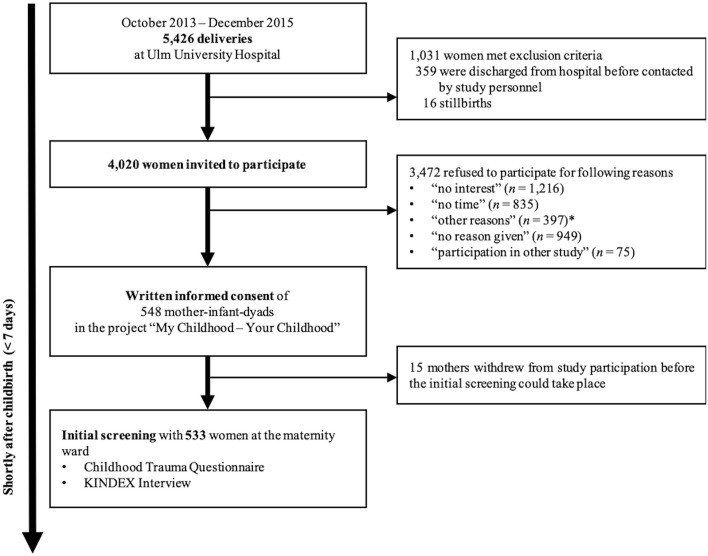
In this cross-sectional replication study an independent cohort of 533 healthy postpartum women was interviewed within seven days after parturition. CM experiences were assessed retrospectively using the German version of the Childhood Trauma Questionnaire (CTQ) and current psychosocial risk factors for child welfare were assessed using the Konstanzer Index (KINDEX).
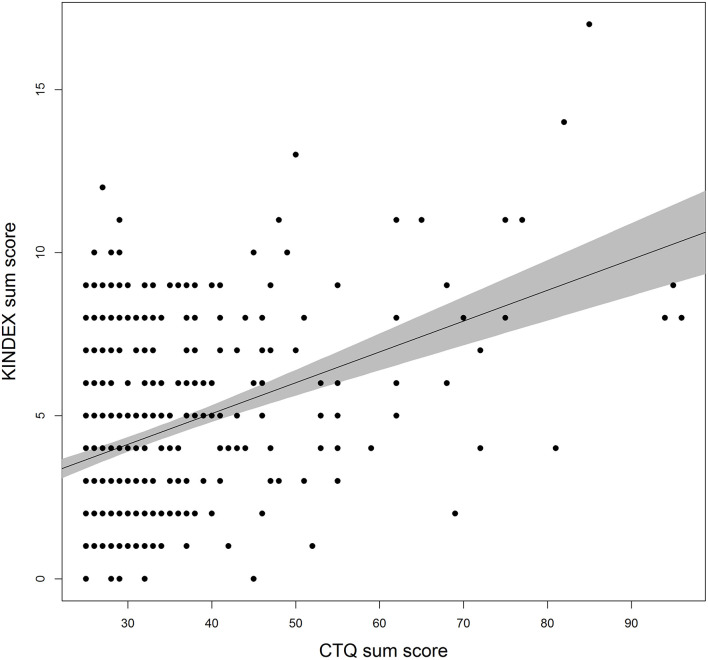
Of all women, 16.1% experienced emotional and 10.1% physical abuse, 28.5% emotional neglect, 9.4% physical neglect and 10.3% experienced sexual abuse. Most importantly, the higher the CM load the more psychosocial stressors existed in women's life. In Particular, women with higher CM load had a higher risk for mental health problems, intimate partner violence, financial problems, and a higher postnatal stress load.
In an independent sample, this study replicated the previous findings that CM and psychosocial risk factors for child welfare were strongly associated in a dose-response manner. Our results emphasize the higher vulnerability of women with a CM history in the postpartum period. To avoid negative consequences for mother and child, a regular and evidence-based screening for CM and psychosocial risk factors during pregnancy and puerperium is needed to identify at-risk mothers early during pregnancy and to provide appropriate support. Hence, our findings highlight the mandatory requirement for an interdisciplinary collaboration of gynecological practices, hospitals and midwifes, along with psychologists and psychotherapists and child and youth welfare services.
童年虐待(CM)作为一种特别沉重的经历,会对个体的心理健康和幸福感产生终身影响,直至成年。我们之前曾报道,CM不仅是心理问题发展的核心风险因素,也是面临其他心理社会风险的因素,危及母亲和后代一生的健康发展(例如,经济问题、亲密伴侣暴力、物质使用)。本研究旨在在一个更大的独立研究队列中重复这些发现。
在这项横断面重复研究中,对533名健康产后妇女的独立队列在分娩后7天内进行了访谈。使用德文版儿童创伤问卷(CTQ)对CM经历进行回顾性评估,并使用康斯坦茨指数(KINDEX)评估当前儿童福利的心理社会风险因素。
在所有女性中,16.1%经历过情感虐待,10.1%经历过身体虐待,28.5%经历过情感忽视,9.4%经历过身体忽视,10.3%经历过性虐待。最重要的是,CM负荷越高,女性生活中存在的心理社会压力源就越多。特别是,CM负荷较高的女性患心理健康问题、亲密伴侣暴力、经济问题的风险更高,产后压力负荷也更高。
在一个独立样本中,本研究重复了先前的发现,即CM与儿童福利的心理社会风险因素以剂量反应方式密切相关。我们的结果强调了有CM病史的女性在产后阶段更高的脆弱性。为避免对母婴产生负面影响,需要在孕期和产褥期对CM和心理社会风险因素进行定期且基于证据的筛查,以便在孕期早期识别出有风险的母亲并提供适当支持。因此,我们的研究结果突出了妇科诊所、医院和助产士与心理学家、心理治疗师以及儿童和青少年福利服务机构进行跨学科合作的必要性。