Anti-Stress and Health Research Center, College of Pharmacy, Jinan University, Guangzhou, Guangdong 510632, China.
Department of Toxicology, School of Public Health, Tianjin Medical University, Heping District, Tianjin, China.
Theranostics. 2018 Nov 10;8(20):5713-5730. doi: 10.7150/thno.28778. eCollection 2018.
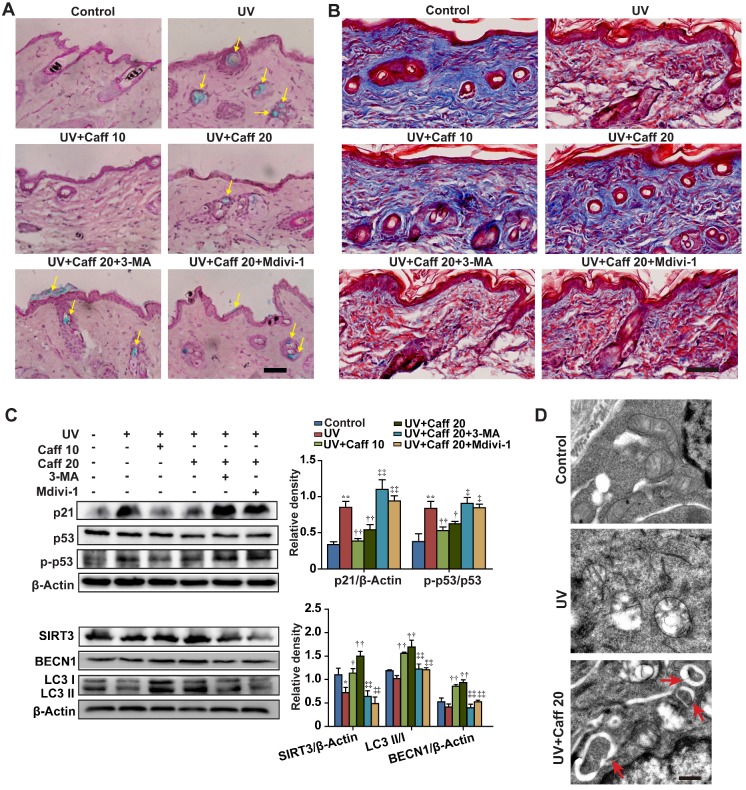
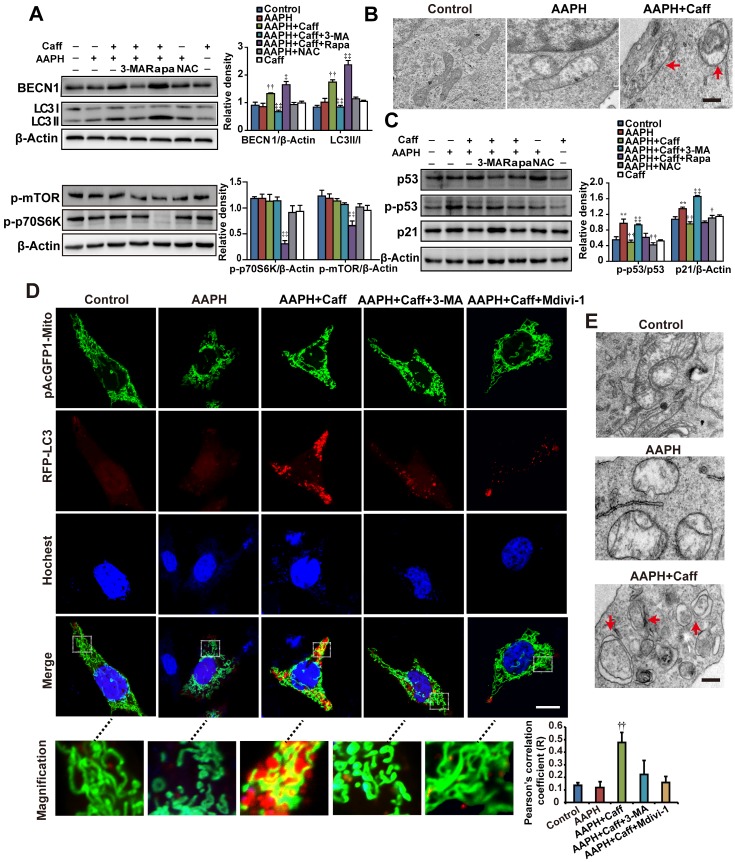
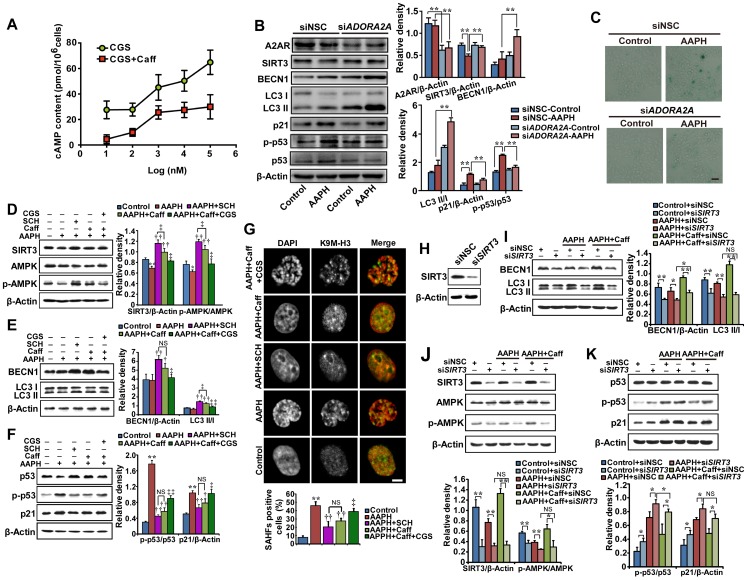
Skin cells are vulnerable to oxidative stress-induced senescence, which may lead to abnormal aging or aging-related disorders. Therefore, strategies that can ameliorate oxidative stress-induced senescence are expected to protect skin from damage, holding the promise of treating skin diseases in the clinic. This study aims to investigate whether caffeine, a well-known purine alkaloid, is able to prevent skin from oxidative stress-induced senescence, and to explore the underlying molecular mechanisms. : A free radical inducer 2,2'-Azobis (2-amidinopropane) dihydrochloride (AAPH) was used to induce oxidative stress and cellular senescence in both transformed skin cells and in normal human epidermal keratinocytes (NHEKs). Ultraviolet (UV) irradiation was established as the oxidative stress model in mouse skin tissues. Cellular senescence was determined by SA β-galactosidase staining, immunofluorescence and western blotting. Activation of autophagy was confirmed by western blotting, immunofluorescence, and transmission electron microscopy. Reactive oxygen species (ROS) detection by commercial kits, gene knockdown by RNA interference (RNAi) and receptor activation/inactivation by agonist/antagonist treatment were applied in mechanistic experiments. : We report that AAPH induced senescence in both transformed skin cells and in NHEKs. Similarly, UV irradiation induced senescence in mouse skin tissues. Remarkably, low dose of caffeine (<10 μM) suppressed cellular senescence and skin damage induced by AAPH or UV. Mechanistically, caffeine facilitated the elimination of ROS by activating autophagy. Using a combination of RNAi and chemical treatment, we demonstrate that caffeine activates autophagy through a series of sequential events, starting from the inhibition of its primary cellular target adenosine A2a receptor (A2AR) to an increase in the protein level of Sirtuin 3 (SIRT3) and to the activation of 5' adenosine monophosphate-activated protein kinase (AMPK). Oral administration of caffeine increased the protein level of SIRT3, induced autophagy, and reduced senescence and tissue damage in UV-irradiated mouse skin. On the other hand, co-administration with autophagy inhibitors attenuated the protective effect of caffeine on UV-induced skin damage in mice. : The results reveal that caffeine protects skin from oxidative stress-induced senescence through activating the A2AR/SIRT3/AMPK-mediated autophagy. Our study not only demonstrated the beneficial effect of caffeine using both and models, but also systematically investigated the underlying molecular mechanisms. These discoveries implicate the potential of caffeine in the protection of skin disease.
皮肤细胞容易受到氧化应激诱导的衰老,这可能导致异常老化或与衰老相关的疾病。因此,能够改善氧化应激诱导的衰老的策略有望保护皮肤免受损伤,有望在临床上治疗皮肤疾病。本研究旨在探讨咖啡因是否能够预防皮肤受到氧化应激诱导的衰老,并探讨其潜在的分子机制。
自由基诱导剂 2,2'-偶氮双(2-脒丙烷)二盐酸盐(AAPH)用于诱导转化皮肤细胞和正常人表皮角质形成细胞(NHEKs)中的氧化应激和细胞衰老。紫外线(UV)照射被建立为小鼠皮肤组织中的氧化应激模型。通过 SA β-半乳糖苷酶染色、免疫荧光和蛋白质印迹法测定细胞衰老。通过蛋白质印迹法、免疫荧光法和透射电子显微镜法证实自噬的激活。通过商业试剂盒检测活性氧(ROS),通过 RNA 干扰(RNAi)进行基因敲低,通过激动剂/拮抗剂处理激活/失活受体,在机制实验中应用这些方法。
我们报告 AAPH 诱导转化皮肤细胞和 NHEKs 衰老。同样,UV 照射诱导小鼠皮肤组织衰老。值得注意的是,低剂量咖啡因(<10 μM)抑制 AAPH 或 UV 诱导的细胞衰老和皮肤损伤。在机制上,咖啡因通过激活自噬来清除 ROS。通过 RNAi 和化学处理的组合,我们证明咖啡因通过一系列连续事件激活自噬,从抑制其主要细胞靶标腺苷 A2a 受体(A2AR)开始,到 Sirtuin 3(SIRT3)蛋白水平增加,再到 5' 腺苷单磷酸激活蛋白激酶(AMPK)的激活。咖啡因的口服给药增加了 SIRT3 的蛋白水平,诱导自噬,并减少 UV 照射的小鼠皮肤中的衰老和组织损伤。另一方面,与自噬抑制剂联合给药会减弱咖啡因对小鼠 UV 诱导皮肤损伤的保护作用。
结果表明,咖啡因通过激活 A2AR/SIRT3/AMPK 介导的自噬来保护皮肤免受氧化应激诱导的衰老。本研究不仅使用 和 模型证明了咖啡因的有益作用,还系统地研究了潜在的分子机制。这些发现暗示了咖啡因在保护皮肤疾病方面的潜力。