Department of Pharmacy, College of Pharmacy, Mokpo National University, Muan, Jeonnam 58554, Korea.
Jeonnam Institute of Natural Resources Research, Jangheung-gun, Jeonnam 57922, Korea.
Molecules. 2018 Dec 14;23(12):3313. doi: 10.3390/molecules23123313.
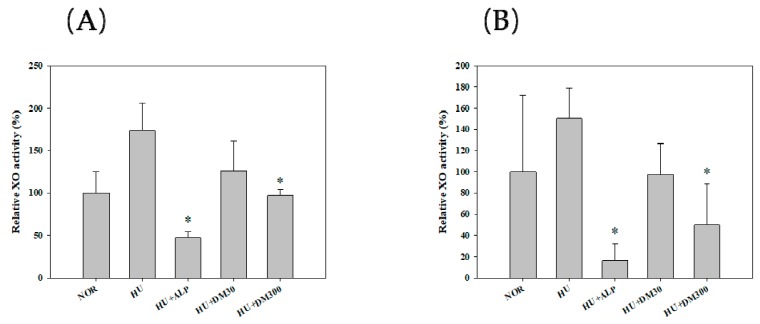
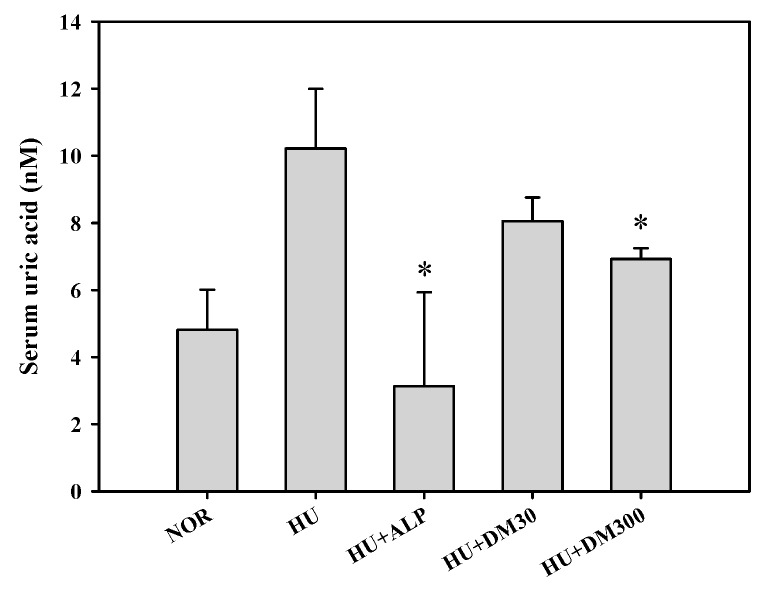
H. Levis a medicinal plant native to South Korea, East Asia, and South America. Among some 75 species, one species grows in Korea. In previous studies, extracts with anti-oxidant, anti-inflammatory, anti-complementary and anti-cancer activities were reported. The present study aims to investigate optimization of extraction and evaluation of anti-hyperuricemic effects of leaf and the phytochemicals contained therein. Ethanol and hexane extract were found to display the best xanthine oxidase inhibition among six types of solvent and water extract. The antioxidant effect of the ethanol extract was superior to that of the hexane extract. The DPPH radical scavenging effect of the ethanol and hexane extracts were 81.52 ± 1.57% and 2.69 ± 0.16. The reducing power of the ethanol and hexane extracts were 9.71 ± 0.15 and 0.89 ± 0.01 mg/g equivalent of gallic acid. Total phenols of the ethanol and hexane extracts were 6.53 ± 0.16 and 0.63 ± 0.001 mg/g equivalent of gallic acid. In addition, we compared the two marker compounds from , chlorogenic acid and rutin, which were determined in the ethanol extract at 0.80 ± 0.03% and 0.52 ± 0.01%, respectively. We found that the ethanol extracts showed better xanthine oxidase inhibition than hexane extracts. Especially, ethanol extracts showed higher antioxidant activity than hexane extracts. Based on these results, we selected the ethanol extract as an effective xanthine oxidase inhibitor and confirmed whether ethanol extracts showed xanthine oxidase inhibition in animal experiments. The in vivo mouse study demonstrated that ethanol extract of leaf at the dose of 300 mg/kg could inhibit blood/hepatic xanthine oxidase activity and this result shows that the xanthine oxidase inhibitory activity in vitro is reproduced in vivo. The present study showed that ethanol extract was optimal xanthine oxidase inhibitor which can be applied to prevent diseases related to hyperuricemia.
朝鲜蓟是一种原产于韩国、东亚和南美洲的药用植物。在大约 75 个品种中,有一种生长在韩国。在以前的研究中,报道了具有抗氧化、抗炎、抗补体和抗癌活性的提取物。本研究旨在探讨优化朝鲜蓟叶的提取方法,并评价其所含的植物化学物质的抗高尿酸血症作用。在六种溶剂中,乙醇和正己烷提取物对黄嘌呤氧化酶的抑制作用最好,而水提取物则无抑制作用。乙醇提取物的抗氧化作用优于正己烷提取物。乙醇和正己烷提取物对 DPPH 自由基的清除率分别为 81.52±1.57%和 2.69±0.16%。乙醇和正己烷提取物的还原能力分别为 9.71±0.15 和 0.89±0.01mg/g 没食子酸当量。乙醇和正己烷提取物的总酚含量分别为 6.53±0.16 和 0.63±0.001mg/g 没食子酸当量。此外,我们比较了从朝鲜蓟中提取的两种标记化合物,绿原酸和芦丁,它们在乙醇提取物中的含量分别为 0.80±0.03%和 0.52±0.01%。结果表明,与正己烷提取物相比,乙醇提取物对黄嘌呤氧化酶的抑制作用更好。特别是,乙醇提取物的抗氧化活性高于正己烷提取物。基于这些结果,我们选择乙醇提取物作为有效的黄嘌呤氧化酶抑制剂,并在动物实验中确认乙醇提取物是否具有黄嘌呤氧化酶抑制作用。体内小鼠实验表明,朝鲜蓟叶乙醇提取物 300mg/kg 剂量可抑制血液/肝脏黄嘌呤氧化酶活性,这一结果表明体外黄嘌呤氧化酶抑制活性在体内得到重现。本研究表明,乙醇提取物是最佳的黄嘌呤氧化酶抑制剂,可用于预防与高尿酸血症相关的疾病。