Division of Haematology, Department of Internal Medicine, Medical University of Vienna, Vienna, Austria.
Waldenströms, POEMS and Myeloma Clinics, University College London Hospitals, National Health Service Foundation Trust & Mount Vernon Cancer Centre, London, United Kingdom.
Blood. 2019 Feb 28;133(9):893-901. doi: 10.1182/blood-2018-06-856930. Epub 2018 Dec 17.
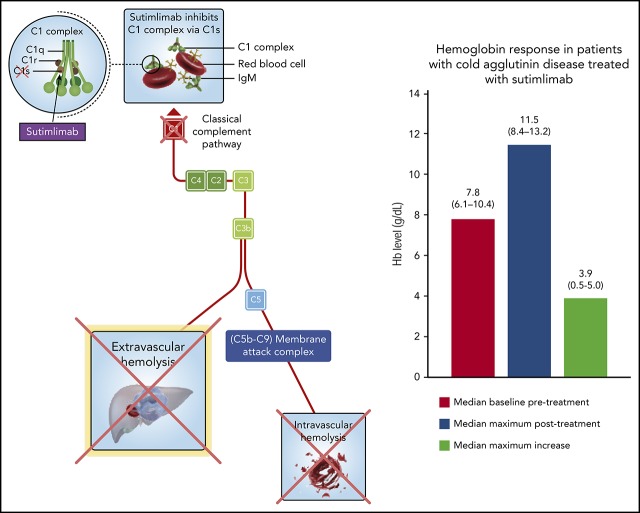
Cold agglutinin disease is a difficult-to-treat autoimmune hemolytic anemia in which immunoglobulin M antibodies bind to erythrocytes and fix complement, resulting in predominantly extravascular hemolysis. This trial tested the hypothesis that the anti-C1s antibody sutimlimab would ameliorate hemolytic anemia. Ten patients with cold agglutinin disease participated in the phase 1b component of a first-in-human trial. Patients received a test dose of 10-mg/kg sutimlimab followed by a full dose of 60 mg/kg 1 to 4 days later and 3 additional weekly doses of 60 mg/kg. All infusions were well tolerated without premedication. No drug-related serious adverse events were observed. Seven of 10 patients with cold agglutinin disease responded with a hemoglobin increase >2 g/dL. Sutimlimab rapidly increased hemoglobin levels by a median of 1.6 g/dL within the first week, and by a median of 3.9 g/dL (interquartile range, 1.3-4.5 g/dL; 95% confidence interval, 2.1-4.5) within 6 weeks ( = .005). Sutimlimab rapidly abrogated extravascular hemolysis, normalizing bilirubin levels within 24 hours in most patients and normalizing haptoglobin levels in 4 patients within 1 week. Hemolytic anemia recurred when drug levels were cleared from the circulation 3 to 4 weeks after the last dose of sutimlimab. Reexposure to sutimlimab in a named patient program recapitulated the control of hemolytic anemia. All 6 previously transfused patients became transfusion-free during treatment. Sutimlimab was safe, well tolerated, and rapidly stopped C1s complement-mediated hemolysis in patients with cold agglutinin disease, significantly increasing hemoglobin levels and precluding the need for transfusions. This trial was registered at www.clinicaltrials.gov as #NCT02502903.
冷抗体自身免疫性溶血性贫血是一种难以治疗的自身免疫性溶血性贫血,其中免疫球蛋白 M 抗体与红细胞结合并固定补体,导致主要是血管外溶血。这项试验检验了这样一个假设,即抗 C1s 抗体 sutimlimab 将改善溶血性贫血。10 名冷抗体自身免疫性溶血性贫血患者参加了一项首次人体试验的 1b 期部分试验。患者接受了 10mg/kg sutimlimab 的测试剂量,然后在 1 至 4 天后给予 60mg/kg 的全剂量,并在接下来的 3 周内每周给予 60mg/kg 的 3 个额外剂量。所有输注均无需预处理即可耐受。未观察到与药物相关的严重不良事件。10 名冷抗体自身免疫性溶血性贫血患者中有 7 名患者的血红蛋白增加 >2g/dL。Sutimlimab 在第一周内将血红蛋白水平中位数提高了 1.6g/dL,在 6 周内中位数提高了 3.9g/dL(四分位距,1.3-4.5g/dL;95%置信区间,2.1-4.5;=.005)。Sutimlimab 迅速消除血管外溶血,大多数患者在 24 小时内使胆红素水平正常化,4 名患者在 1 周内使结合珠蛋白水平正常化。在最后一次 sutimlimab 给药后 3 至 4 周从循环中清除药物水平时,溶血性贫血再次发生。在命名患者计划中重新接触 sutimlimab 重现了对溶血性贫血的控制。所有 6 名先前接受输血的患者在治疗期间无需输血。Sutimlimab 安全、耐受良好,可快速停止冷抗体自身免疫性溶血性贫血患者的 C1s 补体介导的溶血,显著增加血红蛋白水平并避免输血的需要。该试验在 www.clinicaltrials.gov 上注册为 #NCT02502903。