Yin Jia, Wu Caixia, Wei Xiaolin, Sun Qiang
School of Health Care Management, Shandong University, Jinan, China.
NHC Key Laboratory of Health Economics and Policy Research, Shandong University, Jinan, China.
Front Pharmacol. 2018 Dec 3;9:1396. doi: 10.3389/fphar.2018.01396. eCollection 2018.
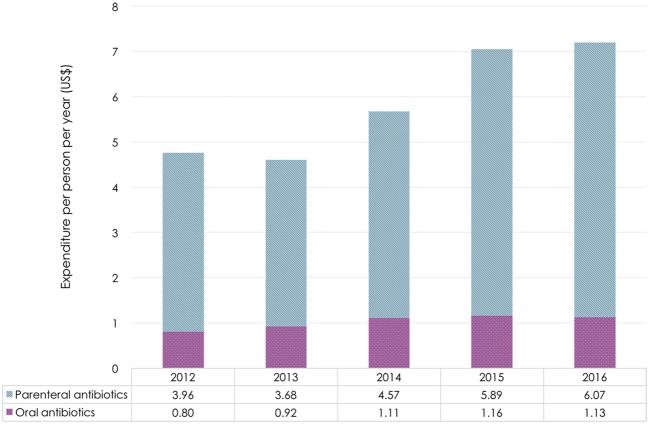
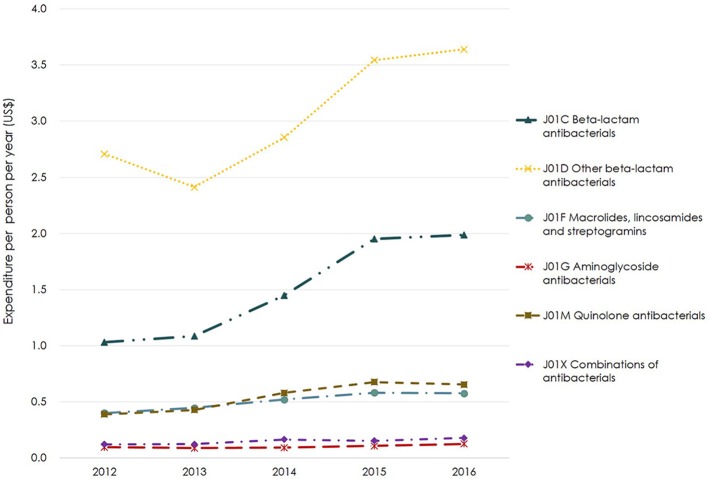
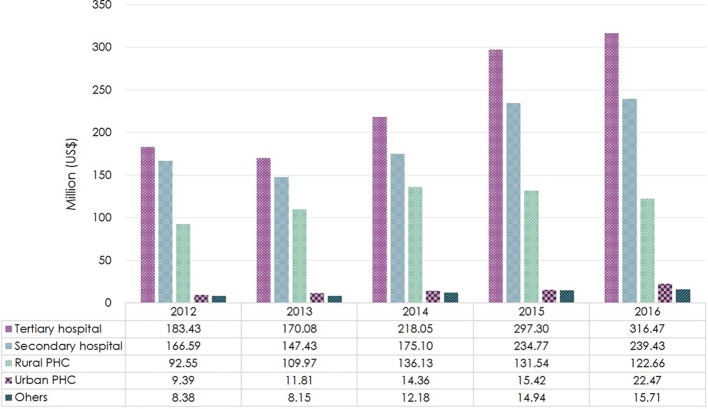
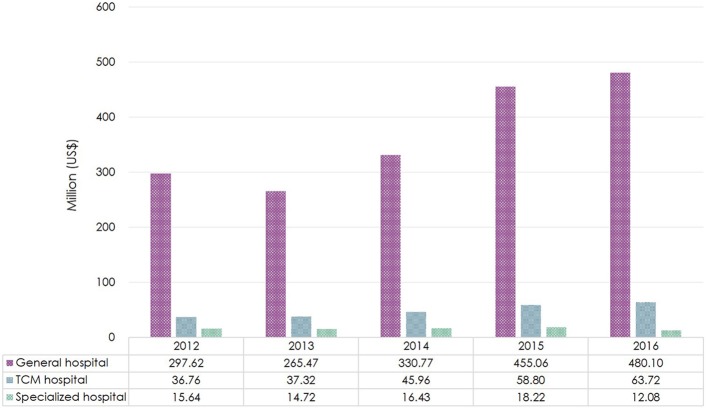
Overuse of antibiotics may not only increase the burden of antimicrobial resistance, but also accelerate the growth of healthcare expenditures. China has issued a series of policies to improve antibiotic use and reduce the cost of medicine in healthcare institutions. This study aimed to evaluate the trends of antibiotic expenditure in public healthcare institutions in Shandong from 2012 to 2016 and to assess antibiotic expenditure by drug class and the level of healthcare institutions. We collected data from the centralized bidding procurement (CBP) system in Shandong province between 2012 and 2016. Governmental health facilities including secondary and tertiary hospitals, and urban and rural primary healthcare centers (PHCs) procured antibiotics via this system. Antibiotics were classified according to the Anatomical Therapeutic Chemical (ATC) classification system. Antibiotic expenditure was assessed using total annual expenditure (US dollars) and expenditure per person per year (US dollars). The overall antibiotic expenditure was $717 million in 2016, a 56% increase compared to 2012. Parenteral antibiotics accounted for 84% of the total antibiotic expenditure in 2016. Most of the antibiotics were procured by secondary and tertiary hospitals (33 and 44%, respectively). The expenditures continuously increased in secondary hospitals, tertiary hospitals, and urban PHCs from 2012 to 2016, while antibiotic procurement decreased in urban PHCs since 2015. The third-generation cephalosporins (J01DD) were among the top five ATC classes of antibiotics in all healthcare institutions. Fluoroquinolones (J01MA) were commonly procured by tertiary hospitals, rural and urban PHCs. The expenditure on carbapenems (J01DH) raised sharply in tertiary hospitals. The overall antibiotic expenditure kept increasing in the public healthcare institutions in Shandong. The trends of increasing expenditure began to decline in 2016, which may be associated with antibiotic stewardship initiatives. The expenditure for expensive and critical important classes of antibiotics increased, therefore it is of importance to develop policies on improving the rational use of antibiotics.
抗生素的过度使用不仅可能增加抗菌药物耐药性的负担,还会加速医疗保健支出的增长。中国已出台一系列政策,以改善抗生素使用情况并降低医疗机构的药品成本。本研究旨在评估2012年至2016年山东省公立医疗机构抗生素支出的趋势,并按药物类别和医疗机构级别评估抗生素支出情况。我们收集了2012年至2016年山东省集中招标采购(CBP)系统的数据。包括二级和三级医院以及城乡基层医疗中心(PHC)在内的政府卫生机构通过该系统采购抗生素。抗生素根据解剖治疗化学(ATC)分类系统进行分类。抗生素支出采用年度总支出(美元)和人均年度支出(美元)进行评估。2016年抗生素总支出为7.17亿美元,与2012年相比增长了56%。2016年注射用抗生素占抗生素总支出的84%。大多数抗生素由二级和三级医院采购(分别占33%和44%)。2012年至2016年,二级医院、三级医院和城市基层医疗中心的支出持续增加,而自2015年以来城市基层医疗中心的抗生素采购量有所下降。第三代头孢菌素(J01DD)是所有医疗机构中抗生素ATC分类排名前五的类别之一。氟喹诺酮类(J01MA)在三级医院、农村和城市基层医疗中心普遍采购。碳青霉烯类(J01DH)在三级医院的支出急剧增加。山东省公立医疗机构的抗生素总支出持续增加。支出增长趋势在2016年开始下降,这可能与抗生素管理举措有关。昂贵且至关重要的抗生素类别的支出增加,因此制定改善抗生素合理使用的政策非常重要。