Li Xiaopan, Deng Yang, Tang Weina, Sun Qiao, Chen Yichen, Yang Chen, Yan Bei, Wang Yingying, Wang Jing, Wang Shuo, Yang Fan, Ding Yibo, Zhao Genming, Cao Guangwen
The Key Laboratory of Public Health and Safety of Education Ministry, School of Public Health, Fudan University, Shanghai, China.
Center for Disease Control and Prevention, Pudong Institute of Preventive Medicine, Fudan University, Shanghai, China.
Front Oncol. 2018 Dec 3;8:579. doi: 10.3389/fonc.2018.00579. eCollection 2018.
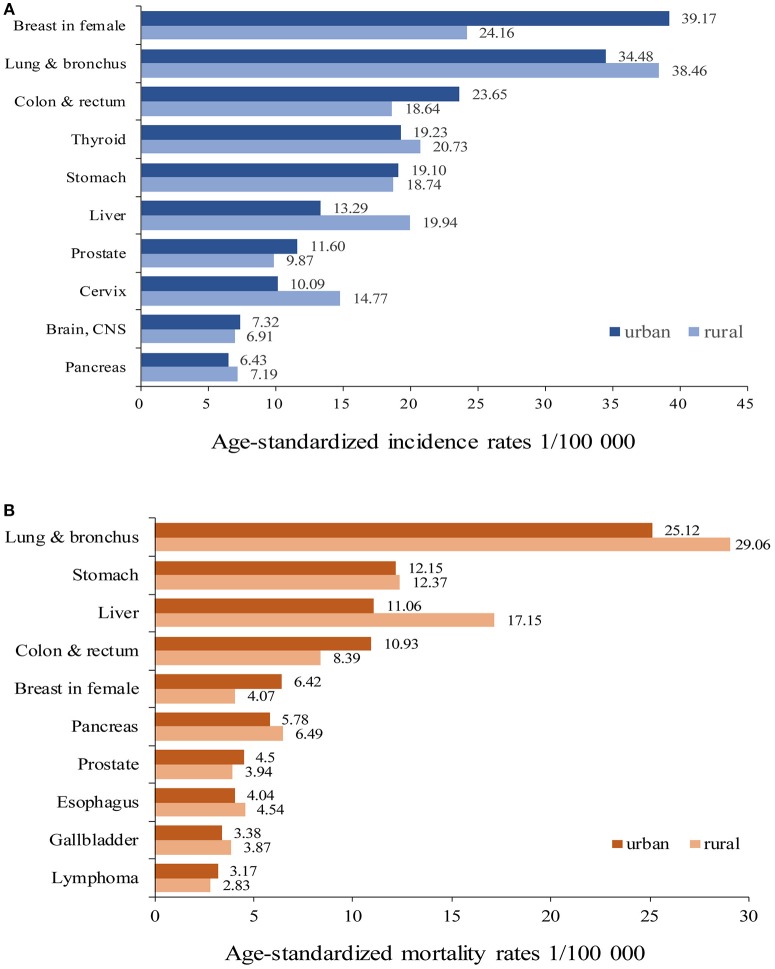
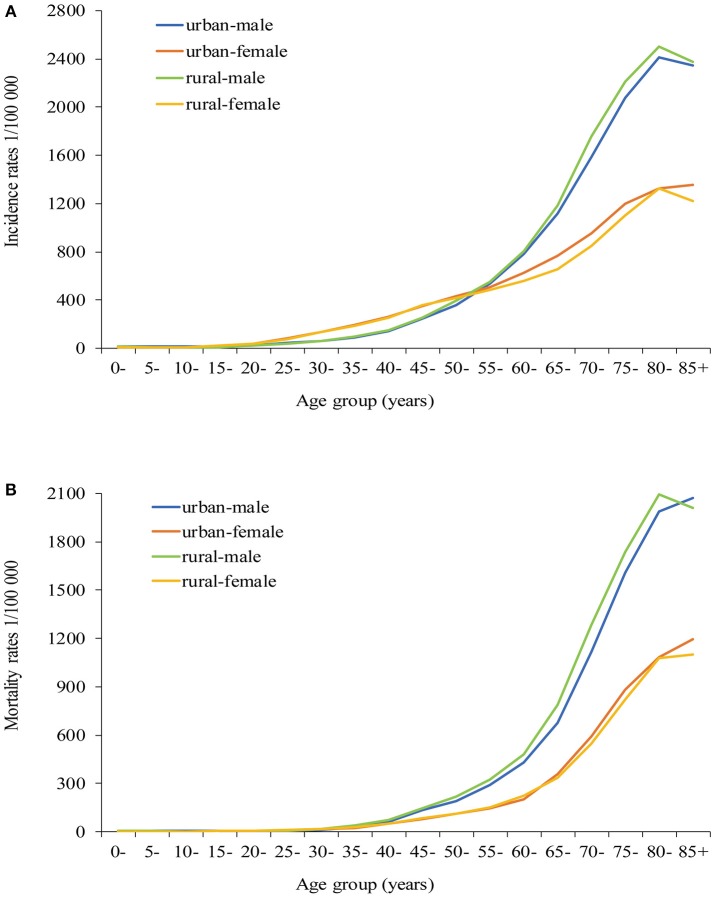
Disparities in the incidence, mortality, and survival of cancer types between urban and rural areas in China reflect the effects of different risk factor exposure, education, and different medical availability. We aimed to characterize the disparities in the incidence, mortality, and survivals of cancer types between urban and rural areas in Shanghai, China, 2002-2015. The incidence and mortality were standardized by Segi's world standard population. Trends in the incidence and mortality of cancers were compared using annual percent change. The 5-year observed and relative survivals were calculated with life table and Ederer II methods. Age-standardized incidences and mortalities were 212.55/10 and 109.45/10 in urban areas and 210.14/10 and 103.99/10 in rural areas, respectively. Female breast cancer and colorectal cancer occurred more frequently in urban than in rural areas, quite in contrast to liver cancer and cervical cancer. Cancers of lung and bronchus, liver, stomach, and colon and rectum were the leading causes of cancer death in both areas. Age-standardized incidence of female breast cancer and colorectal cancer in urban areas increased while gastric cancer and liver cancer decreased in both areas. Age-standardized mortalities of cancers of breast, esophagus, stomach, colon and rectum, liver, and lung and bronchus decreased in both areas. For all cancers combined, the 5-year observed and relative survivals of cancer patients were higher in urban than in rural areas. The 5-year observed and relative survivals of cancers of liver, pancreas, stomach, brain and central nervous system (CNS), and prostate were higher in urban than in rural areas. The 5-year observed and relative survivals of cervical cancer were higher in rural than in urban areas. Factors promoting female breast cancer and colorectal cancer in urban areas and liver cancer and cervical cancer in rural areas should be specifically intervened in cancer prophylaxis. Improved medical services can greatly prolong the survival of major cancers in rural areas.
中国城乡地区癌症类型在发病率、死亡率和生存率方面的差异反映了不同的风险因素暴露、教育水平以及医疗可及性的影响。我们旨在描述2002年至2015年中国上海城乡地区癌症类型在发病率、死亡率和生存率方面的差异。发病率和死亡率采用Segi世界标准人口进行标准化。使用年度百分比变化比较癌症发病率和死亡率的趋势。采用生命表法和Ederer II法计算5年观察生存率和相对生存率。城市地区年龄标准化发病率和死亡率分别为212.55/10万和109.45/10万,农村地区分别为210.14/10万和103.99/10万。女性乳腺癌和结直肠癌在城市地区的发病率高于农村地区,这与肝癌和宫颈癌形成鲜明对比。肺癌、支气管癌、肝癌、胃癌以及结肠癌和直肠癌是两个地区癌症死亡的主要原因。城市地区女性乳腺癌和结直肠癌的年龄标准化发病率上升,而两个地区的胃癌和肝癌发病率下降。乳腺癌、食管癌、胃癌、结肠癌和直肠癌、肝癌以及肺癌和支气管癌的年龄标准化死亡率在两个地区均下降。对于所有癌症综合来看,癌症患者的5年观察生存率和相对生存率在城市地区高于农村地区。肝癌、胰腺癌、胃癌、脑和中枢神经系统(CNS)癌以及前列腺癌的5年观察生存率和相对生存率在城市地区高于农村地区。宫颈癌的5年观察生存率和相对生存率在农村地区高于城市地区。在癌症预防中应特别干预促进城市地区女性乳腺癌和结直肠癌以及农村地区肝癌和宫颈癌发生的因素。改善医疗服务可大大延长农村地区主要癌症患者的生存期。